

214
7. Quantum Field Theory III
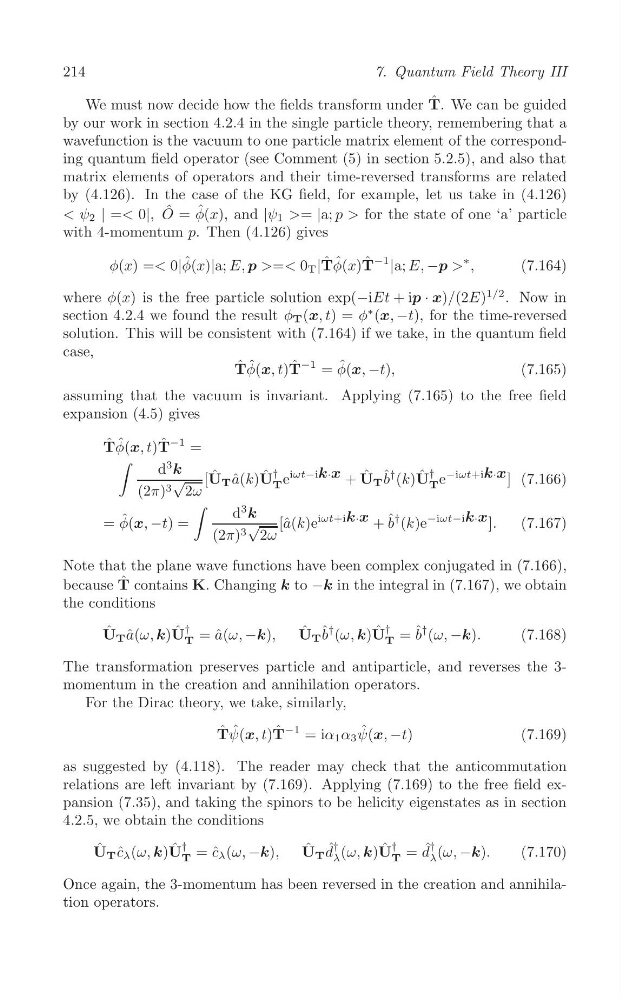
We must now decide how the fields transform under T ˆ . We can be guided
by our work in section 4.2.4 in the single particle theory, remembering that a
wavefunction is the vacuum to one particle matrix element of the corresponding quantum field operator (see Comment (5) in section 5.2.5), and also that
matrix elements of operators and their time-reversed transforms are related
by (4.126). In the case of the KG field, for example, let us take in (4.126)
ˆ
ˆ
< ψ 2 | =< 0|, O = φ(x), and |ψ 1 >= |a; p > for the state of one ‘a’ particle
with 4-momentum p. Then (4.126) gives
∗
φ(x) =< 0|φ ˆ (x)|a; E, p >=< 0 T |T ˆ φ ˆ (x)T ˆ −1 |a; E, −p > ,
(7.164)
where φ(x) is the free particle solution exp(−iEt + ip · x)/(2E)
1/2 . Now in
section 4.2.4 we found the result φ T (x, t) = φ
∗ (x, −t), for the time-reversed
solution. This will be consistent with (7.164) if we take, in the quantum field
case,
T ˆ φ ˆ (x, t)T ˆ −1 = φ ˆ (x, −t),
(7.165)
assuming that the vacuum is invariant. Applying (7.165) to the free field
expansion (4.5) gives
T ˆ φ ˆ (x, t)T ˆ −1 =
∫
d
3
k
† iωt−ik·x
†
√ [U ˆ T a ˆ(k)U ˆ T e
+ U ˆ T ˆ b
† (k)U ˆ T e
−iωt+ik·x ] (7.166)
(2π) 3 2ω
∫
d
3
k
= φ ˆ (x, −t) =
√ [ˆ a(k)e
iωt+ik·x + ˆ b
† (k)e
−iωt−ik·x ].
(7.167)
(2π) 3 2ω
Note that the plane wave functions have been complex conjugated in (7.166),
because T ˆ contains K. Changing k to −k in the integral in (7.167), we obtain
the conditions
†
†
U ˆ T a ˆ(ω, k)U ˆ = ˆ
a(ω, −k),
U ˆ T ˆ b
† (ω, k)U ˆ = ˆ b
† (ω, −k).
(7.168)
T
T
The transformation preserves particle and antiparticle, and reverses the 3momentum in the creation and annihilation operators.
For the Dirac theory, we take, similarly,
T ˆ ψ ˆ (x, t)T ˆ −1 = iα 1 α 3 ψ ˆ (x, −t)
(7.169)
as suggested by (4.118). The reader may check that the anticommutation
relations are left invariant by (7.169). Applying (7.169) to the free field expansion (7.35), and taking the spinors to be helicity eigenstates as in section
4.2.5, we obtain the conditions
†
†
†
†
U ˆ T c ˆ λ (ω, k)U ˆ = ˆ
c λ (ω, −k),
U ˆ T d ˆ (ω, k)U ˆ = d ˆ (ω, −k).
(7.170)
T
λ
T
λ
Once again, the 3-momentum has been reversed in the creation and annihilation operators.
7. Quantum Field Theory III
We must now decide how the fields transform under T ˆ . We can be guided
by our work in section 4.2.4 in the single particle theory, remembering that a
wavefunction is the vacuum to one particle matrix element of the corresponding quantum field operator (see Comment (5) in section 5.2.5), and also that
matrix elements of operators and their time-reversed transforms are related
by (4.126). In the case of the KG field, for example, let us take in (4.126)
ˆ
ˆ
< ψ 2 | =< 0|, O = φ(x), and |ψ 1 >= |a; p > for the state of one ‘a’ particle
with 4-momentum p. Then (4.126) gives
∗
φ(x) =< 0|φ ˆ (x)|a; E, p >=< 0 T |T ˆ φ ˆ (x)T ˆ −1 |a; E, −p > ,
(7.164)
where φ(x) is the free particle solution exp(−iEt + ip · x)/(2E)
1/2 . Now in
section 4.2.4 we found the result φ T (x, t) = φ
∗ (x, −t), for the time-reversed
solution. This will be consistent with (7.164) if we take, in the quantum field
case,
T ˆ φ ˆ (x, t)T ˆ −1 = φ ˆ (x, −t),
(7.165)
assuming that the vacuum is invariant. Applying (7.165) to the free field
expansion (4.5) gives
T ˆ φ ˆ (x, t)T ˆ −1 =
∫
d
3
k
† iωt−ik·x
†
√ [U ˆ T a ˆ(k)U ˆ T e
+ U ˆ T ˆ b
† (k)U ˆ T e
−iωt+ik·x ] (7.166)
(2π) 3 2ω
∫
d
3
k
= φ ˆ (x, −t) =
√ [ˆ a(k)e
iωt+ik·x + ˆ b
† (k)e
−iωt−ik·x ].
(7.167)
(2π) 3 2ω
Note that the plane wave functions have been complex conjugated in (7.166),
because T ˆ contains K. Changing k to −k in the integral in (7.167), we obtain
the conditions
†
†
U ˆ T a ˆ(ω, k)U ˆ = ˆ
a(ω, −k),
U ˆ T ˆ b
† (ω, k)U ˆ = ˆ b
† (ω, −k).
(7.168)
T
T
The transformation preserves particle and antiparticle, and reverses the 3momentum in the creation and annihilation operators.
For the Dirac theory, we take, similarly,
T ˆ ψ ˆ (x, t)T ˆ −1 = iα 1 α 3 ψ ˆ (x, −t)
(7.169)
as suggested by (4.118). The reader may check that the anticommutation
relations are left invariant by (7.169). Applying (7.169) to the free field expansion (7.35), and taking the spinors to be helicity eigenstates as in section
4.2.5, we obtain the conditions
†
†
†
†
U ˆ T c ˆ λ (ω, k)U ˆ = ˆ
c λ (ω, −k),
U ˆ T d ˆ (ω, k)U ˆ = d ˆ (ω, −k).
(7.170)
T
λ
T
λ
Once again, the 3-momentum has been reversed in the creation and annihilation operators.