

166
6. Quantum Field Theory II: Interacting Scalar Fields
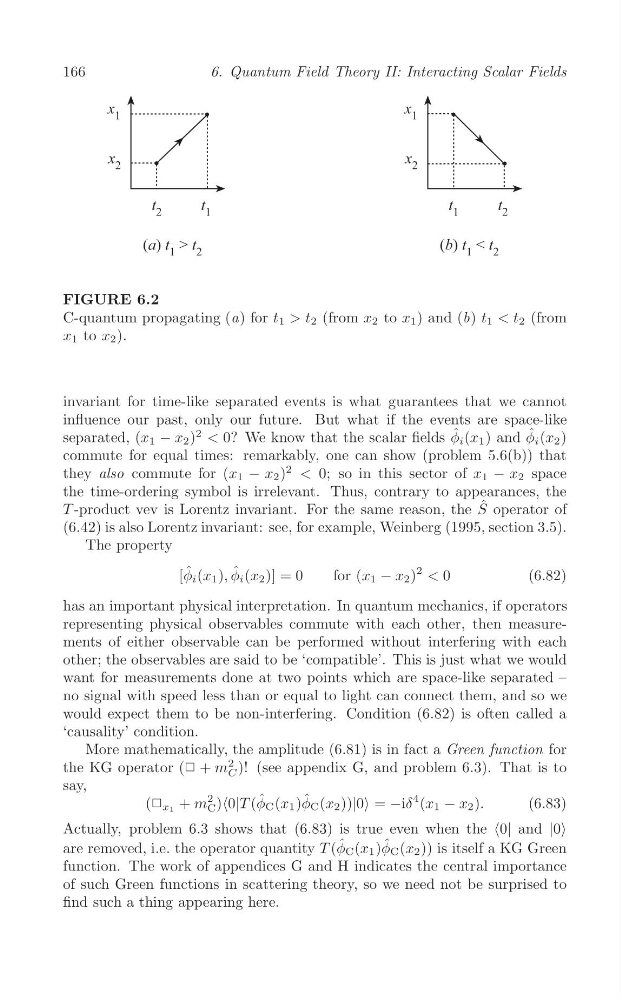
FIGURE 6.2
C-quantum propagating (a) for t 1 > t 2 (from x 2 to x 1 ) and (b) t 1 < t 2 (from
x 1 to x 2 ).
invariant for time-like separated events is what guarantees that we cannot
influence our past, only our future. But what if the events are space-like
separated, (x 1 − x 2 )
2 < 0? We know that the scalar fields φ ˆ i (x 1 ) and φ ˆ i (x 2 )
commute for equal times: remarkably, one can show (problem 5.6(b)) that
they also commute for (x 1 − x 2 )
2 < 0; so in this sector of x 1 − x 2 space
the time-ordering symbol is irrelevant. Thus, contrary to appearances, the
T -product vev is Lorentz invariant. For the same reason, the S ˆ operator of
(6.42) is also Lorentz invariant: see, for example, Weinberg (1995, section 3.5).
The property
[φ ˆ i (x 1 ), φ ˆ i (x 2 )] = 0
for (x 1 − x 2 )
2 < 0
(6.82)
has an important physical interpretation. In quantum mechanics, if operators
representing physical observables commute with each other, then measurements of either observable can be performed without interfering with each
other; the observables are said to be ‘compatible’. This is just what we would
want for measurements done at two points which are space-like separated –
no signal with speed less than or equal to light can connect them, and so we
would expect them to be non-interfering. Condition (6.82) is often called a
‘causality’ condition.
More mathematically, the amplitude (6.81) is in fact a Green function for
2
the KG operator (❗ + m )! (see appendix G, and problem 6.3). That is to
C
say,
2
(❗ x1 + m C )<0|T (φ ˆ C (x 1 )φ ˆ C (x 2 ))|0> = −iδ
4 (x 1 − x 2 ).
(6.83)
Actually, problem 6.3 shows that (6.83) is true even when the <0| and |0>
are removed, i.e. the operator quantity T (φ ˆ C (x 1 )φ ˆ C (x 2 )) is itself a KG Green
function. The work of appendices G and H indicates the central importance
of such Green functions in scattering theory, so we need not be surprised to
find such a thing appearing here.
6. Quantum Field Theory II: Interacting Scalar Fields
FIGURE 6.2
C-quantum propagating (a) for t 1 > t 2 (from x 2 to x 1 ) and (b) t 1 < t 2 (from
x 1 to x 2 ).
invariant for time-like separated events is what guarantees that we cannot
influence our past, only our future. But what if the events are space-like
separated, (x 1 − x 2 )
2 < 0? We know that the scalar fields φ ˆ i (x 1 ) and φ ˆ i (x 2 )
commute for equal times: remarkably, one can show (problem 5.6(b)) that
they also commute for (x 1 − x 2 )
2 < 0; so in this sector of x 1 − x 2 space
the time-ordering symbol is irrelevant. Thus, contrary to appearances, the
T -product vev is Lorentz invariant. For the same reason, the S ˆ operator of
(6.42) is also Lorentz invariant: see, for example, Weinberg (1995, section 3.5).
The property
[φ ˆ i (x 1 ), φ ˆ i (x 2 )] = 0
for (x 1 − x 2 )
2 < 0
(6.82)
has an important physical interpretation. In quantum mechanics, if operators
representing physical observables commute with each other, then measurements of either observable can be performed without interfering with each
other; the observables are said to be ‘compatible’. This is just what we would
want for measurements done at two points which are space-like separated –
no signal with speed less than or equal to light can connect them, and so we
would expect them to be non-interfering. Condition (6.82) is often called a
‘causality’ condition.
More mathematically, the amplitude (6.81) is in fact a Green function for
2
the KG operator (❗ + m )! (see appendix G, and problem 6.3). That is to
C
say,
2
(❗ x1 + m C )<0|T (φ ˆ C (x 1 )φ ˆ C (x 2 ))|0> = −iδ
4 (x 1 − x 2 ).
(6.83)
Actually, problem 6.3 shows that (6.83) is true even when the <0| and |0>
are removed, i.e. the operator quantity T (φ ˆ C (x 1 )φ ˆ C (x 2 )) is itself a KG Green
function. The work of appendices G and H indicates the central importance
of such Green functions in scattering theory, so we need not be surprised to
find such a thing appearing here.