

164
6. Quantum Field Theory II: Interacting Scalar Fields
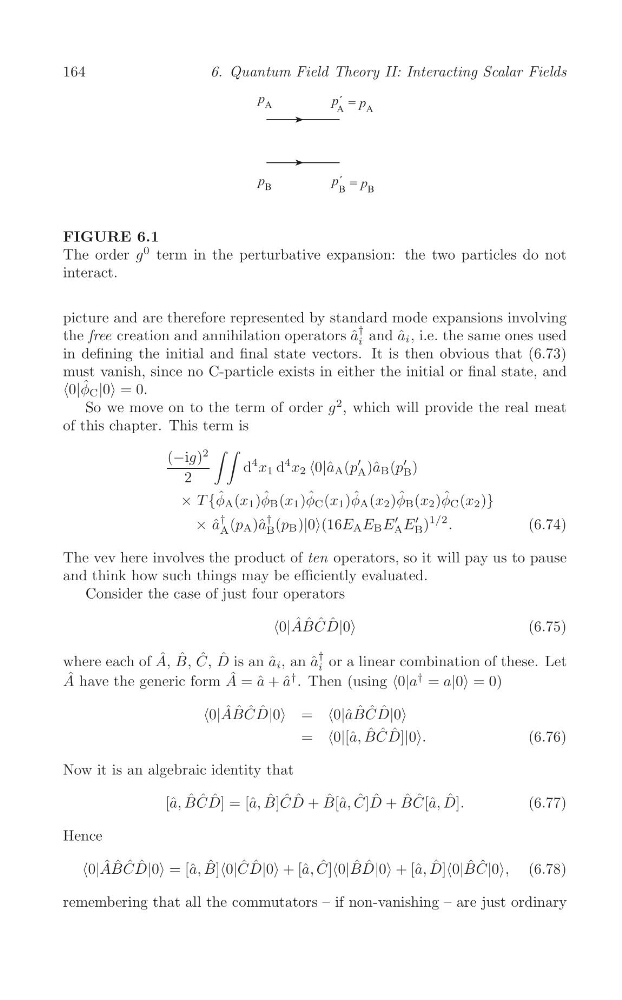
FIGURE 6.1
0
The order g term in the perturbative expansion: the two particles do not
interact.
picture and are therefore represented by standard mode expansions involving
the free creation and annihilation operators a ˆ
† and ˆ
a i , i.e. the same ones used
i
in defining the initial and final state vectors. It is then obvious that (6.73)
must vanish, since no C-particle exists in either the initial or final state, and
<0|φ ˆ C |0> = 0.
So we move on to the term of order g
2 , which will provide the real meat
of this chapter. This term is
∫ ∫
(−ig)
2
′
′
d
4 x 1 d
4 x 2 <0|a ˆ A (p A )ˆ a B (p B )
2
× T {φ ˆ A (x 1 )φ ˆ B (x 1 )φ ˆ C (x 1 )φ ˆ A (x 2 )φ ˆ B (x 2 )φ ˆ C (x 2 )}
†
†
A E B
′ )
1/2
× a ˆ A (p A )ˆ a (p B )|0>(16E A E B E
′
.
(6.74)
B
The vev here involves the product of ten operators, so it will pay us to pause
and think how such things may be efficiently evaluated.
Consider the case of just four operators
<0|A ˆ B ˆ C ˆ D ˆ |0>
(6.75)
†
ˆ ˆ ˆ
where each of A ˆ , B, C, D is an a ˆ i , an a ˆ or a linear combination of these. Let
i
ˆ
†
A have the generic form A ˆ = ˆ
a + ˆ
a
† . Then (using <0|a = a|0> = 0)
<0|A ˆ B ˆ C ˆ D ˆ |0> = <0|a ˆB ˆ C ˆ D ˆ |0>
= <0|[ˆ a, B ˆ C ˆ D ˆ ]|0>.
(6.76)
Now it is an algebraic identity that
[ˆ a, B ˆ C ˆ D ˆ ] = [ˆ a, B ˆ ]C ˆ D ˆ + B ˆ [ˆ a, C ˆ ]D ˆ + B ˆ C ˆ [ˆ a, D ˆ ].
(6.77)
Hence
<0|A ˆ B ˆ C ˆ D ˆ |0> = [ˆ a, B ˆ ]<0|C ˆ D ˆ |0> + [ˆ a, C ˆ ]<0|B ˆ D ˆ |0> + [ˆ a, D ˆ ]<0|B ˆ C ˆ |0>, (6.78)
remembering that all the commutators – if non-vanishing – are just ordinary
6. Quantum Field Theory II: Interacting Scalar Fields
FIGURE 6.1
0
The order g term in the perturbative expansion: the two particles do not
interact.
picture and are therefore represented by standard mode expansions involving
the free creation and annihilation operators a ˆ
† and ˆ
a i , i.e. the same ones used
i
in defining the initial and final state vectors. It is then obvious that (6.73)
must vanish, since no C-particle exists in either the initial or final state, and
<0|φ ˆ C |0> = 0.
So we move on to the term of order g
2 , which will provide the real meat
of this chapter. This term is
∫ ∫
(−ig)
2
′
′
d
4 x 1 d
4 x 2 <0|a ˆ A (p A )ˆ a B (p B )
2
× T {φ ˆ A (x 1 )φ ˆ B (x 1 )φ ˆ C (x 1 )φ ˆ A (x 2 )φ ˆ B (x 2 )φ ˆ C (x 2 )}
†
†
A E B
′ )
1/2
× a ˆ A (p A )ˆ a (p B )|0>(16E A E B E
′
.
(6.74)
B
The vev here involves the product of ten operators, so it will pay us to pause
and think how such things may be efficiently evaluated.
Consider the case of just four operators
<0|A ˆ B ˆ C ˆ D ˆ |0>
(6.75)
†
ˆ ˆ ˆ
where each of A ˆ , B, C, D is an a ˆ i , an a ˆ or a linear combination of these. Let
i
ˆ
†
A have the generic form A ˆ = ˆ
a + ˆ
a
† . Then (using <0|a = a|0> = 0)
<0|A ˆ B ˆ C ˆ D ˆ |0> = <0|a ˆB ˆ C ˆ D ˆ |0>
= <0|[ˆ a, B ˆ C ˆ D ˆ ]|0>.
(6.76)
Now it is an algebraic identity that
[ˆ a, B ˆ C ˆ D ˆ ] = [ˆ a, B ˆ ]C ˆ D ˆ + B ˆ [ˆ a, C ˆ ]D ˆ + B ˆ C ˆ [ˆ a, D ˆ ].
(6.77)
Hence
<0|A ˆ B ˆ C ˆ D ˆ |0> = [ˆ a, B ˆ ]<0|C ˆ D ˆ |0> + [ˆ a, C ˆ ]<0|B ˆ D ˆ |0> + [ˆ a, D ˆ ]<0|B ˆ C ˆ |0>, (6.78)
remembering that all the commutators – if non-vanishing – are just ordinary