

156
6. Quantum Field Theory II: Interacting Scalar Fields
6.2.2 The S-matrix and the Dyson expansion
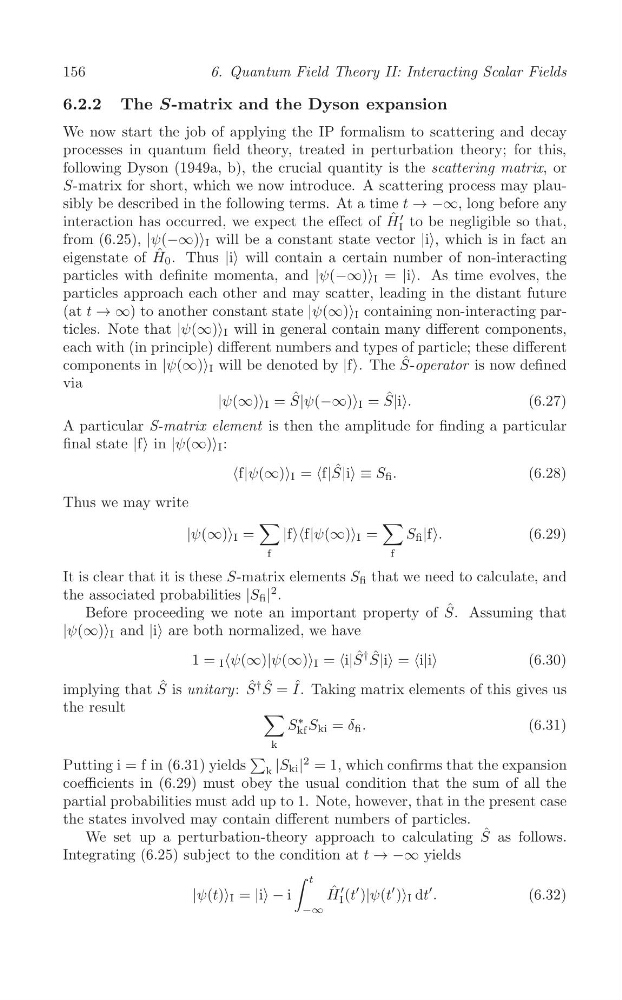
We now start the job of applying the IP formalism to scattering and decay
processes in quantum field theory, treated in perturbation theory; for this,
following Dyson (1949a, b), the crucial quantity is the scattering matrix, or
S-matrix for short, which we now introduce. A scattering process may plausibly be described in the following terms. At a time t → −∞, long before any
′
interaction has occurred, we expect the effect of H ˆ to be negligible so that,
I
from (6.25), |ψ(−∞)> I will be a constant state vector |i>, which is in fact an
eigenstate of H ˆ 0 . Thus |i> will contain a certain number of non-interacting
particles with definite momenta, and |ψ(−∞)> I = |i>. As time evolves, the
particles approach each other and may scatter, leading in the distant future
(at t → ∞) to another constant state |ψ(∞)> I containing non-interacting particles. Note that |ψ(∞)> I will in general contain many different components,
each with (in principle) different numbers and types of particle; these different
components in |ψ(∞)> I will be denoted by |f>. The S ˆ -operator is now defined
via
ˆ
ˆ
|ψ(∞)> I = S|ψ(−∞)> I = S|i>.
(6.27)
A particular S-matrix element is then the amplitude for finding a particular
final state |f> in |ψ(∞)> I :
I = ≡ S fi .
(6.28)
Thus we may write
∑
∑
|ψ(∞)> I =
|f> I =
S fi |f>.
(6.29)
f
f
It is clear that it is these S-matrix elements S fi that we need to calculate, and
2
the associated probabilities |S fi | .
Before proceeding we note an important property of S ˆ . Assuming that
|ψ(∞)> I and |i> are both normalized, we have
1 = I <ψ(∞)|ψ(∞)> I = =
(6.30)
implying that S ˆ is unitary: S ˆ † S ˆ = I ˆ . Taking matrix elements of this gives us
the result
∑
S
∗
kf S ki = δ fi .
(6.31)
k
∑
2
Putting i = f in (6.31) yields
|S ki | = 1, which confirms that the expansion
k
coefficients in (6.29) must obey the usual condition that the sum of all the
partial probabilities must add up to 1. Note, however, that in the present case
the states involved may contain different numbers of particles.
We set up a perturbation-theory approach to calculating S ˆ as follows.
Integrating (6.25) subject to the condition at t → −∞ yields
∫ t
′
′
|ψ(t)> I = |i> − i
H ˆ
I (t
′ )|ψ(t
′ )> I dt .
(6.32)
−∞
6. Quantum Field Theory II: Interacting Scalar Fields
6.2.2 The S-matrix and the Dyson expansion
We now start the job of applying the IP formalism to scattering and decay
processes in quantum field theory, treated in perturbation theory; for this,
following Dyson (1949a, b), the crucial quantity is the scattering matrix, or
S-matrix for short, which we now introduce. A scattering process may plausibly be described in the following terms. At a time t → −∞, long before any
′
interaction has occurred, we expect the effect of H ˆ to be negligible so that,
I
from (6.25), |ψ(−∞)> I will be a constant state vector |i>, which is in fact an
eigenstate of H ˆ 0 . Thus |i> will contain a certain number of non-interacting
particles with definite momenta, and |ψ(−∞)> I = |i>. As time evolves, the
particles approach each other and may scatter, leading in the distant future
(at t → ∞) to another constant state |ψ(∞)> I containing non-interacting particles. Note that |ψ(∞)> I will in general contain many different components,
each with (in principle) different numbers and types of particle; these different
components in |ψ(∞)> I will be denoted by |f>. The S ˆ -operator is now defined
via
ˆ
ˆ
|ψ(∞)> I = S|ψ(−∞)> I = S|i>.
(6.27)
A particular S-matrix element is then the amplitude for finding a particular
final state |f> in |ψ(∞)> I :
(6.28)
Thus we may write
∑
∑
|ψ(∞)> I =
|f>
S fi |f>.
(6.29)
f
f
It is clear that it is these S-matrix elements S fi that we need to calculate, and
2
the associated probabilities |S fi | .
Before proceeding we note an important property of S ˆ . Assuming that
|ψ(∞)> I and |i> are both normalized, we have
1 = I <ψ(∞)|ψ(∞)> I =
(6.30)
implying that S ˆ is unitary: S ˆ † S ˆ = I ˆ . Taking matrix elements of this gives us
the result
∑
S
∗
kf S ki = δ fi .
(6.31)
k
∑
2
Putting i = f in (6.31) yields
|S ki | = 1, which confirms that the expansion
k
coefficients in (6.29) must obey the usual condition that the sum of all the
partial probabilities must add up to 1. Note, however, that in the present case
the states involved may contain different numbers of particles.
We set up a perturbation-theory approach to calculating S ˆ as follows.
Integrating (6.25) subject to the condition at t → −∞ yields
∫ t
′
′
|ψ(t)> I = |i> − i
H ˆ
I (t
′ )|ψ(t
′ )> I dt .
(6.32)
−∞