

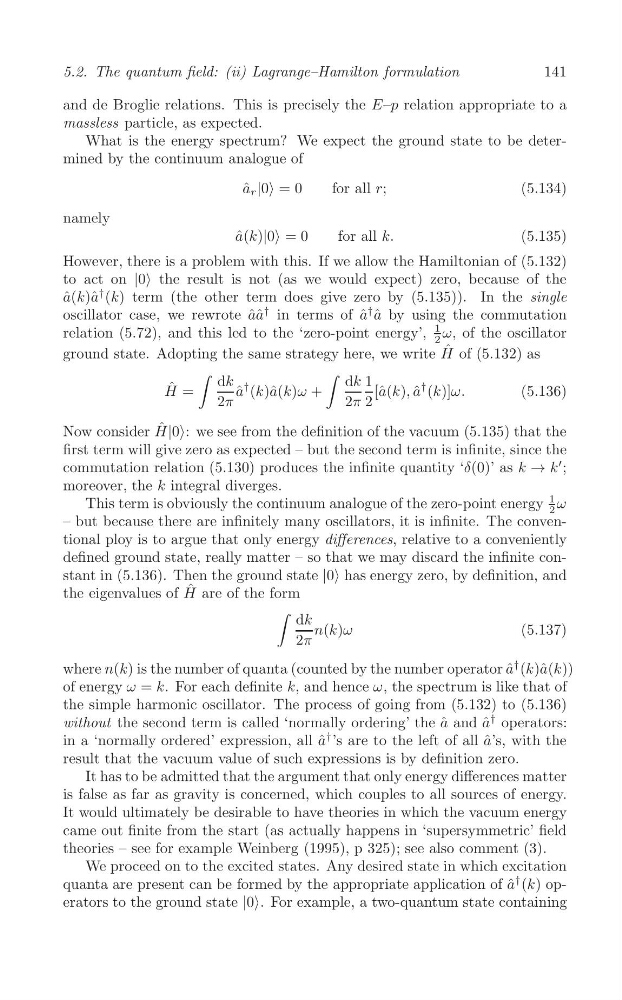
141
5.2. The quantum field: (ii) Lagrange–Hamilton formulation
and de Broglie relations. This is precisely the E–p relation appropriate to a
massless particle, as expected.
What is the energy spectrum? We expect the ground state to be determined by the continuum analogue of
a ˆ r |0> = 0
for all r;
(5.134)
namely
a ˆ(k)|0> = 0
for all k.
(5.135)
However, there is a problem with this. If we allow the Hamiltonian of (5.132)
to act on |0> the result is not (as we would expect) zero, because of the
a ˆ(k)ˆ a
† (k) term (the other term does give zero by (5.135)). In the single
†
oscillator case, we rewrote ˆ
aa ˆ in terms of ˆ
a
† a ˆ by using the commutation
relation (5.72), and this led to the ‘zero-point energy’,
1
2 ω, of the oscillator
ground state. Adopting the same strategy here, we write H ˆ of (5.132) as
∫
∫
dk
dk 1
H ˆ =
a ˆ
† (k)ˆ a(k)ω +
[ˆ a(k), a ˆ
† (k)]ω.
(5.136)
2π
2π 2
Now consider H ˆ |0>: we see from the definition of the vacuum (5.135) that the
first term will give zero as expected – but the second term is infinite, since the
commutation relation (5.130) produces the infinite quantity ‘δ(0)’ as k → k
′ ;
moreover, the k integral diverges.
This term is obviously the continuum analogue of the zero-point energy
1
2 ω
– but because there are infinitely many oscillators, it is infinite. The conventional ploy is to argue that only energy differences, relative to a conveniently
defined ground state, really matter – so that we may discard the infinite constant in (5.136). Then the ground state |0> has energy zero, by definition, and
the eigenvalues of H ˆ are of the form
∫ dk n(k)ω
(5.137)
2π
where n(k) is the number of quanta (counted by the number operator a ˆ
† (k)ˆ a(k))
of energy ω = k. For each definite k, and hence ω, the spectrum is like that of
the simple harmonic oscillator. The process of going from (5.132) to (5.136)
without the second term is called ‘normally ordering’ the ˆ
a and ˆ
a
† operators:
in a ‘normally ordered’ expression, all ˆ
a
† ’s are to the left of all ˆ
a’s, with the
result that the vacuum value of such expressions is by definition zero.
It has to be admitted that the argument that only energy differences matter
is false as far as gravity is concerned, which couples to all sources of energy.
It would ultimately be desirable to have theories in which the vacuum energy
came out finite from the start (as actually happens in ‘supersymmetric’ field
theories – see for example Weinberg (1995), p 325); see also comment (3).
We proceed on to the excited states. Any desired state in which excitation
quanta are present can be formed by the appropriate application of ˆ
a
† (k) operators to the ground state |0>. For example, a two-quantum state containing
5.2. The quantum field: (ii) Lagrange–Hamilton formulation
and de Broglie relations. This is precisely the E–p relation appropriate to a
massless particle, as expected.
What is the energy spectrum? We expect the ground state to be determined by the continuum analogue of
a ˆ r |0> = 0
for all r;
(5.134)
namely
a ˆ(k)|0> = 0
for all k.
(5.135)
However, there is a problem with this. If we allow the Hamiltonian of (5.132)
to act on |0> the result is not (as we would expect) zero, because of the
a ˆ(k)ˆ a
† (k) term (the other term does give zero by (5.135)). In the single
†
oscillator case, we rewrote ˆ
aa ˆ in terms of ˆ
a
† a ˆ by using the commutation
relation (5.72), and this led to the ‘zero-point energy’,
1
2 ω, of the oscillator
ground state. Adopting the same strategy here, we write H ˆ of (5.132) as
∫
∫
dk
dk 1
H ˆ =
a ˆ
† (k)ˆ a(k)ω +
[ˆ a(k), a ˆ
† (k)]ω.
(5.136)
2π
2π 2
Now consider H ˆ |0>: we see from the definition of the vacuum (5.135) that the
first term will give zero as expected – but the second term is infinite, since the
commutation relation (5.130) produces the infinite quantity ‘δ(0)’ as k → k
′ ;
moreover, the k integral diverges.
This term is obviously the continuum analogue of the zero-point energy
1
2 ω
– but because there are infinitely many oscillators, it is infinite. The conventional ploy is to argue that only energy differences, relative to a conveniently
defined ground state, really matter – so that we may discard the infinite constant in (5.136). Then the ground state |0> has energy zero, by definition, and
the eigenvalues of H ˆ are of the form
∫ dk n(k)ω
(5.137)
2π
where n(k) is the number of quanta (counted by the number operator a ˆ
† (k)ˆ a(k))
of energy ω = k. For each definite k, and hence ω, the spectrum is like that of
the simple harmonic oscillator. The process of going from (5.132) to (5.136)
without the second term is called ‘normally ordering’ the ˆ
a and ˆ
a
† operators:
in a ‘normally ordered’ expression, all ˆ
a
† ’s are to the left of all ˆ
a’s, with the
result that the vacuum value of such expressions is by definition zero.
It has to be admitted that the argument that only energy differences matter
is false as far as gravity is concerned, which couples to all sources of energy.
It would ultimately be desirable to have theories in which the vacuum energy
came out finite from the start (as actually happens in ‘supersymmetric’ field
theories – see for example Weinberg (1995), p 325); see also comment (3).
We proceed on to the excited states. Any desired state in which excitation
quanta are present can be formed by the appropriate application of ˆ
a
† (k) operators to the ground state |0>. For example, a two-quantum state containing