

132
5. Quantum Field Theory I: The Free Scalar Field
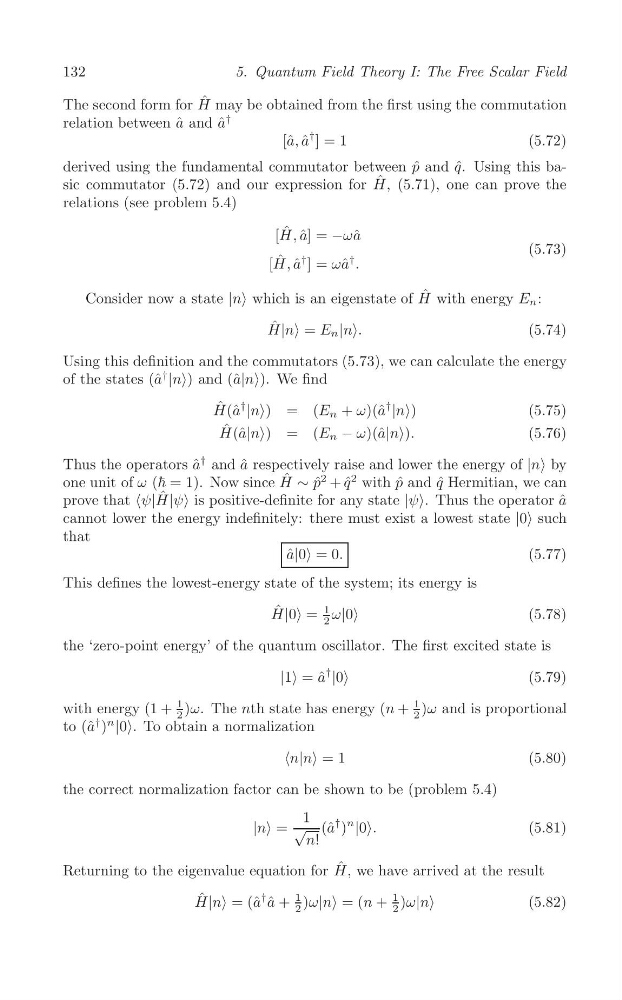
The second form for H ˆ may be obtained from the first using the commutation
†
relation between ˆ
a and ˆ
a
[ˆ a, a ˆ
† ] = 1
(5.72)
derived using the fundamental commutator between ˆ
p and ˆ
q. Using this basic commutator (5.72) and our expression for H ˆ , (5.71), one can prove the
relations (see problem 5.4)
[ ˆ
H, a ˆ] = −ωa ˆ
(5.73)
†
[H, ˆ a ˆ
† ] = ωa ˆ .
Consider now a state |n> which is an eigenstate of H ˆ with energy E n :
ˆ
H|n> = E n |n>.
(5.74)
Using this definition and the commutators (5.73), we can calculate the energy
of the states (ˆ a
†
|n>) and (ˆ a|n>). We find
H ˆ (ˆ a
†
|n>) = (E n + ω)(ˆ a
†
|n>)
(5.75)
ˆ
H(ˆ a|n>) = (E n − ω)(ˆ a|n>).
(5.76)
Thus the operators ˆ
a
† and ˆ
a respectively raise and lower the energy of |n> by
one unit of ω (ħ = 1). Now since H ˆ ∼ p ˆ
2 + ˆ
q
2 with ˆ
p and ˆ
q Hermitian, we can
prove that <ψ|H ˆ |ψ> is positive-definite for any state |ψ>. Thus the operator ˆ
a
cannot lower the energy indefinitely: there must exist a lowest state |0> such
that
a ˆ|0> = 0.
(5.77)
This defines the lowest-energy state of the system; its energy is
ˆ
H|0> =
1
2 ω|0>
(5.78)
the ‘zero-point energy’ of the quantum oscillator. The first excited state is
|1> = ˆ
a
†
|0>
(5.79)
1
2
1
2
with energy (1 + )ω. The nth state has energy (n + )ω and is proportional
to (ˆ a
† )
n
|0>. To obtain a normalization
= 1
(5.80)
the correct normalization factor can be shown to be (problem 5.4)
|n> =
1
√
n!
(ˆ a
† )
n
|0>.
(5.81)
Returning to the eigenvalue equation for H ˆ , we have arrived at the result
ˆ
† ˆ
H|n> = (ˆ a a +
1
2 )ω|n> = (n +
1
2 )ω|n>
(5.82)
5. Quantum Field Theory I: The Free Scalar Field
The second form for H ˆ may be obtained from the first using the commutation
†
relation between ˆ
a and ˆ
a
[ˆ a, a ˆ
† ] = 1
(5.72)
derived using the fundamental commutator between ˆ
p and ˆ
q. Using this basic commutator (5.72) and our expression for H ˆ , (5.71), one can prove the
relations (see problem 5.4)
[ ˆ
H, a ˆ] = −ωa ˆ
(5.73)
†
[H, ˆ a ˆ
† ] = ωa ˆ .
Consider now a state |n> which is an eigenstate of H ˆ with energy E n :
ˆ
H|n> = E n |n>.
(5.74)
Using this definition and the commutators (5.73), we can calculate the energy
of the states (ˆ a
†
|n>) and (ˆ a|n>). We find
H ˆ (ˆ a
†
|n>) = (E n + ω)(ˆ a
†
|n>)
(5.75)
ˆ
H(ˆ a|n>) = (E n − ω)(ˆ a|n>).
(5.76)
Thus the operators ˆ
a
† and ˆ
a respectively raise and lower the energy of |n> by
one unit of ω (ħ = 1). Now since H ˆ ∼ p ˆ
2 + ˆ
q
2 with ˆ
p and ˆ
q Hermitian, we can
prove that <ψ|H ˆ |ψ> is positive-definite for any state |ψ>. Thus the operator ˆ
a
cannot lower the energy indefinitely: there must exist a lowest state |0> such
that
a ˆ|0> = 0.
(5.77)
This defines the lowest-energy state of the system; its energy is
ˆ
H|0> =
1
2 ω|0>
(5.78)
the ‘zero-point energy’ of the quantum oscillator. The first excited state is
|1> = ˆ
a
†
|0>
(5.79)
1
2
1
2
with energy (1 + )ω. The nth state has energy (n + )ω and is proportional
to (ˆ a
† )
n
|0>. To obtain a normalization
(5.80)
the correct normalization factor can be shown to be (problem 5.4)
|n> =
1
√
n!
(ˆ a
† )
n
|0>.
(5.81)
Returning to the eigenvalue equation for H ˆ , we have arrived at the result
ˆ
† ˆ
H|n> = (ˆ a a +
1
2 )ω|n> = (n +
1
2 )ω|n>
(5.82)