

96
4. Lorentz Transformations and Discrete Symmetries
under P. Equation (4.63) will be covariant under (4.61) if we can find a
′
wavefunction ψ P (x , t) for observers using the transformed coordinate system
such that their Dirac equation has exactly the same form in their system as
(4.63):
∂ψ P ′
′
′
∇
′
i
(x , t) = −iα · ψ P (x , t) + βmψ P (x , t).
(4.64)
∂t
′
Now we know that ∇
′ = −∇, since x = −x. Hence (4.64) becomes
∂ψ P ′
′
′
i
(x , t) = iα · ∇ψ P (x , t) + βmψ P (x , t).
(4.65)
∂t
Multiplying this equation from the left by β and using βα = −αβ we find
i∂
′
′
′
[βψ P (x , t)] = −iα · ∇[βψ P (x , t)] + βm[βψ P (x , t)].
(4.66)
∂t
Comparing (4.66) and (4.63), it follows that we may consistently translate
between ψ and ψ P using the relation
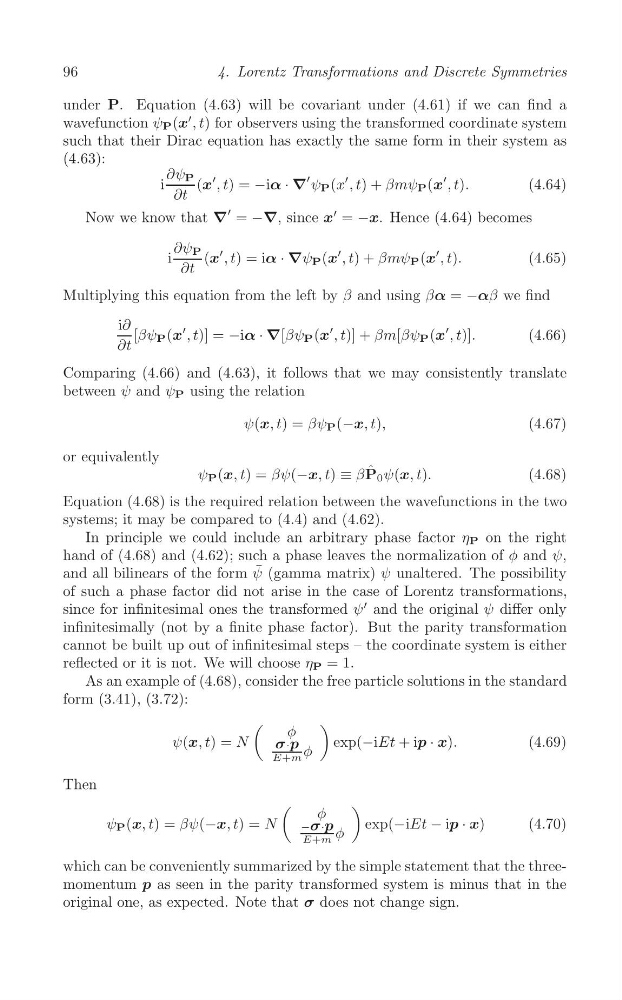
ψ(x, t) = βψ P (−x, t),
(4.67)
or equivalently
ψ P (x, t) = βψ(−x, t) ≡ βP ˆ 0 ψ(x, t).
(4.68)
Equation (4.68) is the required relation between the wavefunctions in the two
systems; it may be compared to (4.4) and (4.62).
In principle we could include an arbitrary phase factor η P on the right
hand of (4.68) and (4.62); such a phase leaves the normalization of φ and ψ,
and all bilinears of the form ψ ¯ (gamma matrix) ψ unaltered. The possibility
of such a phase factor did not arise in the case of Lorentz transformations,
′
since for infinitesimal ones the transformed ψ and the original ψ differ only
infinitesimally (not by a finite phase factor). But the parity transformation
cannot be built up out of infinitesimal steps – the coordinate system is either
reflected or it is not. We will choose η P = 1.
As an example of (4.68), consider the free particle solutions in the standard
form (3.41), (3.72):
(
)
φ
ψ(x, t) = N
σ·p
exp(−iEt + ip · x).
(4.69)
φ
E+m
Then
(
)
φ
ψ P (x, t) = βψ(−x, t) = N
−σ·p
exp(−iEt − ip · x)
(4.70)
φ
E+m
which can be conveniently summarized by the simple statement that the threemomentum p as seen in the parity transformed system is minus that in the
original one, as expected. Note that σ does not change sign.
4. Lorentz Transformations and Discrete Symmetries
under P. Equation (4.63) will be covariant under (4.61) if we can find a
′
wavefunction ψ P (x , t) for observers using the transformed coordinate system
such that their Dirac equation has exactly the same form in their system as
(4.63):
∂ψ P ′
′
′
∇
′
i
(x , t) = −iα · ψ P (x , t) + βmψ P (x , t).
(4.64)
∂t
′
Now we know that ∇
′ = −∇, since x = −x. Hence (4.64) becomes
∂ψ P ′
′
′
i
(x , t) = iα · ∇ψ P (x , t) + βmψ P (x , t).
(4.65)
∂t
Multiplying this equation from the left by β and using βα = −αβ we find
i∂
′
′
′
[βψ P (x , t)] = −iα · ∇[βψ P (x , t)] + βm[βψ P (x , t)].
(4.66)
∂t
Comparing (4.66) and (4.63), it follows that we may consistently translate
between ψ and ψ P using the relation
ψ(x, t) = βψ P (−x, t),
(4.67)
or equivalently
ψ P (x, t) = βψ(−x, t) ≡ βP ˆ 0 ψ(x, t).
(4.68)
Equation (4.68) is the required relation between the wavefunctions in the two
systems; it may be compared to (4.4) and (4.62).
In principle we could include an arbitrary phase factor η P on the right
hand of (4.68) and (4.62); such a phase leaves the normalization of φ and ψ,
and all bilinears of the form ψ ¯ (gamma matrix) ψ unaltered. The possibility
of such a phase factor did not arise in the case of Lorentz transformations,
′
since for infinitesimal ones the transformed ψ and the original ψ differ only
infinitesimally (not by a finite phase factor). But the parity transformation
cannot be built up out of infinitesimal steps – the coordinate system is either
reflected or it is not. We will choose η P = 1.
As an example of (4.68), consider the free particle solutions in the standard
form (3.41), (3.72):
(
)
φ
ψ(x, t) = N
σ·p
exp(−iEt + ip · x).
(4.69)
φ
E+m
Then
(
)
φ
ψ P (x, t) = βψ(−x, t) = N
−σ·p
exp(−iEt − ip · x)
(4.70)
φ
E+m
which can be conveniently summarized by the simple statement that the threemomentum p as seen in the parity transformed system is minus that in the
original one, as expected. Note that σ does not change sign.