

91
4.1. Lorentz transformations
Hence (4.21) is just
′ φ
′
Eφ
′ = σ · p + mχ
′
(4.27)
as required in (4.17). We can similarly check the correctness of the transformation law (4.19) for χ.
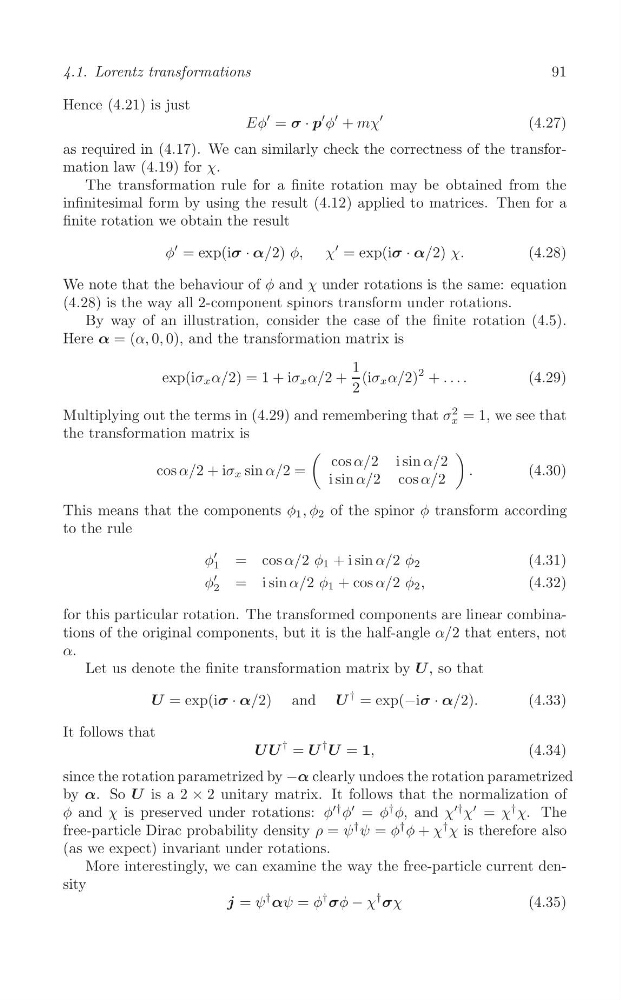
The transformation rule for a finite rotation may be obtained from the
infinitesimal form by using the result (4.12) applied to matrices. Then for a
finite rotation we obtain the result
φ
′ = exp(iσ · α/2) φ,
χ
′ = exp(iσ · α/2) χ.
(4.28)
We note that the behaviour of φ and χ under rotations is the same: equation
(4.28) is the way all 2-component spinors transform under rotations.
By way of an illustration, consider the case of the finite rotation (4.5).
Here α = (α, 0, 0), and the transformation matrix is
exp(iσ x α/2) = 1 + iσ x α/2 +
1 (iσ x α/2)
2 + . . . .
(4.29)
2
Multiplying out the terms in (4.29) and remembering that σ
2 = 1, we see that
x
the transformation matrix is
(
)
cos α/2 isinα/2
cos α/2 + iσ x sin α/2 =
.
(4.30)
i sin α/2 cosα/2
This means that the components φ 1 , φ 2 of the spinor φ transform according
to the rule
φ
′
= cosα/2 φ 1 + i sin α/2 φ 2
(4.31)
1
φ
′
= isinα/2 φ 1 + cos α/2 φ 2 ,
(4.32)
2
for this particular rotation. The transformed components are linear combinations of the original components, but it is the half-angle α/2 that enters, not
α.
Let us denote the finite transformation matrix by U , so that
U
†
U = exp(iσ · α/2) and
= exp(−iσ · α/2).
(4.33)
It follows that
U U
† = U
†
U = 1,
(4.34)
since the rotation parametrized by −α clearly undoes the rotation parametrized
by α. So U is a 2 × 2 unitary matrix. It follows that the normalization of
φ and χ is preserved under rotations: φ
′† φ
′ = φ
† φ, and χ
′† χ
′ = χ
† χ. The
free-particle Dirac probability density ρ = ψ
† ψ = φ
† φ + χ
† χ is therefore also
(as we expect) invariant under rotations.
More interestingly, we can examine the way the free-particle current density
j = ψ
†
αψ = φ
†
σφ − χ
†
σχ
(4.35)
4.1. Lorentz transformations
Hence (4.21) is just
′ φ
′
Eφ
′ = σ · p + mχ
′
(4.27)
as required in (4.17). We can similarly check the correctness of the transformation law (4.19) for χ.
The transformation rule for a finite rotation may be obtained from the
infinitesimal form by using the result (4.12) applied to matrices. Then for a
finite rotation we obtain the result
φ
′ = exp(iσ · α/2) φ,
χ
′ = exp(iσ · α/2) χ.
(4.28)
We note that the behaviour of φ and χ under rotations is the same: equation
(4.28) is the way all 2-component spinors transform under rotations.
By way of an illustration, consider the case of the finite rotation (4.5).
Here α = (α, 0, 0), and the transformation matrix is
exp(iσ x α/2) = 1 + iσ x α/2 +
1 (iσ x α/2)
2 + . . . .
(4.29)
2
Multiplying out the terms in (4.29) and remembering that σ
2 = 1, we see that
x
the transformation matrix is
(
)
cos α/2 isinα/2
cos α/2 + iσ x sin α/2 =
.
(4.30)
i sin α/2 cosα/2
This means that the components φ 1 , φ 2 of the spinor φ transform according
to the rule
φ
′
= cosα/2 φ 1 + i sin α/2 φ 2
(4.31)
1
φ
′
= isinα/2 φ 1 + cos α/2 φ 2 ,
(4.32)
2
for this particular rotation. The transformed components are linear combinations of the original components, but it is the half-angle α/2 that enters, not
α.
Let us denote the finite transformation matrix by U , so that
U
†
U = exp(iσ · α/2) and
= exp(−iσ · α/2).
(4.33)
It follows that
U U
† = U
†
U = 1,
(4.34)
since the rotation parametrized by −α clearly undoes the rotation parametrized
by α. So U is a 2 × 2 unitary matrix. It follows that the normalization of
φ and χ is preserved under rotations: φ
′† φ
′ = φ
† φ, and χ
′† χ
′ = χ
† χ. The
free-particle Dirac probability density ρ = ψ
† ψ = φ
† φ + χ
† χ is therefore also
(as we expect) invariant under rotations.
More interestingly, we can examine the way the free-particle current density
j = ψ
†
αψ = φ
†
σφ − χ
†
σχ
(4.35)