

88
4. Lorentz Transformations and Discrete Symmetries
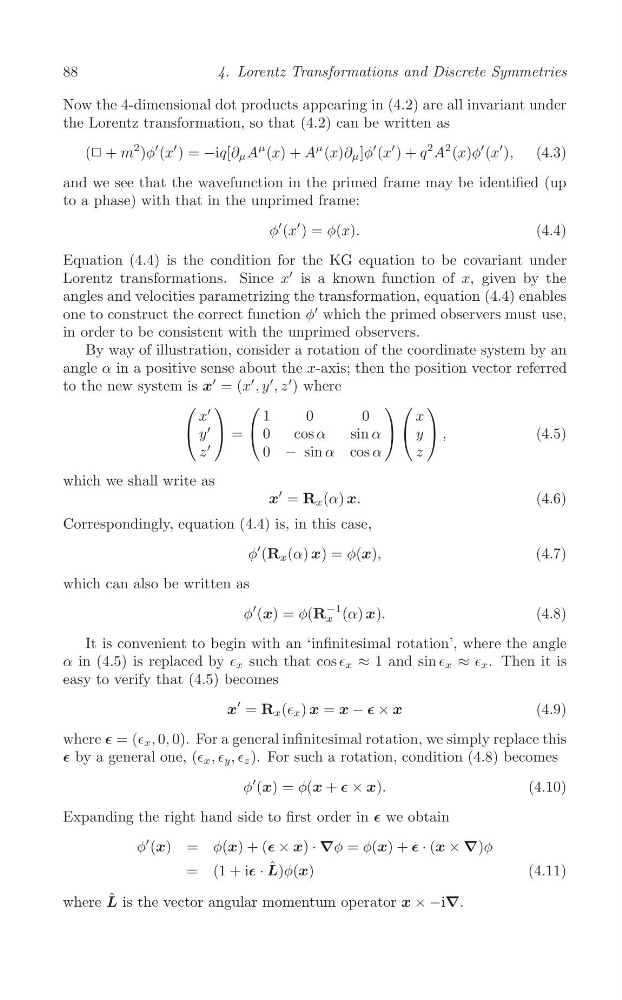
Now the 4-dimensional dot products appearing in (4.2) are all invariant under
the Lorentz transformation, so that (4.2) can be written as
(❗ + m
2 )φ
′ (x
′ ) = −iq[∂ μ A
μ (x) + A
μ (x)∂ μ ]φ
′ (x
′ ) + q
2 A
2 (x)φ
′ (x
′ ), (4.3)
and we see that the wavefunction in the primed frame may be identified (up
to a phase) with that in the unprimed frame:
φ
′ (x
′ ) = φ(x).
(4.4)
Equation (4.4) is the condition for the KG equation to be covariant under
′
Lorentz transformations. Since x is a known function of x, given by the
angles and velocities parametrizing the transformation, equation (4.4) enables
′
one to construct the correct function φ which the primed observers must use,
in order to be consistent with the unprimed observers.
By way of illustration, consider a rotation of the coordinate system by an
angle α in a positive sense about the x-axis; then the position vector referred
′
′ ′
to the new system is x = (x , y , z
′ ) where
( ) (
) ( )
′
x
1
0
0
x
( y
′ ) = ( 0
cosα
sin α ) ( y ) ,
(4.5)
′
z
0 − sin α cos α
z
which we shall write as
′
x = R x (α) x.
(4.6)
Correspondingly, equation (4.4) is, in this case,
φ
′ (R x (α) x) = φ(x),
(4.7)
which can also be written as
φ
′ (x) = φ(R
−1 (α) x).
(4.8)
x
It is convenient to begin with an ‘infinitesimal rotation’, where the angle
α in (4.5) is replaced by ∈ x such that cos ∈ x ≈ 1 and sin ∈ x ≈ ∈ x . Then it is
easy to verify that (4.5) becomes
′
x = R x (∈ x ) x = x − ∈ × x
(4.9)
where ∈ = (∈ x , 0, 0). For a general infinitesimal rotation, we simply replace this
∈ by a general one, (∈ x , ∈ y , ∈ z ). For such a rotation, condition (4.8) becomes
φ
′ (x) = φ(x + ∈ × x).
(4.10)
Expanding the right hand side to first order in ∈ we obtain
φ
′ (x) = φ(x) + (∈ × x) · ∇φ = φ(x) + ∈ · (x × ∇)φ
ˆ
= (1 + i∈ · L)φ(x)
(4.11)
where L ˆ is the vector angular momentum operator x × −i∇.
4. Lorentz Transformations and Discrete Symmetries
Now the 4-dimensional dot products appearing in (4.2) are all invariant under
the Lorentz transformation, so that (4.2) can be written as
(❗ + m
2 )φ
′ (x
′ ) = −iq[∂ μ A
μ (x) + A
μ (x)∂ μ ]φ
′ (x
′ ) + q
2 A
2 (x)φ
′ (x
′ ), (4.3)
and we see that the wavefunction in the primed frame may be identified (up
to a phase) with that in the unprimed frame:
φ
′ (x
′ ) = φ(x).
(4.4)
Equation (4.4) is the condition for the KG equation to be covariant under
′
Lorentz transformations. Since x is a known function of x, given by the
angles and velocities parametrizing the transformation, equation (4.4) enables
′
one to construct the correct function φ which the primed observers must use,
in order to be consistent with the unprimed observers.
By way of illustration, consider a rotation of the coordinate system by an
angle α in a positive sense about the x-axis; then the position vector referred
′
′ ′
to the new system is x = (x , y , z
′ ) where
( ) (
) ( )
′
x
1
0
0
x
( y
′ ) = ( 0
cosα
sin α ) ( y ) ,
(4.5)
′
z
0 − sin α cos α
z
which we shall write as
′
x = R x (α) x.
(4.6)
Correspondingly, equation (4.4) is, in this case,
φ
′ (R x (α) x) = φ(x),
(4.7)
which can also be written as
φ
′ (x) = φ(R
−1 (α) x).
(4.8)
x
It is convenient to begin with an ‘infinitesimal rotation’, where the angle
α in (4.5) is replaced by ∈ x such that cos ∈ x ≈ 1 and sin ∈ x ≈ ∈ x . Then it is
easy to verify that (4.5) becomes
′
x = R x (∈ x ) x = x − ∈ × x
(4.9)
where ∈ = (∈ x , 0, 0). For a general infinitesimal rotation, we simply replace this
∈ by a general one, (∈ x , ∈ y , ∈ z ). For such a rotation, condition (4.8) becomes
φ
′ (x) = φ(x + ∈ × x).
(4.10)
Expanding the right hand side to first order in ∈ we obtain
φ
′ (x) = φ(x) + (∈ × x) · ∇φ = φ(x) + ∈ · (x × ∇)φ
ˆ
= (1 + i∈ · L)φ(x)
(4.11)
where L ˆ is the vector angular momentum operator x × −i∇.