

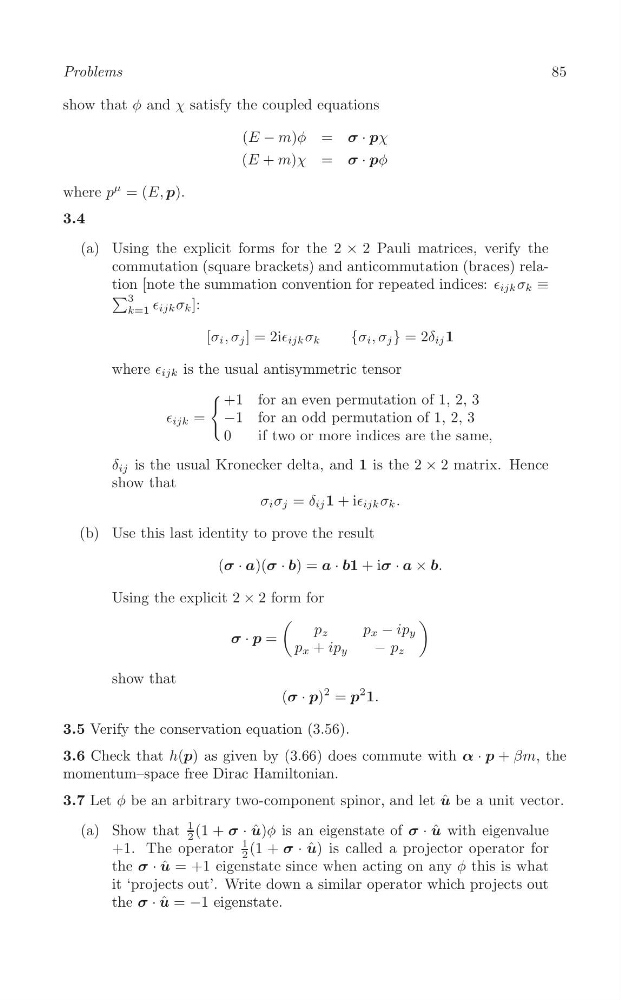
3.4
Problems
85
show that φ and χ satisfy the coupled equations
(E − m)φ = σ · pχ
(E + m)χ = σ · pφ
where p
μ = (E, p).
(a) Using the explicit forms for the 2 × 2 Pauli matrices, verify the
commutation (square brackets) and anticommutation (braces) relation [note the summation convention for repeated indices: ∈ ijk σ k ≡
∑ 3
k=1 ∈ ijk σ k ]:
[σ i , σ j ] = 2i∈ ijk σ k
{σ i , σ j } = 2δ ij 1
where ∈ ijk is the usual antisymmetric tensor
( +1 for an even permutation of 1, 2, 3
∈ ijk = −1 for an odd permutation of 1, 2, 3
0
if two or more indices are the same,
δ ij is the usual Kronecker delta, and 1 is the 2 × 2 matrix. Hence
show that
σ i σ j = δ ij 1 + i∈ ijk σ k .
(b) Use this last identity to prove the result
(σ · a)(σ · b) = a · b1 + iσ · a × b.
Using the explicit 2 × 2 form for
(
)
p z
p x − ip y
σ · p = p x + ip y
− p z
show that
(σ · p)
2 = p
2 1.
3.5 Verify the conservation equation (3.56).
3.6 Check that h(p) as given by (3.66) does commute with α · p + βm, the
momentum–space free Dirac Hamiltonian.
3.7 Let φ be an arbitrary two-component spinor, and let u ˆ be a unit vector.
(a) Show that
1 (1 + σ · u ˆ)φ is an eigenstate of σ · u ˆ with eigenvalue
2
+1. The operator
1 (1 + σ · u ˆ) is called a projector operator for
2
the σ · u ˆ = +1 eigenstate since when acting on any φ this is what
it ‘projects out’. Write down a similar operator which projects out
the σ · u ˆ = −1 eigenstate.
Problems
85
show that φ and χ satisfy the coupled equations
(E − m)φ = σ · pχ
(E + m)χ = σ · pφ
where p
μ = (E, p).
(a) Using the explicit forms for the 2 × 2 Pauli matrices, verify the
commutation (square brackets) and anticommutation (braces) relation [note the summation convention for repeated indices: ∈ ijk σ k ≡
∑ 3
k=1 ∈ ijk σ k ]:
[σ i , σ j ] = 2i∈ ijk σ k
{σ i , σ j } = 2δ ij 1
where ∈ ijk is the usual antisymmetric tensor
( +1 for an even permutation of 1, 2, 3
∈ ijk = −1 for an odd permutation of 1, 2, 3
0
if two or more indices are the same,
δ ij is the usual Kronecker delta, and 1 is the 2 × 2 matrix. Hence
show that
σ i σ j = δ ij 1 + i∈ ijk σ k .
(b) Use this last identity to prove the result
(σ · a)(σ · b) = a · b1 + iσ · a × b.
Using the explicit 2 × 2 form for
(
)
p z
p x − ip y
σ · p = p x + ip y
− p z
show that
(σ · p)
2 = p
2 1.
3.5 Verify the conservation equation (3.56).
3.6 Check that h(p) as given by (3.66) does commute with α · p + βm, the
momentum–space free Dirac Hamiltonian.
3.7 Let φ be an arbitrary two-component spinor, and let u ˆ be a unit vector.
(a) Show that
1 (1 + σ · u ˆ)φ is an eigenstate of σ · u ˆ with eigenvalue
2
+1. The operator
1 (1 + σ · u ˆ) is called a projector operator for
2
the σ · u ˆ = +1 eigenstate since when acting on any φ this is what
it ‘projects out’. Write down a similar operator which projects out
the σ · u ˆ = −1 eigenstate.