

80
5 Understanding the Complementarities of Environmental …
Time
Z footprint
Policy target
Policy gap
Present
Policy
period
Policy
deadline
Preindustrial
Sustainability
gap
Z boundary
ImplementaƟon
gap
Environmental pressure/impact
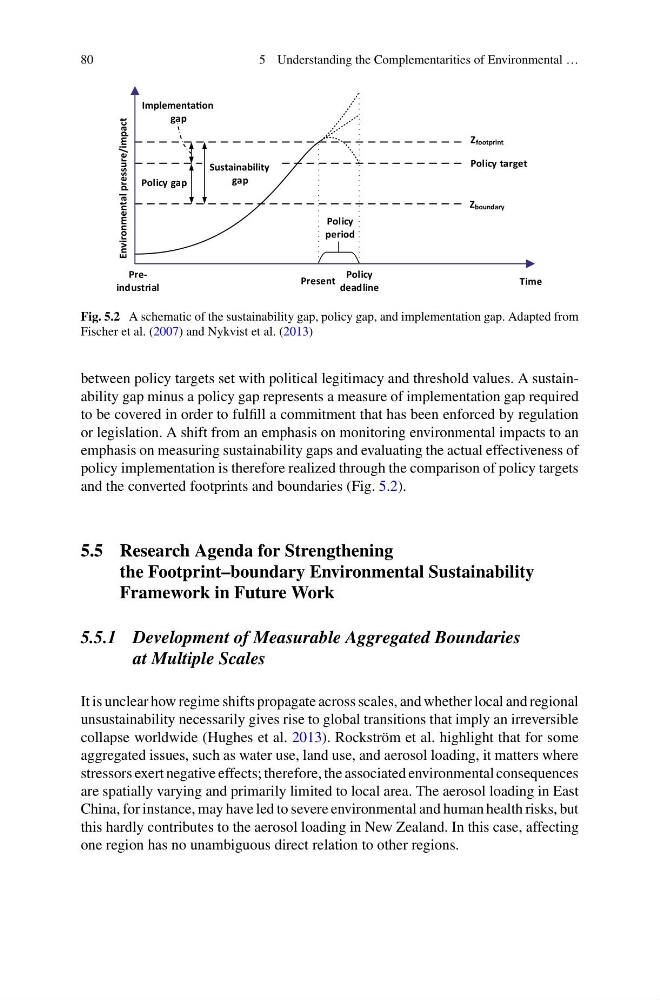
Fig. 5.2 A schematic of the sustainability gap, policy gap, and implementation gap. Adapted from
Fischer et al. (2007) and Nykvist et al. (2013)
between policy targets set with political legitimacy and threshold values. A sustainability gap minus a policy gap represents a measure of implementation gap required
to be covered in order to fulfill a commitment that has been enforced by regulation
or legislation. A shift from an emphasis on monitoring environmental impacts to an
emphasis on measuring sustainability gaps and evaluating the actual effectiveness of
policy implementation is therefore realized through the comparison of policy targets
and the converted footprints and boundaries (Fig. 5.2).
5.5 Research Agenda for Strengthening
the Footprint–boundary Environmental Sustainability
Framework in Future Work
5.5.1 Development of Measurable Aggregated Boundaries
at Multiple Scales
It is unclear how regime shifts propagate across scales, and whether local and regional
unsustainability necessarily gives rise to global transitions that imply an irreversible
collapse worldwide (Hughes et al. 2013). Rockström et al. highlight that for some
aggregated issues, such as water use, land use, and aerosol loading, it matters where
stressors exert negative effects; therefore, the associated environmental consequences
are spatially varying and primarily limited to local area. The aerosol loading in East
China, for instance, may have led to severe environmental and human health risks, but
this hardly contributes to the aerosol loading in New Zealand. In this case, affecting
one region has no unambiguous direct relation to other regions.
5 Understanding the Complementarities of Environmental …
Time
Z footprint
Policy target
Policy gap
Present
Policy
period
Policy
deadline
Preindustrial
Sustainability
gap
Z boundary
ImplementaƟon
gap
Environmental pressure/impact
Fig. 5.2 A schematic of the sustainability gap, policy gap, and implementation gap. Adapted from
Fischer et al. (2007) and Nykvist et al. (2013)
between policy targets set with political legitimacy and threshold values. A sustainability gap minus a policy gap represents a measure of implementation gap required
to be covered in order to fulfill a commitment that has been enforced by regulation
or legislation. A shift from an emphasis on monitoring environmental impacts to an
emphasis on measuring sustainability gaps and evaluating the actual effectiveness of
policy implementation is therefore realized through the comparison of policy targets
and the converted footprints and boundaries (Fig. 5.2).
5.5 Research Agenda for Strengthening
the Footprint–boundary Environmental Sustainability
Framework in Future Work
5.5.1 Development of Measurable Aggregated Boundaries
at Multiple Scales
It is unclear how regime shifts propagate across scales, and whether local and regional
unsustainability necessarily gives rise to global transitions that imply an irreversible
collapse worldwide (Hughes et al. 2013). Rockström et al. highlight that for some
aggregated issues, such as water use, land use, and aerosol loading, it matters where
stressors exert negative effects; therefore, the associated environmental consequences
are spatially varying and primarily limited to local area. The aerosol loading in East
China, for instance, may have led to severe environmental and human health risks, but
this hardly contributes to the aerosol loading in New Zealand. In this case, affecting
one region has no unambiguous direct relation to other regions.