

78
5 Understanding the Complementarities of Environmental …
warming potential (GWP) values. Likewise, U boundary,temperature (in °C) is converted
into Z fboundary,climate (in Gt CO 2 -eq./yr).
• Step 2 creates sustainability indicators by looking at: (1) the difference between
a footprint and a boundary (Z footprint,i − Z boundary,i ); or (2) the ratio of a footprint
to a boundary (Z footprint,i /Z boundary,i ).
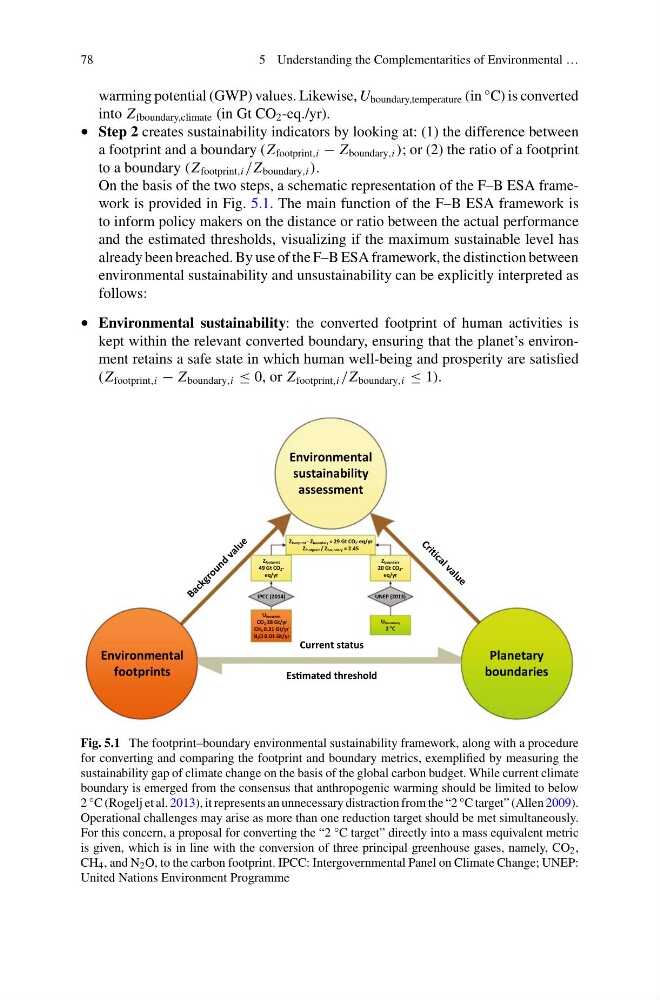
On the basis of the two steps, a schematic representation of the F–B ESA framework is provided in Fig. 5.1. The main function of the F–B ESA framework is
to inform policy makers on the distance or ratio between the actual performance
and the estimated thresholds, visualizing if the maximum sustainable level has
already been breached. By use of the F–B ESA framework, the distinction between
environmental sustainability and unsustainability can be explicitly interpreted as
follows:
• Environmental sustainability: the converted footprint of human activities is
kept within the relevant converted boundary, ensuring that the planet’s environment retains a safe state in which human well-being and prosperity are satisfied
(Z footprint,i − Z boundary,i ≤ 0, or Z footprint,i /Z boundary,i ≤ 1).
Environmental
footprints
Environmental
sustainability
assessment
Planetary
boundaries
Current status
EsƟmated threshold
Ufootprint
CO2 38 Gt/yr
CH4 0.31 Gt/yr
N2O 0.01 Gt/yr
Zfootprint
49 Gt CO2eq/yr
Uboundary
2 °C
Zboundary
20 Gt CO2eq/yr
Zfootprint - Zboundary = 29 Gt CO2-eq/yr
Zfootprint / Zboundary = 2.45
IPCC (2014)
UNEP (2013)
Fig. 5.1 The footprint–boundary environmental sustainability framework, along with a procedure
for converting and comparing the footprint and boundary metrics, exemplified by measuring the
sustainability gap of climate change on the basis of the global carbon budget. While current climate
boundary is emerged from the consensus that anthropogenic warming should be limited to below
2 °C (Rogelj et al. 2013), it represents an unnecessary distraction from the “2 °C target” (Allen 2009).
Operational challenges may arise as more than one reduction target should be met simultaneously.
For this concern, a proposal for converting the “2 °C target” directly into a mass equivalent metric
is given, which is in line with the conversion of three principal greenhouse gases, namely, CO 2 ,
CH 4 , and N 2 O, to the carbon footprint. IPCC: Intergovernmental Panel on Climate Change; UNEP:
United Nations Environment Programme
5 Understanding the Complementarities of Environmental …
warming potential (GWP) values. Likewise, U boundary,temperature (in °C) is converted
into Z fboundary,climate (in Gt CO 2 -eq./yr).
• Step 2 creates sustainability indicators by looking at: (1) the difference between
a footprint and a boundary (Z footprint,i − Z boundary,i ); or (2) the ratio of a footprint
to a boundary (Z footprint,i /Z boundary,i ).
On the basis of the two steps, a schematic representation of the F–B ESA framework is provided in Fig. 5.1. The main function of the F–B ESA framework is
to inform policy makers on the distance or ratio between the actual performance
and the estimated thresholds, visualizing if the maximum sustainable level has
already been breached. By use of the F–B ESA framework, the distinction between
environmental sustainability and unsustainability can be explicitly interpreted as
follows:
• Environmental sustainability: the converted footprint of human activities is
kept within the relevant converted boundary, ensuring that the planet’s environment retains a safe state in which human well-being and prosperity are satisfied
(Z footprint,i − Z boundary,i ≤ 0, or Z footprint,i /Z boundary,i ≤ 1).
Environmental
footprints
Environmental
sustainability
assessment
Planetary
boundaries
Current status
EsƟmated threshold
Ufootprint
CO2 38 Gt/yr
CH4 0.31 Gt/yr
N2O 0.01 Gt/yr
Zfootprint
49 Gt CO2eq/yr
Uboundary
2 °C
Zboundary
20 Gt CO2eq/yr
Zfootprint - Zboundary = 29 Gt CO2-eq/yr
Zfootprint / Zboundary = 2.45
IPCC (2014)
UNEP (2013)
Fig. 5.1 The footprint–boundary environmental sustainability framework, along with a procedure
for converting and comparing the footprint and boundary metrics, exemplified by measuring the
sustainability gap of climate change on the basis of the global carbon budget. While current climate
boundary is emerged from the consensus that anthropogenic warming should be limited to below
2 °C (Rogelj et al. 2013), it represents an unnecessary distraction from the “2 °C target” (Allen 2009).
Operational challenges may arise as more than one reduction target should be met simultaneously.
For this concern, a proposal for converting the “2 °C target” directly into a mass equivalent metric
is given, which is in line with the conversion of three principal greenhouse gases, namely, CO 2 ,
CH 4 , and N 2 O, to the carbon footprint. IPCC: Intergovernmental Panel on Climate Change; UNEP:
United Nations Environment Programme