

5.3 Why Environmental Footprints Are Important for Making …
73
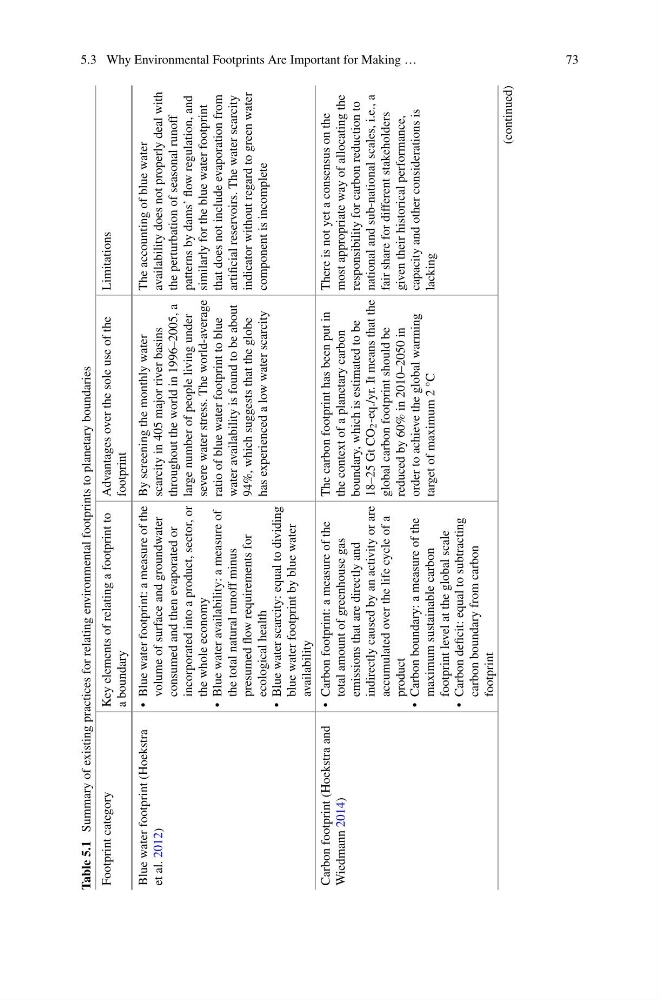
Table 5.1
Summary of existing practices for relating environmental footprints to planetary boundaries
Footprint category
Key elements of relating a footprint to
a boundary
Advantages over the sole use of the
footprint
Limitations
Blue water footprint (Hoekstra
et al. 2012)
• Blue water footprint: a measure of the
volume of surface and groundwater
consumed and then evaporated or
incorporated into a product, sector, or
the whole economy
• Blue water availability: a measure of
the total natural runoff minus
presumed flow requirements for
ecological health
• Blue water scarcity: equal to dividing
blue water footprint by blue water
availability
By screening the monthly water
scarcity in 405 major river basins
throughout the world in 1996–2005, a
large number of people living under
severe water stress. The world-average
ratio of blue water footprint to blue
water availability is found to be about
94%, which suggests that the globe
has experienced a low water scarcity
The accounting of blue water
availability does not properly deal with
the perturbation of seasonal runoff
patterns by dams’ flow regulation, and
similarly for the blue water footprint
that does not include evaporation from
artificial reservoirs. The water scarcity
indicator without regard to green water
component is incomplete
Carbon footprint (Hoekstra and
Wiedmann 2014)
• Carbon footprint: a measure of the
total amount of greenhouse gas
emissions that are directly and
indirectly caused by an activity or are
accumulated over the life cycle of a
product
• Carbon boundary: a measure of the
maximum sustainable carbon
footprint level at the global scale
• Carbon deficit: equal to subtracting
carbon boundary from carbon
footprint
The carbon footprint has been put in
the context of a planetary carbon
boundary, which is estimated to be
18–25 Gt CO
2 -eq./yr. It means that the
global carbon footprint should be
reduced by 60% in 2010–2050 in
order to achieve the global warming
target of maximum 2 °C
There is not yet a consensus on the
most appropriate way of allocating the
responsibility for carbon reduction to
national and sub-national scales, i.e., a
fair share for different stakeholders
given their historical performance,
capacity and other considerations is
lacking
(continued)
73
Table 5.1
Summary of existing practices for relating environmental footprints to planetary boundaries
Footprint category
Key elements of relating a footprint to
a boundary
Advantages over the sole use of the
footprint
Limitations
Blue water footprint (Hoekstra
et al. 2012)
• Blue water footprint: a measure of the
volume of surface and groundwater
consumed and then evaporated or
incorporated into a product, sector, or
the whole economy
• Blue water availability: a measure of
the total natural runoff minus
presumed flow requirements for
ecological health
• Blue water scarcity: equal to dividing
blue water footprint by blue water
availability
By screening the monthly water
scarcity in 405 major river basins
throughout the world in 1996–2005, a
large number of people living under
severe water stress. The world-average
ratio of blue water footprint to blue
water availability is found to be about
94%, which suggests that the globe
has experienced a low water scarcity
The accounting of blue water
availability does not properly deal with
the perturbation of seasonal runoff
patterns by dams’ flow regulation, and
similarly for the blue water footprint
that does not include evaporation from
artificial reservoirs. The water scarcity
indicator without regard to green water
component is incomplete
Carbon footprint (Hoekstra and
Wiedmann 2014)
• Carbon footprint: a measure of the
total amount of greenhouse gas
emissions that are directly and
indirectly caused by an activity or are
accumulated over the life cycle of a
product
• Carbon boundary: a measure of the
maximum sustainable carbon
footprint level at the global scale
• Carbon deficit: equal to subtracting
carbon boundary from carbon
footprint
The carbon footprint has been put in
the context of a planetary carbon
boundary, which is estimated to be
18–25 Gt CO
2 -eq./yr. It means that the
global carbon footprint should be
reduced by 60% in 2010–2050 in
order to achieve the global warming
target of maximum 2 °C
There is not yet a consensus on the
most appropriate way of allocating the
responsibility for carbon reduction to
national and sub-national scales, i.e., a
fair share for different stakeholders
given their historical performance,
capacity and other considerations is
lacking
(continued)