

4.2 On the Strengths of LCA for Environmental Footprints
63
1.00E-11
1.00E-10
1.00E-09
1.00E-08
1.00E-07
1.00E-06
1.00E-05
1.00E-04
1.00E-03
1.00E-02
1.00E-01
1.00E+00
1.00E+01
1.00E+02
Ag
Al
Au
As
B
Ba
Be
Bi
Br
Cd
Cl
Co
Cr
Cu
Fe
Ga
Ge
Hg
I
In
K
Li
Mg
Mn
Mo
Na
Ni
Nb
P
Pb
Pd
Pt
Re
S
Sb
Se
Si
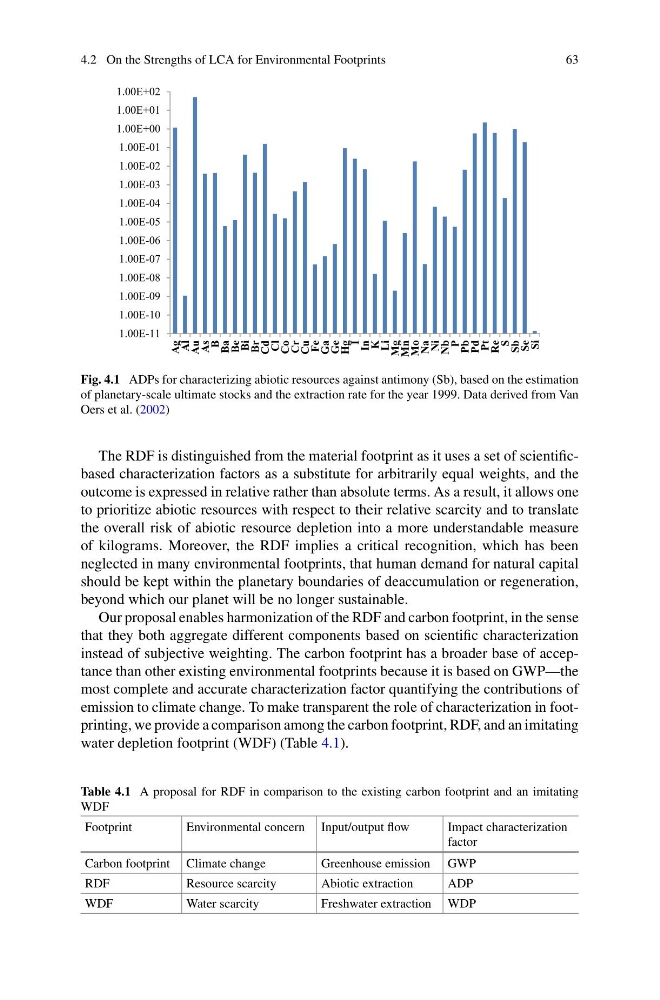
Fig. 4.1 ADPs for characterizing abiotic resources against antimony (Sb), based on the estimation
of planetary-scale ultimate stocks and the extraction rate for the year 1999. Data derived from Van
Oers et al. (2002)
The RDF is distinguished from the material footprint as it uses a set of scientificbased characterization factors as a substitute for arbitrarily equal weights, and the
outcome is expressed in relative rather than absolute terms. As a result, it allows one
to prioritize abiotic resources with respect to their relative scarcity and to translate
the overall risk of abiotic resource depletion into a more understandable measure
of kilograms. Moreover, the RDF implies a critical recognition, which has been
neglected in many environmental footprints, that human demand for natural capital
should be kept within the planetary boundaries of deaccumulation or regeneration,
beyond which our planet will be no longer sustainable.
Our proposal enables harmonization of the RDF and carbon footprint, in the sense
that they both aggregate different components based on scientific characterization
instead of subjective weighting. The carbon footprint has a broader base of acceptance than other existing environmental footprints because it is based on GWP—the
most complete and accurate characterization factor quantifying the contributions of
emission to climate change. To make transparent the role of characterization in footprinting, we provide a comparison among the carbon footprint, RDF, and an imitating
water depletion footprint (WDF) (Table 4.1).
Table 4.1 A proposal for RDF in comparison to the existing carbon footprint and an imitating
WDF
Footprint
Environmental concern Input/output flow
Impact characterization
factor
Carbon footprint Climate change
Greenhouse emission GWP
RDF
Resource scarcity
Abiotic extraction
ADP
WDF
Water scarcity
Freshwater extraction WDP
63
1.00E-11
1.00E-10
1.00E-09
1.00E-08
1.00E-07
1.00E-06
1.00E-05
1.00E-04
1.00E-03
1.00E-02
1.00E-01
1.00E+00
1.00E+01
1.00E+02
Ag
Al
Au
As
B
Ba
Be
Bi
Br
Cd
Cl
Co
Cr
Cu
Fe
Ga
Ge
Hg
I
In
K
Li
Mg
Mn
Mo
Na
Ni
Nb
P
Pb
Pd
Pt
Re
S
Sb
Se
Si
Fig. 4.1 ADPs for characterizing abiotic resources against antimony (Sb), based on the estimation
of planetary-scale ultimate stocks and the extraction rate for the year 1999. Data derived from Van
Oers et al. (2002)
The RDF is distinguished from the material footprint as it uses a set of scientificbased characterization factors as a substitute for arbitrarily equal weights, and the
outcome is expressed in relative rather than absolute terms. As a result, it allows one
to prioritize abiotic resources with respect to their relative scarcity and to translate
the overall risk of abiotic resource depletion into a more understandable measure
of kilograms. Moreover, the RDF implies a critical recognition, which has been
neglected in many environmental footprints, that human demand for natural capital
should be kept within the planetary boundaries of deaccumulation or regeneration,
beyond which our planet will be no longer sustainable.
Our proposal enables harmonization of the RDF and carbon footprint, in the sense
that they both aggregate different components based on scientific characterization
instead of subjective weighting. The carbon footprint has a broader base of acceptance than other existing environmental footprints because it is based on GWP—the
most complete and accurate characterization factor quantifying the contributions of
emission to climate change. To make transparent the role of characterization in footprinting, we provide a comparison among the carbon footprint, RDF, and an imitating
water depletion footprint (WDF) (Table 4.1).
Table 4.1 A proposal for RDF in comparison to the existing carbon footprint and an imitating
WDF
Footprint
Environmental concern Input/output flow
Impact characterization
factor
Carbon footprint Climate change
Greenhouse emission GWP
RDF
Resource scarcity
Abiotic extraction
ADP
WDF
Water scarcity
Freshwater extraction WDP