

3.2 Investigation into the Inventory and Characterization …
45
MF scarc is distinguished from the MF class in that it substitutes abiotic depletion potentials (ADPs) for equal weighting factors and in that the outcome is expressed in equivalent units, with antimony (Sb) as a reference substance (e.g., kg Sb-eq.). It allows us
to characterize abiotic resources with respect to relative scarcity and to translate the
overall risk of abiotic depletion into an understandable measure of kilograms (Fang
and Heijungs 2014a).
3.3 Lessons for the Classification and Integration
of Environmental Footprints
3.3.1 General Lessons
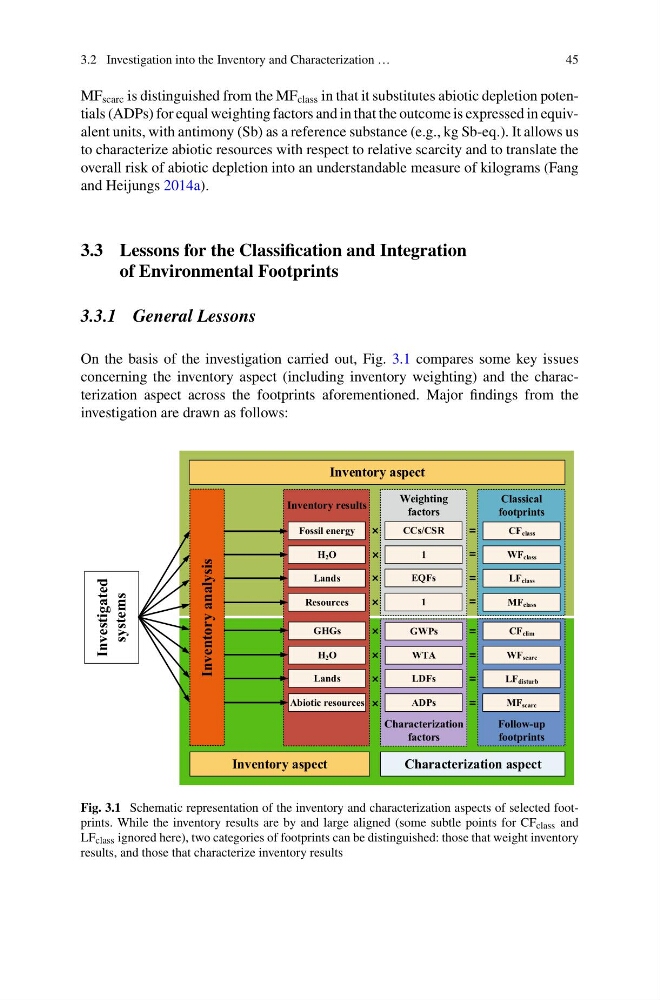
On the basis of the investigation carried out, Fig. 3.1 compares some key issues
concerning the inventory aspect (including inventory weighting) and the characterization aspect across the footprints aforementioned. Major findings from the
investigation are drawn as follows:
Inventory aspect
Fossil energy
CCs/CSR
Inventory results
Weighting
factors
H2O
1
Lands
EQFs
Resources
1
GHGs
H2O
Lands
Abiotic resources
Investigated
systems
CFclass
Classical
footprints
WFclass
LFclass
MFclass
Inventory analysis
GWPs
WTA
LDFs
ADPs
Characterization
factors
Inventory aspect
Characterization aspect
CFclim
WFscarc
LFdisturb
MFscarc
Follow-up
footprints
Fig. 3.1 Schematic representation of the inventory and characterization aspects of selected footprints. While the inventory results are by and large aligned (some subtle points for CF class and
LF class ignored here), two categories of footprints can be distinguished: those that weight inventory
results, and those that characterize inventory results
45
MF scarc is distinguished from the MF class in that it substitutes abiotic depletion potentials (ADPs) for equal weighting factors and in that the outcome is expressed in equivalent units, with antimony (Sb) as a reference substance (e.g., kg Sb-eq.). It allows us
to characterize abiotic resources with respect to relative scarcity and to translate the
overall risk of abiotic depletion into an understandable measure of kilograms (Fang
and Heijungs 2014a).
3.3 Lessons for the Classification and Integration
of Environmental Footprints
3.3.1 General Lessons
On the basis of the investigation carried out, Fig. 3.1 compares some key issues
concerning the inventory aspect (including inventory weighting) and the characterization aspect across the footprints aforementioned. Major findings from the
investigation are drawn as follows:
Inventory aspect
Fossil energy
CCs/CSR
Inventory results
Weighting
factors
H2O
1
Lands
EQFs
Resources
1
GHGs
H2O
Lands
Abiotic resources
Investigated
systems
CFclass
Classical
footprints
WFclass
LFclass
MFclass
Inventory analysis
GWPs
WTA
LDFs
ADPs
Characterization
factors
Inventory aspect
Characterization aspect
CFclim
WFscarc
LFdisturb
MFscarc
Follow-up
footprints
Fig. 3.1 Schematic representation of the inventory and characterization aspects of selected footprints. While the inventory results are by and large aligned (some subtle points for CF class and
LF class ignored here), two categories of footprints can be distinguished: those that weight inventory
results, and those that characterize inventory results