

40
3 Exploring Some Fundamentals of Environmental Footprints
• Impact characterization: a subsequent step aimed in assessing the inventory
results according to their relative contributions to a specific environmental impact
or a set of environmental impacts. In LCA, the contributing elementary flows are
quantified using characterization factors and translated to common impact units to
make them comparable and ready for aggregation into impact indicators. This step
is known as life cycle impact assessment (LCIA), where characterization factors
are derived from science-based models reflecting the environmental mechanism
underlying the impact category under assessment. In MFA—an analytical tool
to quantify material flows in well-defined systems, such steps are part of the
interpretation of results (Van der Voet et al 1995). Again, in EW-MFA and IOA,
this activity is often present, although without an explicit name. Characterization
factors are part of the LCIA-specific jargon, but such factors are used by many
other studies as well (e.g., Fuglestvedt et al. 2008; Skeie et al. 2009).
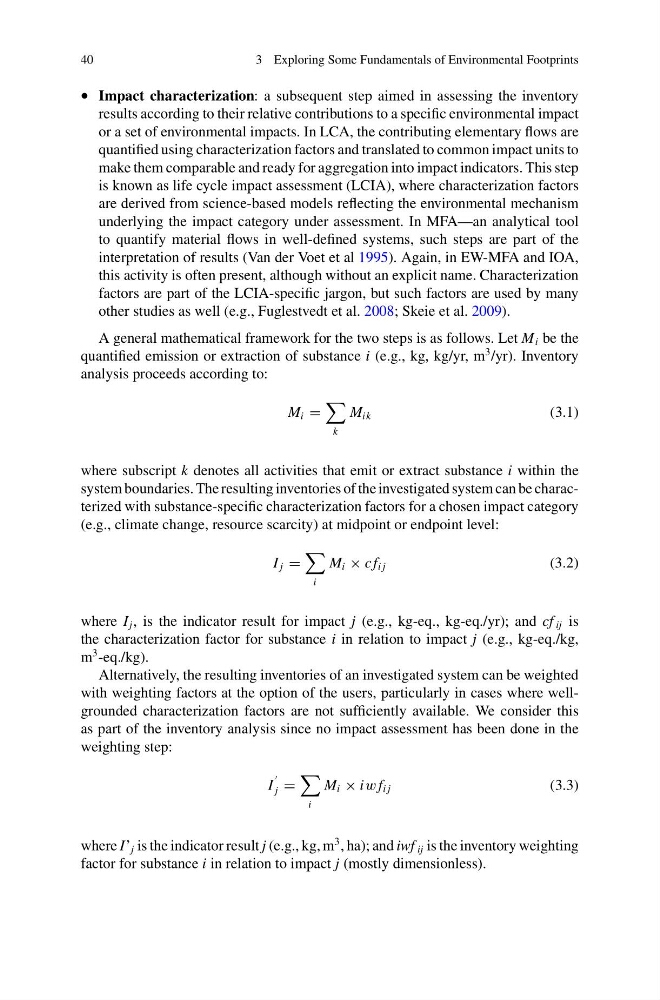
A general mathematical framework for the two steps is as follows. Let M i be the
quantified emission or extraction of substance i (e.g., kg, kg/yr, m
3 /yr). Inventory
analysis proceeds according to:
M i =
k
M ik
(3.1)
where subscript k denotes all activities that emit or extract substance i within the
system boundaries. The resulting inventories of the investigated system can be characterized with substance-specific characterization factors for a chosen impact category
(e.g., climate change, resource scarcity) at midpoint or endpoint level:
I j =
i
M i × c f i j
(3.2)
where I j , is the indicator result for impact j (e.g., kg-eq., kg-eq./yr); and cf ij is
the characterization factor for substance i in relation to impact j (e.g., kg-eq./kg,
m
3 -eq./kg).
Alternatively, the resulting inventories of an investigated system can be weighted
with weighting factors at the option of the users, particularly in cases where wellgrounded characterization factors are not sufficiently available. We consider this
as part of the inventory analysis since no impact assessment has been done in the
weighting step:
I
j =
i
M i × iw f i j
(3.3)
where I’ j is the indicator result j (e.g., kg, m
3 , ha); and iwf ij is the inventory weighting
factor for substance i in relation to impact j (mostly dimensionless).
3 Exploring Some Fundamentals of Environmental Footprints
• Impact characterization: a subsequent step aimed in assessing the inventory
results according to their relative contributions to a specific environmental impact
or a set of environmental impacts. In LCA, the contributing elementary flows are
quantified using characterization factors and translated to common impact units to
make them comparable and ready for aggregation into impact indicators. This step
is known as life cycle impact assessment (LCIA), where characterization factors
are derived from science-based models reflecting the environmental mechanism
underlying the impact category under assessment. In MFA—an analytical tool
to quantify material flows in well-defined systems, such steps are part of the
interpretation of results (Van der Voet et al 1995). Again, in EW-MFA and IOA,
this activity is often present, although without an explicit name. Characterization
factors are part of the LCIA-specific jargon, but such factors are used by many
other studies as well (e.g., Fuglestvedt et al. 2008; Skeie et al. 2009).
A general mathematical framework for the two steps is as follows. Let M i be the
quantified emission or extraction of substance i (e.g., kg, kg/yr, m
3 /yr). Inventory
analysis proceeds according to:
M i =
k
M ik
(3.1)
where subscript k denotes all activities that emit or extract substance i within the
system boundaries. The resulting inventories of the investigated system can be characterized with substance-specific characterization factors for a chosen impact category
(e.g., climate change, resource scarcity) at midpoint or endpoint level:
I j =
i
M i × c f i j
(3.2)
where I j , is the indicator result for impact j (e.g., kg-eq., kg-eq./yr); and cf ij is
the characterization factor for substance i in relation to impact j (e.g., kg-eq./kg,
m
3 -eq./kg).
Alternatively, the resulting inventories of an investigated system can be weighted
with weighting factors at the option of the users, particularly in cases where wellgrounded characterization factors are not sufficiently available. We consider this
as part of the inventory analysis since no impact assessment has been done in the
weighting step:
I
j =
i
M i × iw f i j
(3.3)
where I’ j is the indicator result j (e.g., kg, m
3 , ha); and iwf ij is the inventory weighting
factor for substance i in relation to impact j (mostly dimensionless).