

22
2 A Conceptual Framework for Constituting a Footprint Family
distinguish the green, blue, and gray water components as they should have
held different values for the environment (Hoekstra 2009). The blue water’s
opportunity cost, for instance, is thought to be higher than the green water
(Chapagain et al. 2006a).
2.3.3.3 Methods and Scales
An important aspect to consider is that an environmental footprint measures the
pressure or impact of X on Y, where Y stands for land appropriation, climate change,
virtual water, etc., and X stands for a product, an organization, a country, etc. In
other words, the object and scale of study act as an important contributor to the
methodological options of a given footprint. A full understanding of all of the possible
methods for the four footprints on different scales is, therefore, needed.
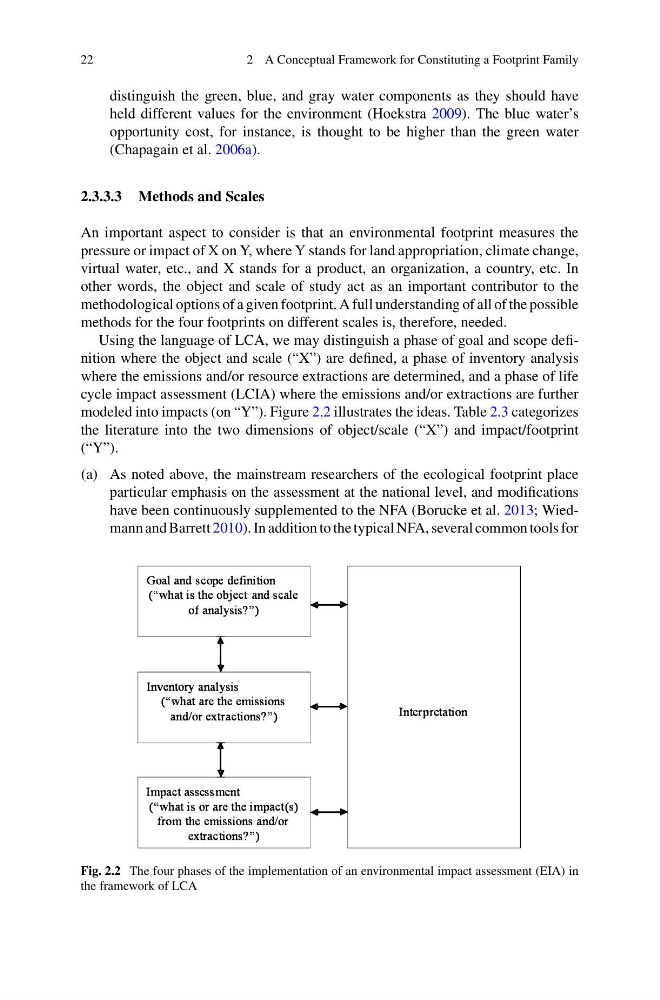
Using the language of LCA, we may distinguish a phase of goal and scope definition where the object and scale (“X”) are defined, a phase of inventory analysis
where the emissions and/or resource extractions are determined, and a phase of life
cycle impact assessment (LCIA) where the emissions and/or extractions are further
modeled into impacts (on “Y”). Figure 2.2 illustrates the ideas. Table 2.3 categorizes
the literature into the two dimensions of object/scale (“X”) and impact/footprint
(“Y”).
(a) As noted above, the mainstream researchers of the ecological footprint place
particular emphasis on the assessment at the national level, and modifications
have been continuously supplemented to the NFA (Borucke et al. 2013; Wiedmann and Barrett 2010). In addition to the typical NFA, several common tools for
Fig. 2.2 The four phases of the implementation of an environmental impact assessment (EIA) in
the framework of LCA
2 A Conceptual Framework for Constituting a Footprint Family
distinguish the green, blue, and gray water components as they should have
held different values for the environment (Hoekstra 2009). The blue water’s
opportunity cost, for instance, is thought to be higher than the green water
(Chapagain et al. 2006a).
2.3.3.3 Methods and Scales
An important aspect to consider is that an environmental footprint measures the
pressure or impact of X on Y, where Y stands for land appropriation, climate change,
virtual water, etc., and X stands for a product, an organization, a country, etc. In
other words, the object and scale of study act as an important contributor to the
methodological options of a given footprint. A full understanding of all of the possible
methods for the four footprints on different scales is, therefore, needed.
Using the language of LCA, we may distinguish a phase of goal and scope definition where the object and scale (“X”) are defined, a phase of inventory analysis
where the emissions and/or resource extractions are determined, and a phase of life
cycle impact assessment (LCIA) where the emissions and/or extractions are further
modeled into impacts (on “Y”). Figure 2.2 illustrates the ideas. Table 2.3 categorizes
the literature into the two dimensions of object/scale (“X”) and impact/footprint
(“Y”).
(a) As noted above, the mainstream researchers of the ecological footprint place
particular emphasis on the assessment at the national level, and modifications
have been continuously supplemented to the NFA (Borucke et al. 2013; Wiedmann and Barrett 2010). In addition to the typical NFA, several common tools for
Fig. 2.2 The four phases of the implementation of an environmental impact assessment (EIA) in
the framework of LCA