

20
2 A Conceptual Framework for Constituting a Footprint Family
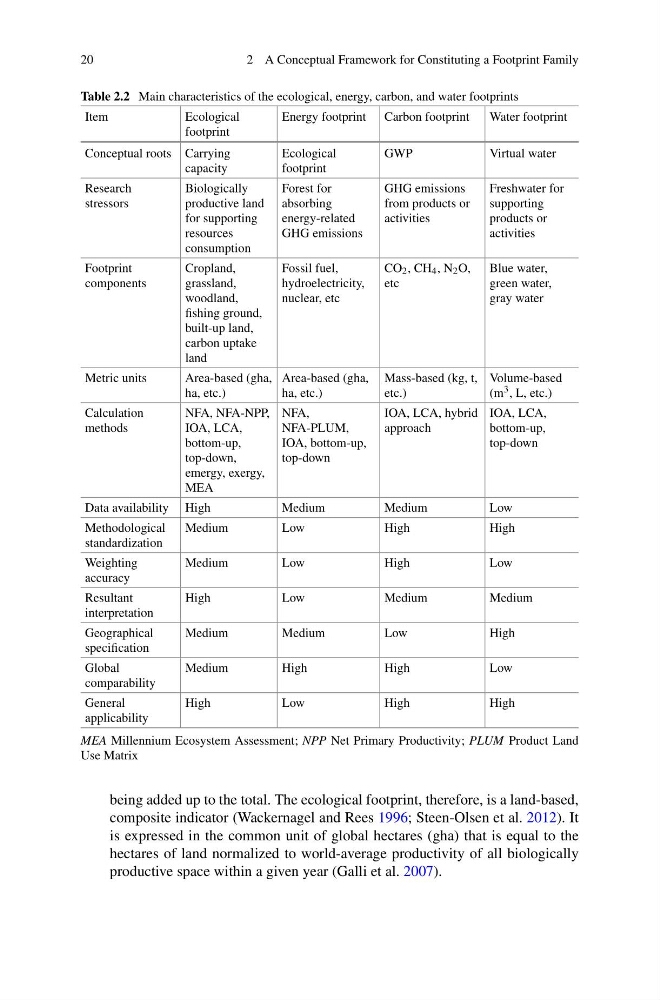
Table 2.2 Main characteristics of the ecological, energy, carbon, and water footprints
Item
Ecological
footprint
Energy footprint Carbon footprint
Water footprint
Conceptual roots Carrying
capacity
Ecological
footprint
GWP
Virtual water
Research
stressors
Biologically
productive land
for supporting
resources
consumption
Forest for
absorbing
energy-related
GHG emissions
GHG emissions
from products or
activities
Freshwater for
supporting
products or
activities
Footprint
components
Cropland,
grassland,
woodland,
fishing ground,
built-up land,
carbon uptake
land
Fossil fuel,
hydroelectricity,
nuclear, etc
CO 2 , CH 4 , N 2 O,
etc
Blue water,
green water,
gray water
Metric units
Area-based (gha,
ha, etc.)
Area-based (gha,
ha, etc.)
Mass-based (kg, t,
etc.)
Volume-based
(m 3 , L, etc.)
Calculation
methods
NFA, NFA-NPP,
IOA, LCA,
bottom-up,
top-down,
emergy, exergy,
MEA
NFA,
NFA-PLUM,
IOA, bottom-up,
top-down
IOA, LCA, hybrid
approach
IOA, LCA,
bottom-up,
top-down
Data availability High
Medium
Medium
Low
Methodological
standardization
Medium
Low
High
High
Weighting
accuracy
Medium
Low
High
Low
Resultant
interpretation
High
Low
Medium
Medium
Geographical
specification
Medium
Medium
Low
High
Global
comparability
Medium
High
High
Low
General
applicability
High
Low
High
High
MEA Millennium Ecosystem Assessment; NPP Net Primary Productivity; PLUM Product Land
Use Matrix
being added up to the total. The ecological footprint, therefore, is a land-based,
composite indicator (Wackernagel and Rees 1996; Steen-Olsen et al. 2012). It
is expressed in the common unit of global hectares (gha) that is equal to the
hectares of land normalized to world-average productivity of all biologically
productive space within a given year (Galli et al. 2007).
2 A Conceptual Framework for Constituting a Footprint Family
Table 2.2 Main characteristics of the ecological, energy, carbon, and water footprints
Item
Ecological
footprint
Energy footprint Carbon footprint
Water footprint
Conceptual roots Carrying
capacity
Ecological
footprint
GWP
Virtual water
Research
stressors
Biologically
productive land
for supporting
resources
consumption
Forest for
absorbing
energy-related
GHG emissions
GHG emissions
from products or
activities
Freshwater for
supporting
products or
activities
Footprint
components
Cropland,
grassland,
woodland,
fishing ground,
built-up land,
carbon uptake
land
Fossil fuel,
hydroelectricity,
nuclear, etc
CO 2 , CH 4 , N 2 O,
etc
Blue water,
green water,
gray water
Metric units
Area-based (gha,
ha, etc.)
Area-based (gha,
ha, etc.)
Mass-based (kg, t,
etc.)
Volume-based
(m 3 , L, etc.)
Calculation
methods
NFA, NFA-NPP,
IOA, LCA,
bottom-up,
top-down,
emergy, exergy,
MEA
NFA,
NFA-PLUM,
IOA, bottom-up,
top-down
IOA, LCA, hybrid
approach
IOA, LCA,
bottom-up,
top-down
Data availability High
Medium
Medium
Low
Methodological
standardization
Medium
Low
High
High
Weighting
accuracy
Medium
Low
High
Low
Resultant
interpretation
High
Low
Medium
Medium
Geographical
specification
Medium
Medium
Low
High
Global
comparability
Medium
High
High
Low
General
applicability
High
Low
High
High
MEA Millennium Ecosystem Assessment; NPP Net Primary Productivity; PLUM Product Land
Use Matrix
being added up to the total. The ecological footprint, therefore, is a land-based,
composite indicator (Wackernagel and Rees 1996; Steen-Olsen et al. 2012). It
is expressed in the common unit of global hectares (gha) that is equal to the
hectares of land normalized to world-average productivity of all biologically
productive space within a given year (Galli et al. 2007).