

2.3 Elaboration of a Footprint Family
17
0
100
200
300
400
500
600
700
800
1992
1994
1996
1998
2000
2002
2004
2006
2008
2010
2012
2014
Number of articles
Ecological footprint
Energy footprint
Carbon footprint
Water footprint
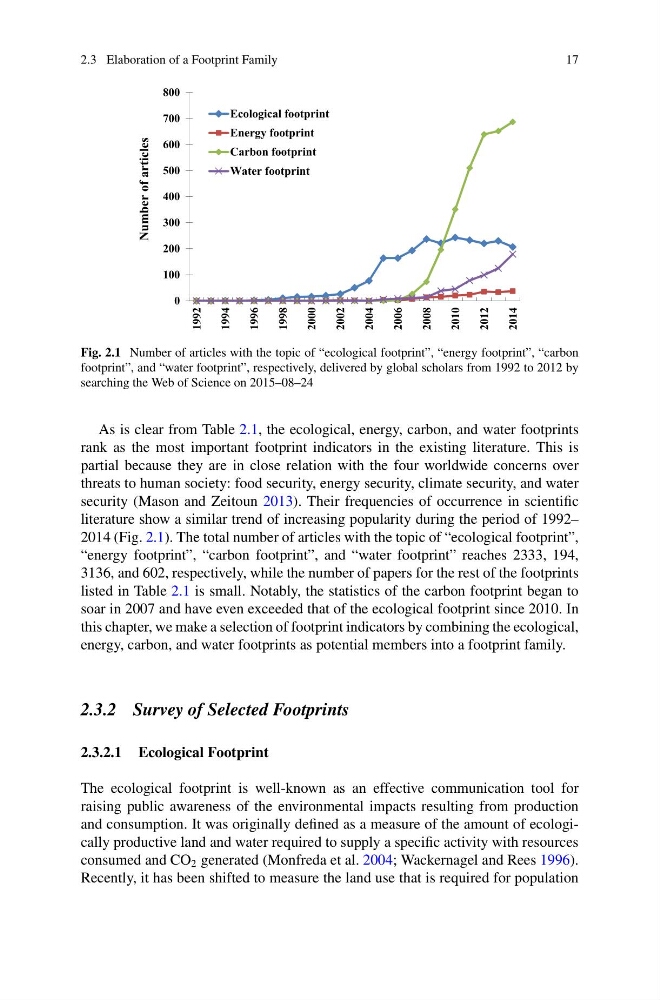
Fig. 2.1 Number of articles with the topic of “ecological footprint”, “energy footprint”, “carbon
footprint”, and “water footprint”, respectively, delivered by global scholars from 1992 to 2012 by
searching the Web of Science on 2015–08–24
As is clear from Table 2.1, the ecological, energy, carbon, and water footprints
rank as the most important footprint indicators in the existing literature. This is
partial because they are in close relation with the four worldwide concerns over
threats to human society: food security, energy security, climate security, and water
security (Mason and Zeitoun 2013). Their frequencies of occurrence in scientific
literature show a similar trend of increasing popularity during the period of 1992–
2014 (Fig. 2.1). The total number of articles with the topic of “ecological footprint”,
“energy footprint”, “carbon footprint”, and “water footprint” reaches 2333, 194,
3136, and 602, respectively, while the number of papers for the rest of the footprints
listed in Table 2.1 is small. Notably, the statistics of the carbon footprint began to
soar in 2007 and have even exceeded that of the ecological footprint since 2010. In
this chapter, we make a selection of footprint indicators by combining the ecological,
energy, carbon, and water footprints as potential members into a footprint family.
2.3.2 Survey of Selected Footprints
2.3.2.1 Ecological Footprint
The ecological footprint is well-known as an effective communication tool for
raising public awareness of the environmental impacts resulting from production
and consumption. It was originally defined as a measure of the amount of ecologically productive land and water required to supply a specific activity with resources
consumed and CO 2 generated (Monfreda et al. 2004; Wackernagel and Rees 1996).
Recently, it has been shifted to measure the land use that is required for population
17
0
100
200
300
400
500
600
700
800
1992
1994
1996
1998
2000
2002
2004
2006
2008
2010
2012
2014
Number of articles
Ecological footprint
Energy footprint
Carbon footprint
Water footprint
Fig. 2.1 Number of articles with the topic of “ecological footprint”, “energy footprint”, “carbon
footprint”, and “water footprint”, respectively, delivered by global scholars from 1992 to 2012 by
searching the Web of Science on 2015–08–24
As is clear from Table 2.1, the ecological, energy, carbon, and water footprints
rank as the most important footprint indicators in the existing literature. This is
partial because they are in close relation with the four worldwide concerns over
threats to human society: food security, energy security, climate security, and water
security (Mason and Zeitoun 2013). Their frequencies of occurrence in scientific
literature show a similar trend of increasing popularity during the period of 1992–
2014 (Fig. 2.1). The total number of articles with the topic of “ecological footprint”,
“energy footprint”, “carbon footprint”, and “water footprint” reaches 2333, 194,
3136, and 602, respectively, while the number of papers for the rest of the footprints
listed in Table 2.1 is small. Notably, the statistics of the carbon footprint began to
soar in 2007 and have even exceeded that of the ecological footprint since 2010. In
this chapter, we make a selection of footprint indicators by combining the ecological,
energy, carbon, and water footprints as potential members into a footprint family.
2.3.2 Survey of Selected Footprints
2.3.2.1 Ecological Footprint
The ecological footprint is well-known as an effective communication tool for
raising public awareness of the environmental impacts resulting from production
and consumption. It was originally defined as a measure of the amount of ecologically productive land and water required to supply a specific activity with resources
consumed and CO 2 generated (Monfreda et al. 2004; Wackernagel and Rees 1996).
Recently, it has been shifted to measure the land use that is required for population