

6.3 Results
103
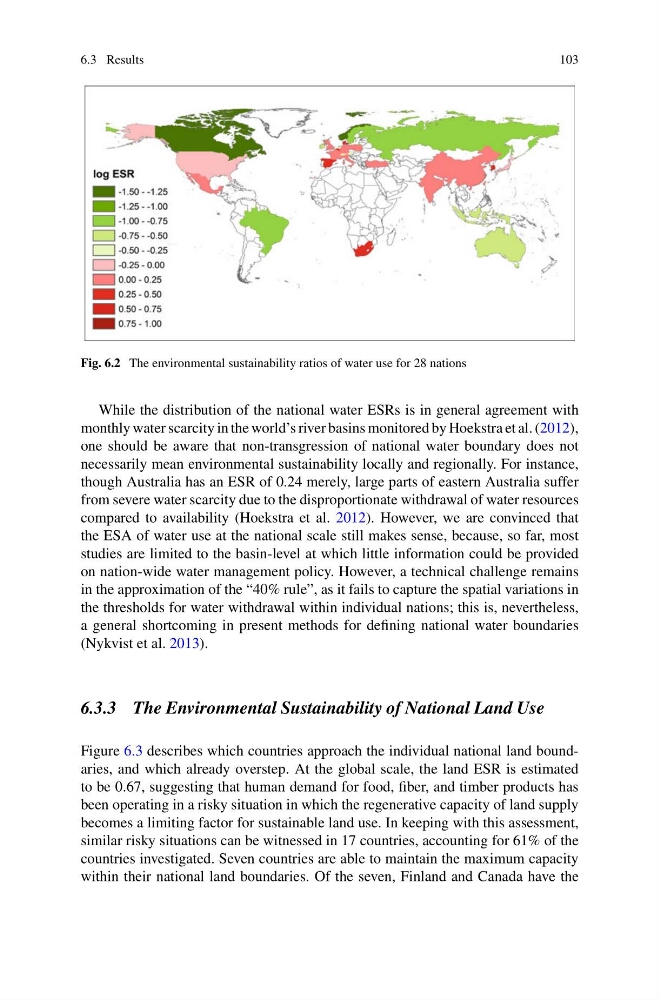
Fig. 6.2 The environmental sustainability ratios of water use for 28 nations
While the distribution of the national water ESRs is in general agreement with
monthly water scarcity in the world’s river basins monitored by Hoekstra et al. (2012),
one should be aware that non-transgression of national water boundary does not
necessarily mean environmental sustainability locally and regionally. For instance,
though Australia has an ESR of 0.24 merely, large parts of eastern Australia suffer
from severe water scarcity due to the disproportionate withdrawal of water resources
compared to availability (Hoekstra et al. 2012). However, we are convinced that
the ESA of water use at the national scale still makes sense, because, so far, most
studies are limited to the basin-level at which little information could be provided
on nation-wide water management policy. However, a technical challenge remains
in the approximation of the “40% rule”, as it fails to capture the spatial variations in
the thresholds for water withdrawal within individual nations; this is, nevertheless,
a general shortcoming in present methods for defining national water boundaries
(Nykvist et al. 2013).
6.3.3 The Environmental Sustainability of National Land Use
Figure 6.3 describes which countries approach the individual national land boundaries, and which already overstep. At the global scale, the land ESR is estimated
to be 0.67, suggesting that human demand for food, fiber, and timber products has
been operating in a risky situation in which the regenerative capacity of land supply
becomes a limiting factor for sustainable land use. In keeping with this assessment,
similar risky situations can be witnessed in 17 countries, accounting for 61% of the
countries investigated. Seven countries are able to maintain the maximum capacity
within their national land boundaries. Of the seven, Finland and Canada have the
103
Fig. 6.2 The environmental sustainability ratios of water use for 28 nations
While the distribution of the national water ESRs is in general agreement with
monthly water scarcity in the world’s river basins monitored by Hoekstra et al. (2012),
one should be aware that non-transgression of national water boundary does not
necessarily mean environmental sustainability locally and regionally. For instance,
though Australia has an ESR of 0.24 merely, large parts of eastern Australia suffer
from severe water scarcity due to the disproportionate withdrawal of water resources
compared to availability (Hoekstra et al. 2012). However, we are convinced that
the ESA of water use at the national scale still makes sense, because, so far, most
studies are limited to the basin-level at which little information could be provided
on nation-wide water management policy. However, a technical challenge remains
in the approximation of the “40% rule”, as it fails to capture the spatial variations in
the thresholds for water withdrawal within individual nations; this is, nevertheless,
a general shortcoming in present methods for defining national water boundaries
(Nykvist et al. 2013).
6.3.3 The Environmental Sustainability of National Land Use
Figure 6.3 describes which countries approach the individual national land boundaries, and which already overstep. At the global scale, the land ESR is estimated
to be 0.67, suggesting that human demand for food, fiber, and timber products has
been operating in a risky situation in which the regenerative capacity of land supply
becomes a limiting factor for sustainable land use. In keeping with this assessment,
similar risky situations can be witnessed in 17 countries, accounting for 61% of the
countries investigated. Seven countries are able to maintain the maximum capacity
within their national land boundaries. Of the seven, Finland and Canada have the