

324
E. Neverova-Dziopak
Trophic
state
Transparency
Suspended solids
рН
BOD
Oxygen content
Saprophyte bacteria
Coli titer
Single-cell protozoa
Microscopic algae
Saprobic index
Species diversity index
Oligo
Mezo
Mezoeutro
Eutro
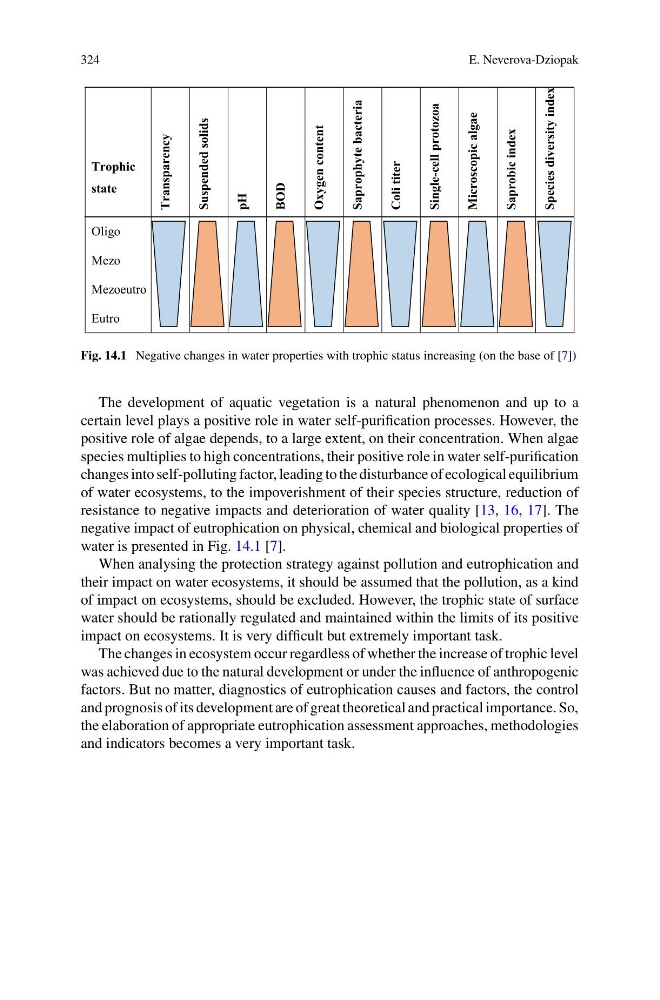
Fig. 14.1 Negative changes in water properties with trophic status increasing (on the base of [7])
The development of aquatic vegetation is a natural phenomenon and up to a
certain level plays a positive role in water self-purification processes. However, the
positive role of algae depends, to a large extent, on their concentration. When algae
species multiplies to high concentrations, their positive role in water self-purification
changes into self-polluting factor, leading to the disturbance of ecological equilibrium
of water ecosystems, to the impoverishment of their species structure, reduction of
resistance to negative impacts and deterioration of water quality [13, 16, 17]. The
negative impact of eutrophication on physical, chemical and biological properties of
water is presented in Fig. 14.1 [7].
When analysing the protection strategy against pollution and eutrophication and
their impact on water ecosystems, it should be assumed that the pollution, as a kind
of impact on ecosystems, should be excluded. However, the trophic state of surface
water should be rationally regulated and maintained within the limits of its positive
impact on ecosystems. It is very difficult but extremely important task.
The changes in ecosystem occur regardless of whether the increase of trophic level
was achieved due to the natural development or under the influence of anthropogenic
factors. But no matter, diagnostics of eutrophication causes and factors, the control
and prognosis of its development are of great theoretical and practical importance. So,
the elaboration of appropriate eutrophication assessment approaches, methodologies
and indicators becomes a very important task.
E. Neverova-Dziopak
Trophic
state
Transparency
Suspended solids
рН
BOD
Oxygen content
Saprophyte bacteria
Coli titer
Single-cell protozoa
Microscopic algae
Saprobic index
Species diversity index
Oligo
Mezo
Mezoeutro
Eutro
Fig. 14.1 Negative changes in water properties with trophic status increasing (on the base of [7])
The development of aquatic vegetation is a natural phenomenon and up to a
certain level plays a positive role in water self-purification processes. However, the
positive role of algae depends, to a large extent, on their concentration. When algae
species multiplies to high concentrations, their positive role in water self-purification
changes into self-polluting factor, leading to the disturbance of ecological equilibrium
of water ecosystems, to the impoverishment of their species structure, reduction of
resistance to negative impacts and deterioration of water quality [13, 16, 17]. The
negative impact of eutrophication on physical, chemical and biological properties of
water is presented in Fig. 14.1 [7].
When analysing the protection strategy against pollution and eutrophication and
their impact on water ecosystems, it should be assumed that the pollution, as a kind
of impact on ecosystems, should be excluded. However, the trophic state of surface
water should be rationally regulated and maintained within the limits of its positive
impact on ecosystems. It is very difficult but extremely important task.
The changes in ecosystem occur regardless of whether the increase of trophic level
was achieved due to the natural development or under the influence of anthropogenic
factors. But no matter, diagnostics of eutrophication causes and factors, the control
and prognosis of its development are of great theoretical and practical importance. So,
the elaboration of appropriate eutrophication assessment approaches, methodologies
and indicators becomes a very important task.