

13 Environmental and Anthropogenic Determinants of Water Chemistry …
303
material [27]. Lowest TDS values are noted for waters flowing through Istebnatype and Godula-type sandstone—rocks that form the westernmost chains of the
Beskidy Mountains (Beskid ´
Sl˛ aski Mountains, Beskid Mały Mountains) as well as
foothills (Pogórze ´
Sl˛ askie Foothills, Pogórze Wielickie Foothills) [23, 27]. The mean
TDS of groundwater in this region oscillates from 180 to 490 mg/L [23]. A slightly
higher TDS is noted for waters found across Magura Beds forming the following five
mountain ranges: Beskid ˙
Zywiecki Mountains, Beskid S˛ adecki Mountains, Beskid
´
Sredni Mountains, Beskid Wyspowy Mountains, and Beskid Niski Mountains. The
mean TDS of these waters ranges in between 151 and 523 mg/L [23]. According
to Kostrakiewicz [23], the highest mean TDS ranges from 221 to 717 mg/L and
occurs in Krosno Beds forming the Bieszczady Mountains as well as the Pogórze
Ci˛ e˙ zkowickie Foothills and Pogórze Dynowskie Foothills. However, according to
case studies by Jasik et al. [11], Lasek [24], Rajda et al. [28], and Małek and Gaw˛ eda
[29] mean TDS and conductivity of groundwater in selected parts of the Beskidy
Mountains usually correspond to the lower extent of TDS and conductivity values
provided by Kostrakiewicz [23]. Furthermore, Siwek et al. [13] and Kisiel et al.
[30] found distinctly lower average TDS and conductivity of spring water in the
Bieszczady Mountains than Kostrakiewicz [23] provided. Numerous case studies of
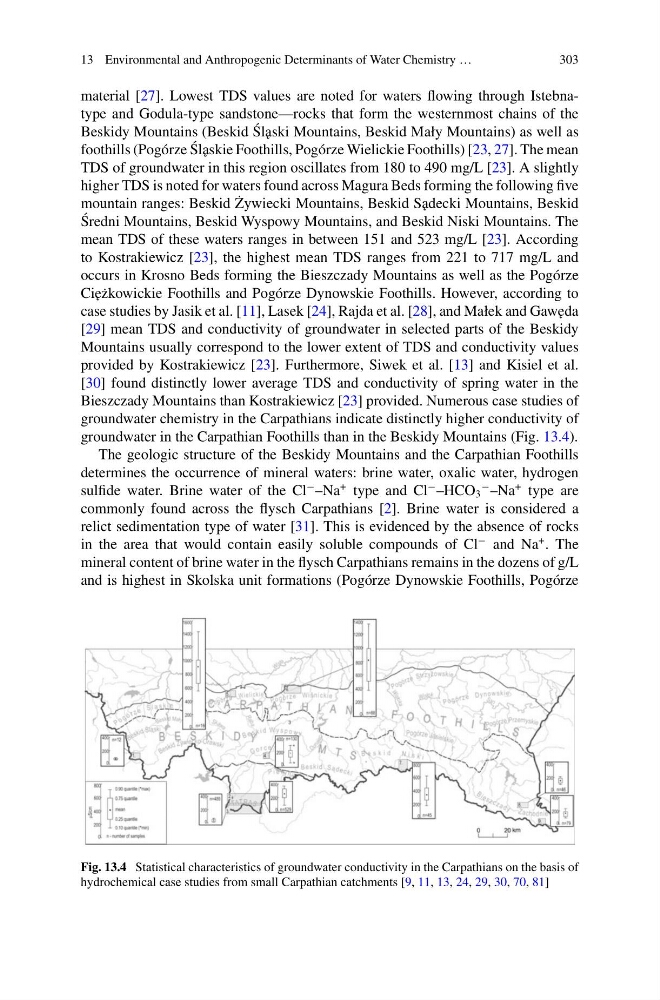
groundwater chemistry in the Carpathians indicate distinctly higher conductivity of
groundwater in the Carpathian Foothills than in the Beskidy Mountains (Fig. 13.4).
The geologic structure of the Beskidy Mountains and the Carpathian Foothills
determines the occurrence of mineral waters: brine water, oxalic water, hydrogen
sulfide water. Brine water of the Cl
− –Na
+ type and Cl
− –HCO 3
− –Na
+ type are
commonly found across the flysch Carpathians [2]. Brine water is considered a
relict sedimentation type of water [31]. This is evidenced by the absence of rocks
in the area that would contain easily soluble compounds of Cl
− and Na
+ . The
mineral content of brine water in the flysch Carpathians remains in the dozens of g/L
and is highest in Skolska unit formations (Pogórze Dynowskie Foothills, Pogórze
Fig. 13.4 Statistical characteristics of groundwater conductivity in the Carpathians on the basis of
hydrochemical case studies from small Carpathian catchments [9, 11, 13, 24, 29, 30, 70, 81]
303
material [27]. Lowest TDS values are noted for waters flowing through Istebnatype and Godula-type sandstone—rocks that form the westernmost chains of the
Beskidy Mountains (Beskid ´
Sl˛ aski Mountains, Beskid Mały Mountains) as well as
foothills (Pogórze ´
Sl˛ askie Foothills, Pogórze Wielickie Foothills) [23, 27]. The mean
TDS of groundwater in this region oscillates from 180 to 490 mg/L [23]. A slightly
higher TDS is noted for waters found across Magura Beds forming the following five
mountain ranges: Beskid ˙
Zywiecki Mountains, Beskid S˛ adecki Mountains, Beskid
´
Sredni Mountains, Beskid Wyspowy Mountains, and Beskid Niski Mountains. The
mean TDS of these waters ranges in between 151 and 523 mg/L [23]. According
to Kostrakiewicz [23], the highest mean TDS ranges from 221 to 717 mg/L and
occurs in Krosno Beds forming the Bieszczady Mountains as well as the Pogórze
Ci˛ e˙ zkowickie Foothills and Pogórze Dynowskie Foothills. However, according to
case studies by Jasik et al. [11], Lasek [24], Rajda et al. [28], and Małek and Gaw˛ eda
[29] mean TDS and conductivity of groundwater in selected parts of the Beskidy
Mountains usually correspond to the lower extent of TDS and conductivity values
provided by Kostrakiewicz [23]. Furthermore, Siwek et al. [13] and Kisiel et al.
[30] found distinctly lower average TDS and conductivity of spring water in the
Bieszczady Mountains than Kostrakiewicz [23] provided. Numerous case studies of
groundwater chemistry in the Carpathians indicate distinctly higher conductivity of
groundwater in the Carpathian Foothills than in the Beskidy Mountains (Fig. 13.4).
The geologic structure of the Beskidy Mountains and the Carpathian Foothills
determines the occurrence of mineral waters: brine water, oxalic water, hydrogen
sulfide water. Brine water of the Cl
− –Na
+ type and Cl
− –HCO 3
− –Na
+ type are
commonly found across the flysch Carpathians [2]. Brine water is considered a
relict sedimentation type of water [31]. This is evidenced by the absence of rocks
in the area that would contain easily soluble compounds of Cl
− and Na
+ . The
mineral content of brine water in the flysch Carpathians remains in the dozens of g/L
and is highest in Skolska unit formations (Pogórze Dynowskie Foothills, Pogórze
Fig. 13.4 Statistical characteristics of groundwater conductivity in the Carpathians on the basis of
hydrochemical case studies from small Carpathian catchments [9, 11, 13, 24, 29, 30, 70, 81]