

270
M. Habel et al.
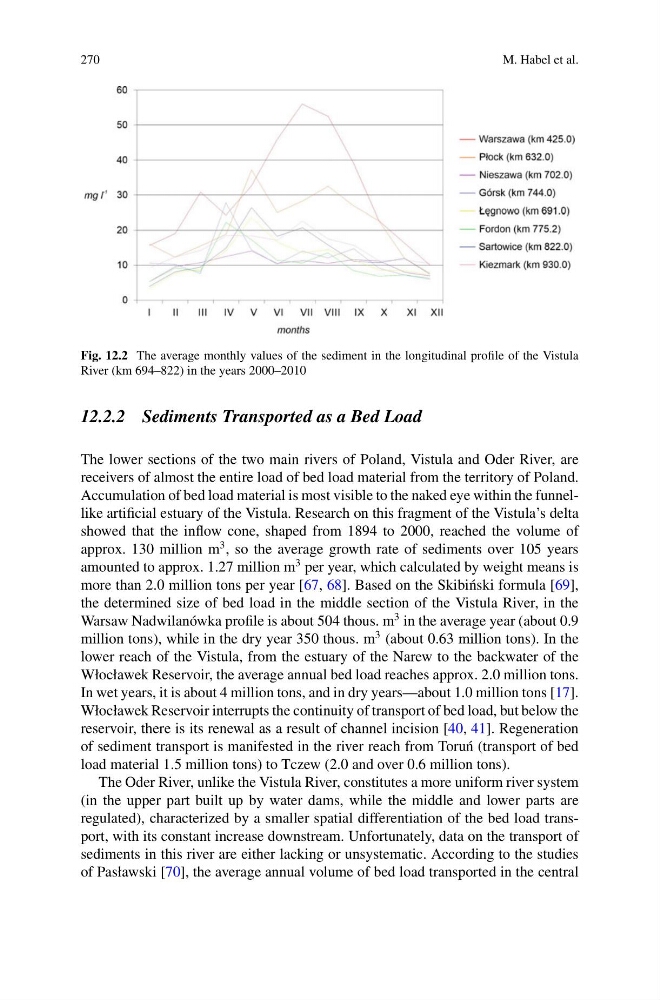
Fig. 12.2 The average monthly values of the sediment in the longitudinal profile of the Vistula
River (km 694–822) in the years 2000–2010
12.2.2 Sediments Transported as a Bed Load
The lower sections of the two main rivers of Poland, Vistula and Oder River, are
receivers of almost the entire load of bed load material from the territory of Poland.
Accumulation of bed load material is most visible to the naked eye within the funnellike artificial estuary of the Vistula. Research on this fragment of the Vistula’s delta
showed that the inflow cone, shaped from 1894 to 2000, reached the volume of
approx. 130 million m
3 , so the average growth rate of sediments over 105 years
amounted to approx. 1.27 million m
3 per year, which calculated by weight means is
more than 2.0 million tons per year [67, 68]. Based on the Skibi´ nski formula [69],
the determined size of bed load in the middle section of the Vistula River, in the
Warsaw Nadwilanówka profile is about 504 thous. m
3 in the average year (about 0.9
million tons), while in the dry year 350 thous. m
3 (about 0.63 million tons). In the
lower reach of the Vistula, from the estuary of the Narew to the backwater of the
Włocławek Reservoir, the average annual bed load reaches approx. 2.0 million tons.
In wet years, it is about 4 million tons, and in dry years—about 1.0 million tons [17].
Włocławek Reservoir interrupts the continuity of transport of bed load, but below the
reservoir, there is its renewal as a result of channel incision [40, 41]. Regeneration
of sediment transport is manifested in the river reach from Toru´ n (transport of bed
load material 1.5 million tons) to Tczew (2.0 and over 0.6 million tons).
The Oder River, unlike the Vistula River, constitutes a more uniform river system
(in the upper part built up by water dams, while the middle and lower parts are
regulated), characterized by a smaller spatial differentiation of the bed load transport, with its constant increase downstream. Unfortunately, data on the transport of
sediments in this river are either lacking or unsystematic. According to the studies
of Pasławski [70], the average annual volume of bed load transported in the central
M. Habel et al.
Fig. 12.2 The average monthly values of the sediment in the longitudinal profile of the Vistula
River (km 694–822) in the years 2000–2010
12.2.2 Sediments Transported as a Bed Load
The lower sections of the two main rivers of Poland, Vistula and Oder River, are
receivers of almost the entire load of bed load material from the territory of Poland.
Accumulation of bed load material is most visible to the naked eye within the funnellike artificial estuary of the Vistula. Research on this fragment of the Vistula’s delta
showed that the inflow cone, shaped from 1894 to 2000, reached the volume of
approx. 130 million m
3 , so the average growth rate of sediments over 105 years
amounted to approx. 1.27 million m
3 per year, which calculated by weight means is
more than 2.0 million tons per year [67, 68]. Based on the Skibi´ nski formula [69],
the determined size of bed load in the middle section of the Vistula River, in the
Warsaw Nadwilanówka profile is about 504 thous. m
3 in the average year (about 0.9
million tons), while in the dry year 350 thous. m
3 (about 0.63 million tons). In the
lower reach of the Vistula, from the estuary of the Narew to the backwater of the
Włocławek Reservoir, the average annual bed load reaches approx. 2.0 million tons.
In wet years, it is about 4 million tons, and in dry years—about 1.0 million tons [17].
Włocławek Reservoir interrupts the continuity of transport of bed load, but below the
reservoir, there is its renewal as a result of channel incision [40, 41]. Regeneration
of sediment transport is manifested in the river reach from Toru´ n (transport of bed
load material 1.5 million tons) to Tczew (2.0 and over 0.6 million tons).
The Oder River, unlike the Vistula River, constitutes a more uniform river system
(in the upper part built up by water dams, while the middle and lower parts are
regulated), characterized by a smaller spatial differentiation of the bed load transport, with its constant increase downstream. Unfortunately, data on the transport of
sediments in this river are either lacking or unsystematic. According to the studies
of Pasławski [70], the average annual volume of bed load transported in the central