

6 Quality Assessment of Water Resources of River in Poland
125
pollutants from the Gda´ nsk industrial zone. In the rivers of the Przemsza and Kłodnica
catchments, the high SEC is caused by the inflow of mining discharge waters loaded
above all with significant levels of chlorides and sulphates. These catchments contain
the most industrialised areas in Poland, with mining, metallurgical and chemical
industries. High contents of the main ions is also a feature of river catchments with
intensive farming in the Wielkopolska and Kujawia regions. The lowest levels of
dissolved mineral substances are seen in rivers in mountain and foothill catchments
(Mała Wisła and Biała, Soła [170 µS/cm], Skawa, Dunajec, Nysa Kłodzka) and in
sandy areas with high proportions of forest (e.g. Bóbr, Liswarta, Drawa, Gwda, Pisa,
Tanew, Lubaczówka).
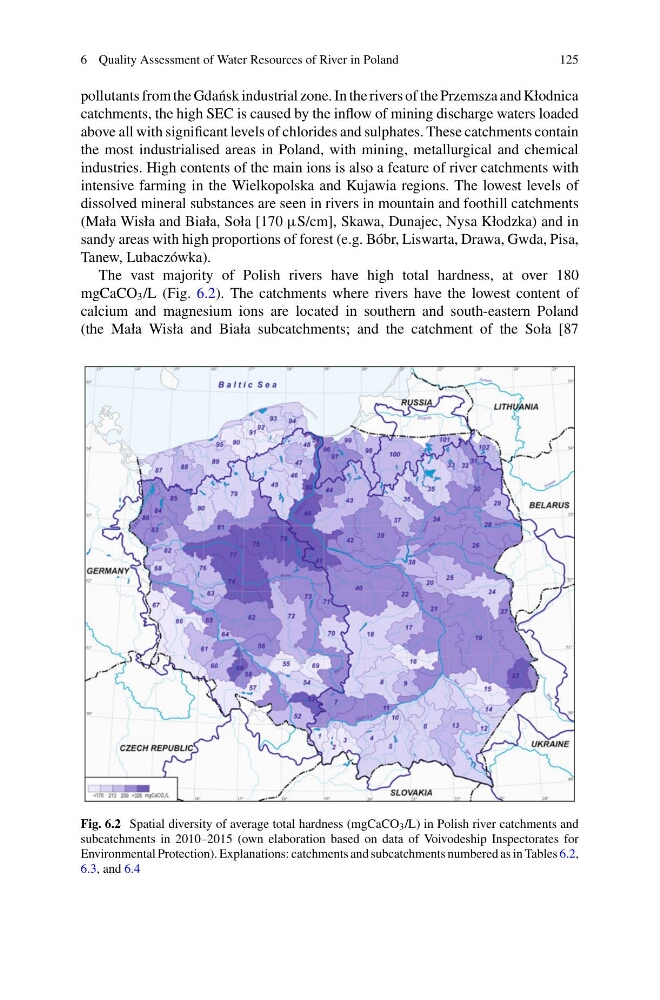
The vast majority of Polish rivers have high total hardness, at over 180
mgCaCO 3 /L (Fig. 6.2). The catchments where rivers have the lowest content of
calcium and magnesium ions are located in southern and south-eastern Poland
(the Mała Wisła and Biała subcatchments; and the catchment of the Soła [87
Fig. 6.2 Spatial diversity of average total hardness (mgCaCO 3 /L) in Polish river catchments and
subcatchments in 2010–2015 (own elaboration based on data of Voivodeship Inspectorates for
Environmental Protection). Explanations: catchments and subcatchments numbered as in Tables 6.2,
6.3, and 6.4
125
pollutants from the Gda´ nsk industrial zone. In the rivers of the Przemsza and Kłodnica
catchments, the high SEC is caused by the inflow of mining discharge waters loaded
above all with significant levels of chlorides and sulphates. These catchments contain
the most industrialised areas in Poland, with mining, metallurgical and chemical
industries. High contents of the main ions is also a feature of river catchments with
intensive farming in the Wielkopolska and Kujawia regions. The lowest levels of
dissolved mineral substances are seen in rivers in mountain and foothill catchments
(Mała Wisła and Biała, Soła [170 µS/cm], Skawa, Dunajec, Nysa Kłodzka) and in
sandy areas with high proportions of forest (e.g. Bóbr, Liswarta, Drawa, Gwda, Pisa,
Tanew, Lubaczówka).
The vast majority of Polish rivers have high total hardness, at over 180
mgCaCO 3 /L (Fig. 6.2). The catchments where rivers have the lowest content of
calcium and magnesium ions are located in southern and south-eastern Poland
(the Mała Wisła and Biała subcatchments; and the catchment of the Soła [87
Fig. 6.2 Spatial diversity of average total hardness (mgCaCO 3 /L) in Polish river catchments and
subcatchments in 2010–2015 (own elaboration based on data of Voivodeship Inspectorates for
Environmental Protection). Explanations: catchments and subcatchments numbered as in Tables 6.2,
6.3, and 6.4