

5 Irrigation and Drainage in Polish Agriculture …
103
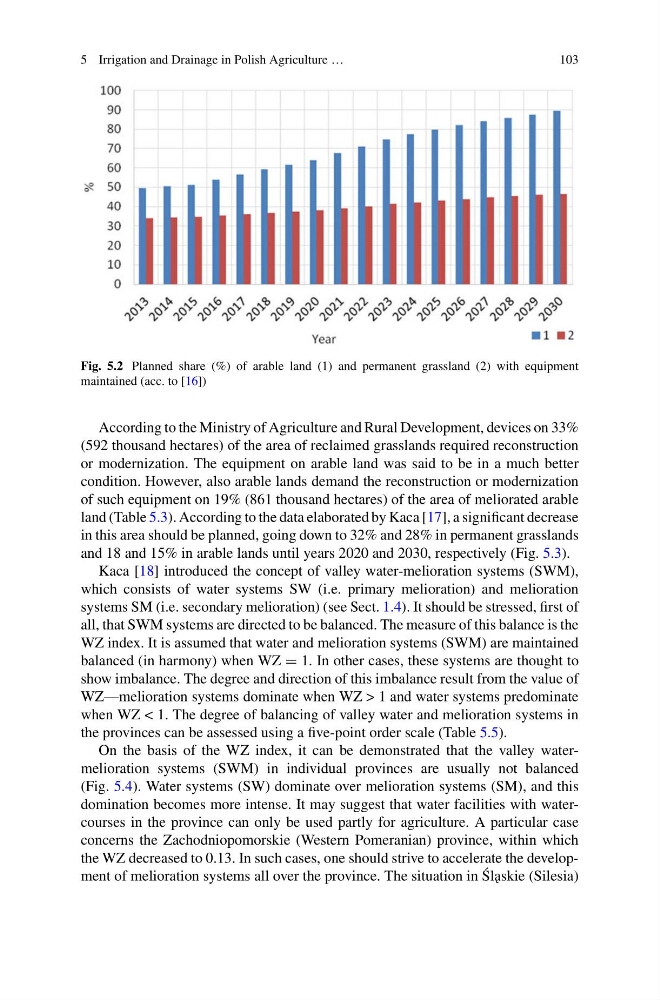
Fig. 5.2 Planned share (%) of arable land (1) and permanent grassland (2) with equipment
maintained (acc. to [16])
According to the Ministry of Agriculture and Rural Development, devices on 33%
(592 thousand hectares) of the area of reclaimed grasslands required reconstruction
or modernization. The equipment on arable land was said to be in a much better
condition. However, also arable lands demand the reconstruction or modernization
of such equipment on 19% (861 thousand hectares) of the area of meliorated arable
land (Table 5.3). According to the data elaborated by Kaca [17], a significant decrease
in this area should be planned, going down to 32% and 28% in permanent grasslands
and 18 and 15% in arable lands until years 2020 and 2030, respectively (Fig. 5.3).
Kaca [18] introduced the concept of valley water-melioration systems (SWM),
which consists of water systems SW (i.e. primary melioration) and melioration
systems SM (i.e. secondary melioration) (see Sect. 1.4). It should be stressed, first of
all, that SWM systems are directed to be balanced. The measure of this balance is the
WZ index. It is assumed that water and melioration systems (SWM) are maintained
balanced (in harmony) when WZ = 1. In other cases, these systems are thought to
show imbalance. The degree and direction of this imbalance result from the value of
WZ—melioration systems dominate when WZ > 1 and water systems predominate
when WZ < 1. The degree of balancing of valley water and melioration systems in
the provinces can be assessed using a five-point order scale (Table 5.5).
On the basis of the WZ index, it can be demonstrated that the valley watermelioration systems (SWM) in individual provinces are usually not balanced
(Fig. 5.4). Water systems (SW) dominate over melioration systems (SM), and this
domination becomes more intense. It may suggest that water facilities with watercourses in the province can only be used partly for agriculture. A particular case
concerns the Zachodniopomorskie (Western Pomeranian) province, within which
the WZ decreased to 0.13. In such cases, one should strive to accelerate the development of melioration systems all over the province. The situation in ´
Sl˛ askie (Silesia)
103
Fig. 5.2 Planned share (%) of arable land (1) and permanent grassland (2) with equipment
maintained (acc. to [16])
According to the Ministry of Agriculture and Rural Development, devices on 33%
(592 thousand hectares) of the area of reclaimed grasslands required reconstruction
or modernization. The equipment on arable land was said to be in a much better
condition. However, also arable lands demand the reconstruction or modernization
of such equipment on 19% (861 thousand hectares) of the area of meliorated arable
land (Table 5.3). According to the data elaborated by Kaca [17], a significant decrease
in this area should be planned, going down to 32% and 28% in permanent grasslands
and 18 and 15% in arable lands until years 2020 and 2030, respectively (Fig. 5.3).
Kaca [18] introduced the concept of valley water-melioration systems (SWM),
which consists of water systems SW (i.e. primary melioration) and melioration
systems SM (i.e. secondary melioration) (see Sect. 1.4). It should be stressed, first of
all, that SWM systems are directed to be balanced. The measure of this balance is the
WZ index. It is assumed that water and melioration systems (SWM) are maintained
balanced (in harmony) when WZ = 1. In other cases, these systems are thought to
show imbalance. The degree and direction of this imbalance result from the value of
WZ—melioration systems dominate when WZ > 1 and water systems predominate
when WZ < 1. The degree of balancing of valley water and melioration systems in
the provinces can be assessed using a five-point order scale (Table 5.5).
On the basis of the WZ index, it can be demonstrated that the valley watermelioration systems (SWM) in individual provinces are usually not balanced
(Fig. 5.4). Water systems (SW) dominate over melioration systems (SM), and this
domination becomes more intense. It may suggest that water facilities with watercourses in the province can only be used partly for agriculture. A particular case
concerns the Zachodniopomorskie (Western Pomeranian) province, within which
the WZ decreased to 0.13. In such cases, one should strive to accelerate the development of melioration systems all over the province. The situation in ´
Sl˛ askie (Silesia)