

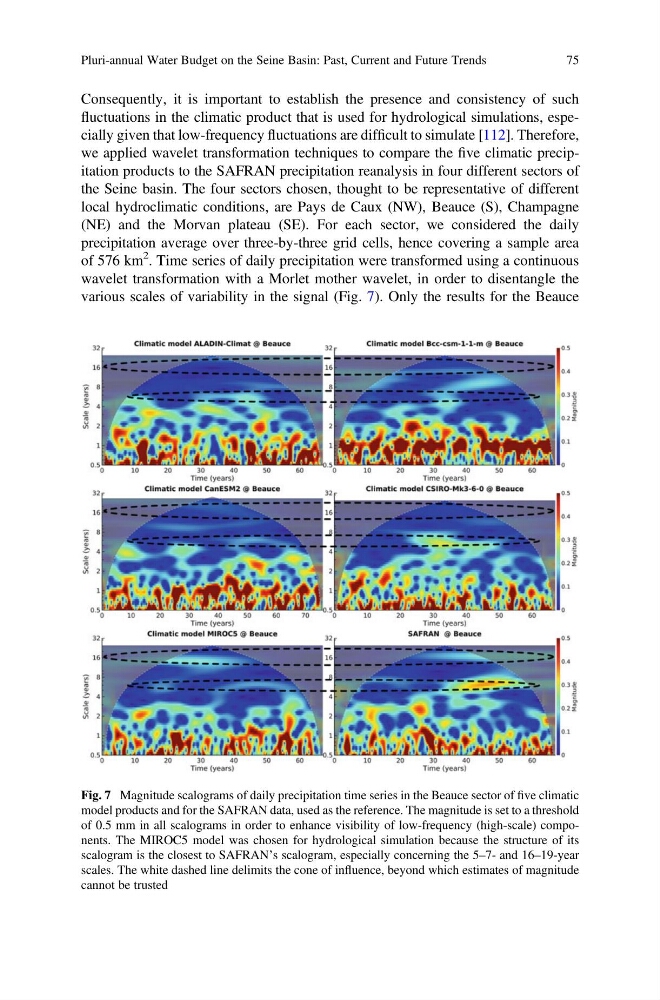
Consequently, it is important to establish the presence and consistency of such
fluctuations in the climatic product that is used for hydrological simulations, especially given that low-frequency fluctuations are difficult to simulate [112]. Therefore,
we applied wavelet transformation techniques to compare the five climatic precipitation products to the SAFRAN precipitation reanalysis in four different sectors of
the Seine basin. The four sectors chosen, thought to be representative of different
local hydroclimatic conditions, are Pays de Caux (NW), Beauce (S), Champagne
(NE) and the Morvan plateau (SE). For each sector, we considered the daily
precipitation average over three-by-three grid cells, hence covering a sample area
of 576 km
2 . Time series of daily precipitation were transformed using a continuous
wavelet transformation with a Morlet mother wavelet, in order to disentangle the
various scales of variability in the signal (Fig. 7). Only the results for the Beauce
Fig. 7 Magnitude scalograms of daily precipitation time series in the Beauce sector of five climatic
model products and for the SAFRAN data, used as the reference. The magnitude is set to a threshold
of 0.5 mm in all scalograms in order to enhance visibility of low-frequency (high-scale) components. The MIROC5 model was chosen for hydrological simulation because the structure of its
scalogram is the closest to SAFRAN’s scalogram, especially concerning the 5–7- and 16–19-year
scales. The white dashed line delimits the cone of influence, beyond which estimates of magnitude
cannot be trusted
Pluri-annual Water Budget on the Seine Basin: Past, Current and Future Trends
75
fluctuations in the climatic product that is used for hydrological simulations, especially given that low-frequency fluctuations are difficult to simulate [112]. Therefore,
we applied wavelet transformation techniques to compare the five climatic precipitation products to the SAFRAN precipitation reanalysis in four different sectors of
the Seine basin. The four sectors chosen, thought to be representative of different
local hydroclimatic conditions, are Pays de Caux (NW), Beauce (S), Champagne
(NE) and the Morvan plateau (SE). For each sector, we considered the daily
precipitation average over three-by-three grid cells, hence covering a sample area
of 576 km
2 . Time series of daily precipitation were transformed using a continuous
wavelet transformation with a Morlet mother wavelet, in order to disentangle the
various scales of variability in the signal (Fig. 7). Only the results for the Beauce
Fig. 7 Magnitude scalograms of daily precipitation time series in the Beauce sector of five climatic
model products and for the SAFRAN data, used as the reference. The magnitude is set to a threshold
of 0.5 mm in all scalograms in order to enhance visibility of low-frequency (high-scale) components. The MIROC5 model was chosen for hydrological simulation because the structure of its
scalogram is the closest to SAFRAN’s scalogram, especially concerning the 5–7- and 16–19-year
scales. The white dashed line delimits the cone of influence, beyond which estimates of magnitude
cannot be trusted
Pluri-annual Water Budget on the Seine Basin: Past, Current and Future Trends
75