

has led to a sharp deterioration in water quality of the limestone groundwater of
Champigny, the main groundwater resource in Île-de-France. Since 2005,
AQUI’Brie, an association of users of the Champigny aquifer, and Irstea researchers
have been developing local initiatives to reduce pesticide flows from drained
agricultural land. Artificial wetlands have been established on agricultural plots as
landscape interfaces with a hydrological buffer function, which improve water
quality parameters [35].
The project consists of a joint evaluation process of these land cover devices on
water quality and the improvement of biodiversity. The challenge of the participatory approach is to create the conditions for dialogue between local actors, particularly those in the agricultural and drinking water sectors. To improve water quality,
two levers for action are placed at the heart of the process: changes in agricultural
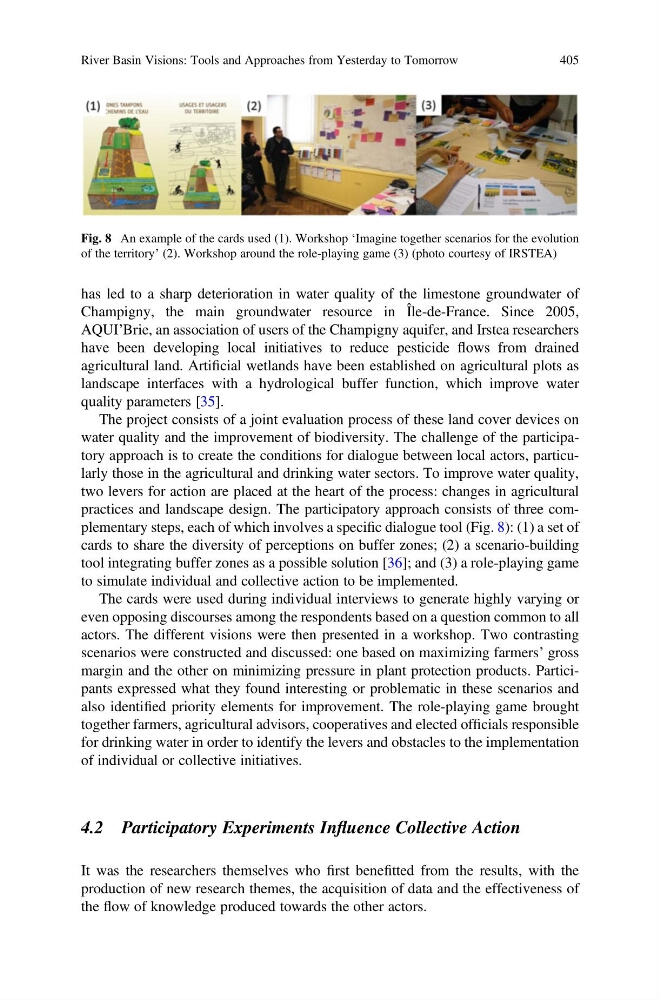
practices and landscape design. The participatory approach consists of three complementary steps, each of which involves a specific dialogue tool (Fig. 8): (1) a set of
cards to share the diversity of perceptions on buffer zones; (2) a scenario-building
tool integrating buffer zones as a possible solution [36]; and (3) a role-playing game
to simulate individual and collective action to be implemented.
The cards were used during individual interviews to generate highly varying or
even opposing discourses among the respondents based on a question common to all
actors. The different visions were then presented in a workshop. Two contrasting
scenarios were constructed and discussed: one based on maximizing farmers’ gross
margin and the other on minimizing pressure in plant protection products. Participants expressed what they found interesting or problematic in these scenarios and
also identified priority elements for improvement. The role-playing game brought
together farmers, agricultural advisors, cooperatives and elected officials responsible
for drinking water in order to identify the levers and obstacles to the implementation
of individual or collective initiatives.
4.2 Participatory Experiments Influence Collective Action
It was the researchers themselves who first benefitted from the results, with the
production of new research themes, the acquisition of data and the effectiveness of
the flow of knowledge produced towards the other actors.
Fig. 8 An example of the cards used (1). Workshop ‘Imagine together scenarios for the evolution
of the territory’ (2). Workshop around the role-playing game (3) (photo courtesy of IRSTEA)
River Basin Visions: Tools and Approaches from Yesterday to Tomorrow
405
Champigny, the main groundwater resource in Île-de-France. Since 2005,
AQUI’Brie, an association of users of the Champigny aquifer, and Irstea researchers
have been developing local initiatives to reduce pesticide flows from drained
agricultural land. Artificial wetlands have been established on agricultural plots as
landscape interfaces with a hydrological buffer function, which improve water
quality parameters [35].
The project consists of a joint evaluation process of these land cover devices on
water quality and the improvement of biodiversity. The challenge of the participatory approach is to create the conditions for dialogue between local actors, particularly those in the agricultural and drinking water sectors. To improve water quality,
two levers for action are placed at the heart of the process: changes in agricultural
practices and landscape design. The participatory approach consists of three complementary steps, each of which involves a specific dialogue tool (Fig. 8): (1) a set of
cards to share the diversity of perceptions on buffer zones; (2) a scenario-building
tool integrating buffer zones as a possible solution [36]; and (3) a role-playing game
to simulate individual and collective action to be implemented.
The cards were used during individual interviews to generate highly varying or
even opposing discourses among the respondents based on a question common to all
actors. The different visions were then presented in a workshop. Two contrasting
scenarios were constructed and discussed: one based on maximizing farmers’ gross
margin and the other on minimizing pressure in plant protection products. Participants expressed what they found interesting or problematic in these scenarios and
also identified priority elements for improvement. The role-playing game brought
together farmers, agricultural advisors, cooperatives and elected officials responsible
for drinking water in order to identify the levers and obstacles to the implementation
of individual or collective initiatives.
4.2 Participatory Experiments Influence Collective Action
It was the researchers themselves who first benefitted from the results, with the
production of new research themes, the acquisition of data and the effectiveness of
the flow of knowledge produced towards the other actors.
Fig. 8 An example of the cards used (1). Workshop ‘Imagine together scenarios for the evolution
of the territory’ (2). Workshop around the role-playing game (3) (photo courtesy of IRSTEA)
River Basin Visions: Tools and Approaches from Yesterday to Tomorrow
405