

their internal and external exchanges of material, and the (physical, chemical,
biological, or social-economic) mechanisms controlling these exchanges. Here
we open the way to a comprehensive and, why not, citizen-oriented way of
practicing science, helping to clarify the societal choices to which we are
confronted to address the threat of global change’ [27].
Two contrasting scenarios have recently been developed by Billen et al.
[28] for 2040. The first one represents a continuation of the current trends of
opening and specialization (O/S scenario) into cropping systems based on
chemically synthesized inputs, as is the case in the Seine basin. The second
explores a shift to autonomy via organic farming and a reconnection of crop
and livestock farming while reducing animal protein in human diets by half,
the so-called demitarian diet (A/R/D scenario). These scenarios both involve
the strict application of regulations on WWTPs.
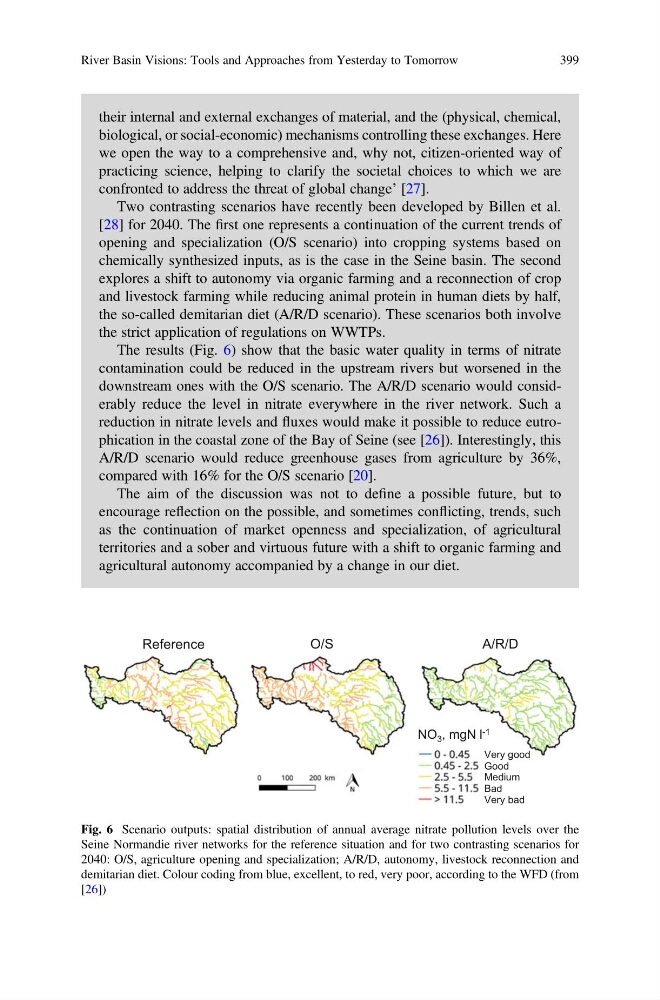
The results (Fig. 6) show that the basic water quality in terms of nitrate
contamination could be reduced in the upstream rivers but worsened in the
downstream ones with the O/S scenario. The A/R/D scenario would considerably reduce the level in nitrate everywhere in the river network. Such a
reduction in nitrate levels and fluxes would make it possible to reduce eutrophication in the coastal zone of the Bay of Seine (see [26]). Interestingly, this
A/R/D scenario would reduce greenhouse gases from agriculture by 36%,
compared with 16% for the O/S scenario [20].
The aim of the discussion was not to define a possible future, but to
encourage reflection on the possible, and sometimes conflicting, trends, such
as the continuation of market openness and specialization, of agricultural
territories and a sober and virtuous future with a shift to organic farming and
agricultural autonomy accompanied by a change in our diet.
NO 3 , mgN l -1
Reference
O/S
A/R/D
Very good
Good
Medium
Bad
Very bad
Fig. 6 Scenario outputs: spatial distribution of annual average nitrate pollution levels over the
Seine Normandie river networks for the reference situation and for two contrasting scenarios for
2040: O/S, agriculture opening and specialization; A/R/D, autonomy, livestock reconnection and
demitarian diet. Colour coding from blue, excellent, to red, very poor, according to the WFD (from
[26])
River Basin Visions: Tools and Approaches from Yesterday to Tomorrow
399
biological, or social-economic) mechanisms controlling these exchanges. Here
we open the way to a comprehensive and, why not, citizen-oriented way of
practicing science, helping to clarify the societal choices to which we are
confronted to address the threat of global change’ [27].
Two contrasting scenarios have recently been developed by Billen et al.
[28] for 2040. The first one represents a continuation of the current trends of
opening and specialization (O/S scenario) into cropping systems based on
chemically synthesized inputs, as is the case in the Seine basin. The second
explores a shift to autonomy via organic farming and a reconnection of crop
and livestock farming while reducing animal protein in human diets by half,
the so-called demitarian diet (A/R/D scenario). These scenarios both involve
the strict application of regulations on WWTPs.
The results (Fig. 6) show that the basic water quality in terms of nitrate
contamination could be reduced in the upstream rivers but worsened in the
downstream ones with the O/S scenario. The A/R/D scenario would considerably reduce the level in nitrate everywhere in the river network. Such a
reduction in nitrate levels and fluxes would make it possible to reduce eutrophication in the coastal zone of the Bay of Seine (see [26]). Interestingly, this
A/R/D scenario would reduce greenhouse gases from agriculture by 36%,
compared with 16% for the O/S scenario [20].
The aim of the discussion was not to define a possible future, but to
encourage reflection on the possible, and sometimes conflicting, trends, such
as the continuation of market openness and specialization, of agricultural
territories and a sober and virtuous future with a shift to organic farming and
agricultural autonomy accompanied by a change in our diet.
NO 3 , mgN l -1
Reference
O/S
A/R/D
Very good
Good
Medium
Bad
Very bad
Fig. 6 Scenario outputs: spatial distribution of annual average nitrate pollution levels over the
Seine Normandie river networks for the reference situation and for two contrasting scenarios for
2040: O/S, agriculture opening and specialization; A/R/D, autonomy, livestock reconnection and
demitarian diet. Colour coding from blue, excellent, to red, very poor, according to the WFD (from
[26])
River Basin Visions: Tools and Approaches from Yesterday to Tomorrow
399