

50 years in the form of scenarios that can be used to support management
decisions. Models and scenarios are conceived and developed in collaboration
with PIREN-Seine partners. Their development has been presented regularly every
year at the partner meetings since 1993. Conceptual models are generally developed to present a synthetic understanding of the society–basin–river evolution and
interaction; their nonnumerical presentation makes them suitable for the communication of scientists’ work to a lay audience. Conceptual and numerical models
are also used in participatory scientific experiments, where they facilitate dialogue
between water users and allow the transfer of scientific knowledge directly to the
local level.
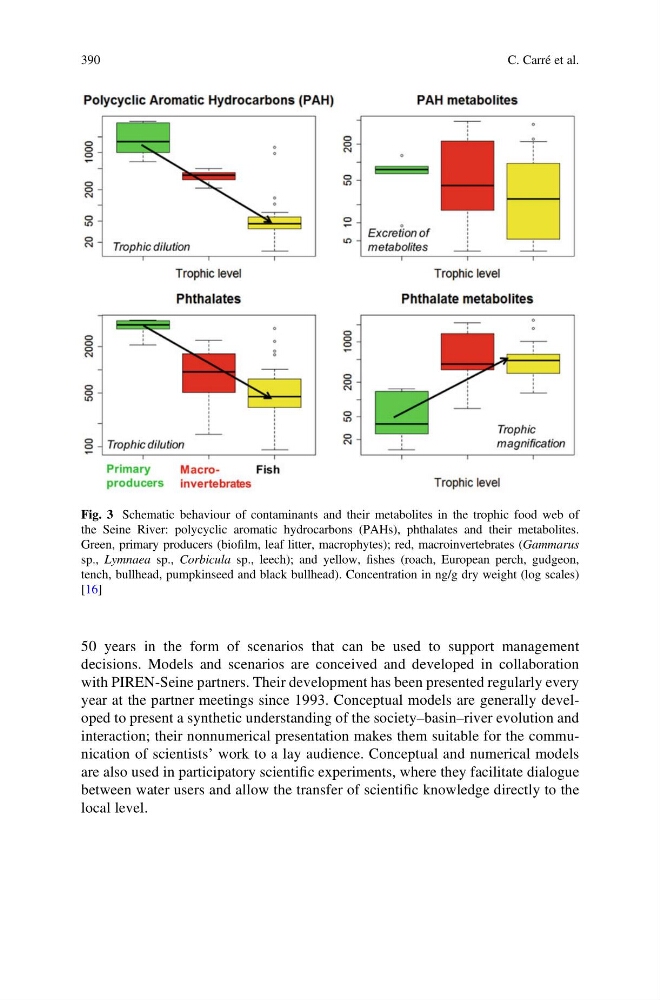
Fig. 3 Schematic behaviour of contaminants and their metabolites in the trophic food web of
the Seine River: polycyclic aromatic hydrocarbons (PAHs), phthalates and their metabolites.
Green, primary producers (biofilm, leaf litter, macrophytes); red, macroinvertebrates (Gammarus
sp., Lymnaea sp., Corbicula sp., leech); and yellow, fishes (roach, European perch, gudgeon,
tench, bullhead, pumpkinseed and black bullhead). Concentration in ng/g dry weight (log scales)
[16]
390
C. Carré et al.
decisions. Models and scenarios are conceived and developed in collaboration
with PIREN-Seine partners. Their development has been presented regularly every
year at the partner meetings since 1993. Conceptual models are generally developed to present a synthetic understanding of the society–basin–river evolution and
interaction; their nonnumerical presentation makes them suitable for the communication of scientists’ work to a lay audience. Conceptual and numerical models
are also used in participatory scientific experiments, where they facilitate dialogue
between water users and allow the transfer of scientific knowledge directly to the
local level.
Fig. 3 Schematic behaviour of contaminants and their metabolites in the trophic food web of
the Seine River: polycyclic aromatic hydrocarbons (PAHs), phthalates and their metabolites.
Green, primary producers (biofilm, leaf litter, macrophytes); red, macroinvertebrates (Gammarus
sp., Lymnaea sp., Corbicula sp., leech); and yellow, fishes (roach, European perch, gudgeon,
tench, bullhead, pumpkinseed and black bullhead). Concentration in ng/g dry weight (log scales)
[16]
390
C. Carré et al.