

2.2 Transforming Field and Laboratory Data into
an Understanding of System Functioning
Targeted field studies make it possible to construct the hydrological, sedimentary
and biogeochemical dynamics of the river along the stream order hierarchy and
separate diffuse and point sources of material, natural and anthropogenic sources.
These measurements contribute to the knowledge of the biogeochemical processes
by examining the transfers between the different compartments of the Seine system
and the transit times along the fluvial continuum.
2.2.1 Basic Processes and Their Controlling Factors
The river system is conceptualized first by a set of reservoirs (soil, plant, atmosphere,
unsaturated zone, aquifers, river network) between which the material (gas, solute
and particulate) is exchanged and transported (e.g. water, carbon, nitrogen). Once in
the water runoff and/or in groundwaters, this material is routed from one stream
order to the next and is exposed to another set of physical and biogeochemical
processes (e.g. algal production, bacterial respiration, deposition/resuspension,
solute–particulate exchange). Scientists measure amount in the environment, as
well as rates, from which they can derive the main process parameters, which may
vary spatially and temporally within the basin. These parameters integrated into
conceptual frameworks are then used in the modelling at the basin scale
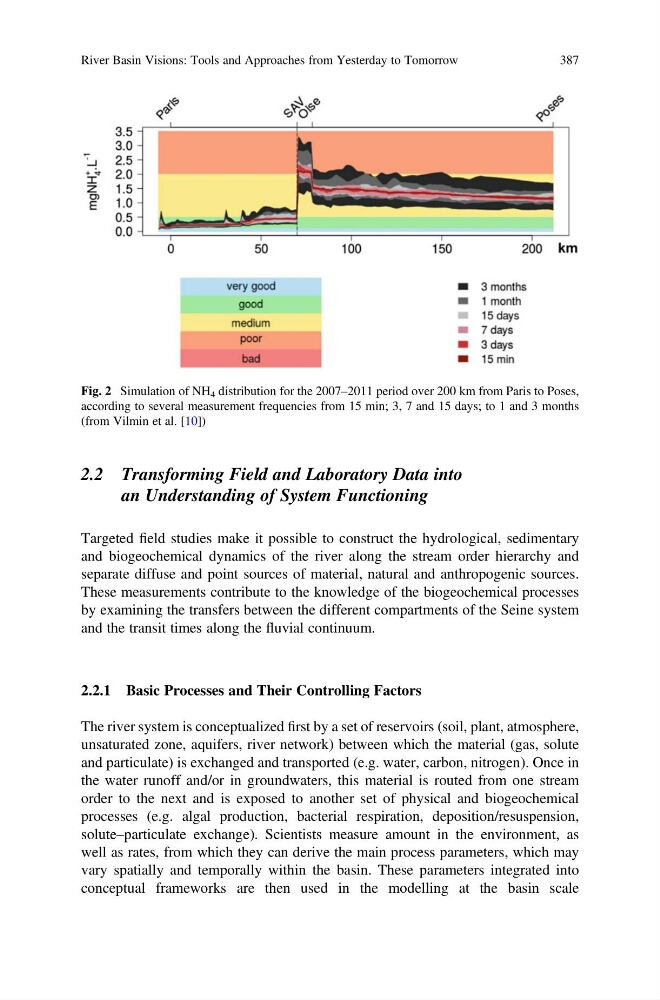
Fig. 2 Simulation of NH 4 distribution for the 2007–2011 period over 200 km from Paris to Poses,
according to several measurement frequencies from 15 min; 3, 7 and 15 days; to 1 and 3 months
(from Vilmin et al. [10])
River Basin Visions: Tools and Approaches from Yesterday to Tomorrow
387
an Understanding of System Functioning
Targeted field studies make it possible to construct the hydrological, sedimentary
and biogeochemical dynamics of the river along the stream order hierarchy and
separate diffuse and point sources of material, natural and anthropogenic sources.
These measurements contribute to the knowledge of the biogeochemical processes
by examining the transfers between the different compartments of the Seine system
and the transit times along the fluvial continuum.
2.2.1 Basic Processes and Their Controlling Factors
The river system is conceptualized first by a set of reservoirs (soil, plant, atmosphere,
unsaturated zone, aquifers, river network) between which the material (gas, solute
and particulate) is exchanged and transported (e.g. water, carbon, nitrogen). Once in
the water runoff and/or in groundwaters, this material is routed from one stream
order to the next and is exposed to another set of physical and biogeochemical
processes (e.g. algal production, bacterial respiration, deposition/resuspension,
solute–particulate exchange). Scientists measure amount in the environment, as
well as rates, from which they can derive the main process parameters, which may
vary spatially and temporally within the basin. These parameters integrated into
conceptual frameworks are then used in the modelling at the basin scale
Fig. 2 Simulation of NH 4 distribution for the 2007–2011 period over 200 km from Paris to Poses,
according to several measurement frequencies from 15 min; 3, 7 and 15 days; to 1 and 3 months
(from Vilmin et al. [10])
River Basin Visions: Tools and Approaches from Yesterday to Tomorrow
387