

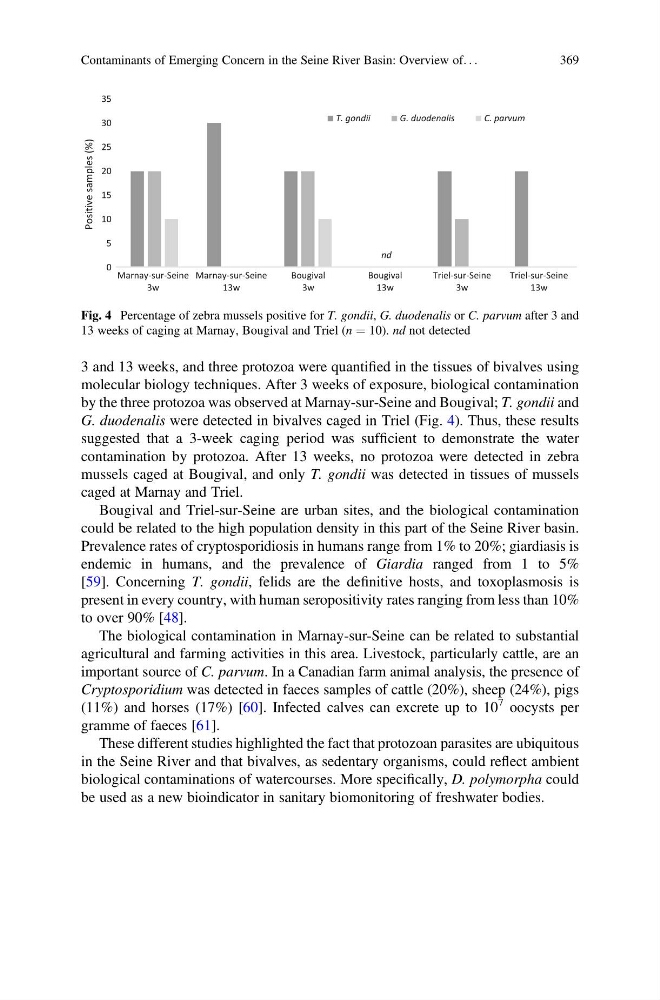
3 and 13 weeks, and three protozoa were quantified in the tissues of bivalves using
molecular biology techniques. After 3 weeks of exposure, biological contamination
by the three protozoa was observed at Marnay-sur-Seine and Bougival; T. gondii and
G. duodenalis were detected in bivalves caged in Triel (Fig. 4). Thus, these results
suggested that a 3-week caging period was sufficient to demonstrate the water
contamination by protozoa. After 13 weeks, no protozoa were detected in zebra
mussels caged at Bougival, and only T. gondii was detected in tissues of mussels
caged at Marnay and Triel.
Bougival and Triel-sur-Seine are urban sites, and the biological contamination
could be related to the high population density in this part of the Seine River basin.
Prevalence rates of cryptosporidiosis in humans range from 1% to 20%; giardiasis is
endemic in humans, and the prevalence of Giardia ranged from 1 to 5%
[59]. Concerning T. gondii, felids are the definitive hosts, and toxoplasmosis is
present in every country, with human seropositivity rates ranging from less than 10%
to over 90% [48].
The biological contamination in Marnay-sur-Seine can be related to substantial
agricultural and farming activities in this area. Livestock, particularly cattle, are an
important source of C. parvum. In a Canadian farm animal analysis, the presence of
Cryptosporidium was detected in faeces samples of cattle (20%), sheep (24%), pigs
(11%) and horses (17%) [60]. Infected calves can excrete up to 10
7 oocysts per
gramme of faeces [61].
These different studies highlighted the fact that protozoan parasites are ubiquitous
in the Seine River and that bivalves, as sedentary organisms, could reflect ambient
biological contaminations of watercourses. More specifically, D. polymorpha could
be used as a new bioindicator in sanitary biomonitoring of freshwater bodies.
0
5
10
15
20
25
30
35
Marnay-sur-Seine
3w
Marnay-sur-Seine
13w
Bougival
3w
Bougival
13w
Triel-sur-Seine
3w
Triel-sur-Seine
13w
T. gondii
G. duodenalis
C. parvum
nd
Positive samples (%)
Fig. 4 Percentage of zebra mussels positive for T. gondii, G. duodenalis or C. parvum after 3 and
13 weeks of caging at Marnay, Bougival and Triel (n ¼ 10). nd not detected
Contaminants of Emerging Concern in the Seine River Basin: Overview of. . .
369
molecular biology techniques. After 3 weeks of exposure, biological contamination
by the three protozoa was observed at Marnay-sur-Seine and Bougival; T. gondii and
G. duodenalis were detected in bivalves caged in Triel (Fig. 4). Thus, these results
suggested that a 3-week caging period was sufficient to demonstrate the water
contamination by protozoa. After 13 weeks, no protozoa were detected in zebra
mussels caged at Bougival, and only T. gondii was detected in tissues of mussels
caged at Marnay and Triel.
Bougival and Triel-sur-Seine are urban sites, and the biological contamination
could be related to the high population density in this part of the Seine River basin.
Prevalence rates of cryptosporidiosis in humans range from 1% to 20%; giardiasis is
endemic in humans, and the prevalence of Giardia ranged from 1 to 5%
[59]. Concerning T. gondii, felids are the definitive hosts, and toxoplasmosis is
present in every country, with human seropositivity rates ranging from less than 10%
to over 90% [48].
The biological contamination in Marnay-sur-Seine can be related to substantial
agricultural and farming activities in this area. Livestock, particularly cattle, are an
important source of C. parvum. In a Canadian farm animal analysis, the presence of
Cryptosporidium was detected in faeces samples of cattle (20%), sheep (24%), pigs
(11%) and horses (17%) [60]. Infected calves can excrete up to 10
7 oocysts per
gramme of faeces [61].
These different studies highlighted the fact that protozoan parasites are ubiquitous
in the Seine River and that bivalves, as sedentary organisms, could reflect ambient
biological contaminations of watercourses. More specifically, D. polymorpha could
be used as a new bioindicator in sanitary biomonitoring of freshwater bodies.
0
5
10
15
20
25
30
35
Marnay-sur-Seine
3w
Marnay-sur-Seine
13w
Bougival
3w
Bougival
13w
Triel-sur-Seine
3w
Triel-sur-Seine
13w
T. gondii
G. duodenalis
C. parvum
nd
Positive samples (%)
Fig. 4 Percentage of zebra mussels positive for T. gondii, G. duodenalis or C. parvum after 3 and
13 weeks of caging at Marnay, Bougival and Triel (n ¼ 10). nd not detected
Contaminants of Emerging Concern in the Seine River Basin: Overview of. . .
369