

the molecular pattern (>50% of ∑PFASs), in agreement with profiles commonly
reported for aquatic wildlife [40]. It can be speculated that PFASs were not only
absorbed at the biofilm cell surface, but that they may also have been incorporated
within the extracellular polymeric matrix or undergo intracellular accumulation
[41]. These results imply that periphyton may constitute a key entry point for
PFASs at the base of riverine food webs and a major source of PFASs for grazers.
The bioconcentration factor (BCF) is a useful metric to assess the
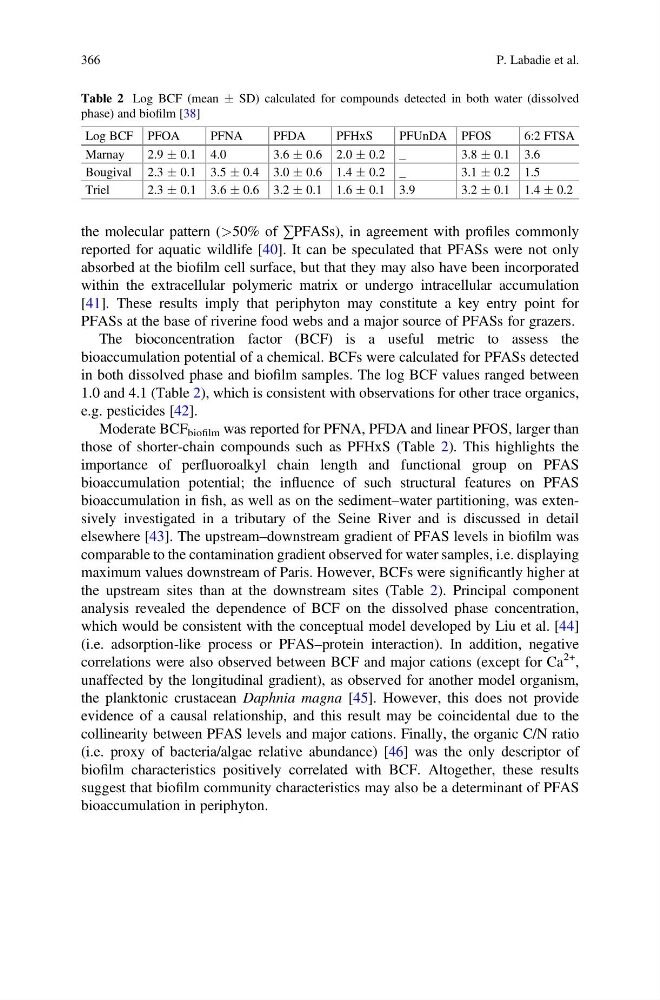
bioaccumulation potential of a chemical. BCFs were calculated for PFASs detected
in both dissolved phase and biofilm samples. The log BCF values ranged between
1.0 and 4.1 (Table 2), which is consistent with observations for other trace organics,
e.g. pesticides [42].
Moderate BCF biofilm was reported for PFNA, PFDA and linear PFOS, larger than
those of shorter-chain compounds such as PFHxS (Table 2). This highlights the
importance of perfluoroalkyl chain length and functional group on PFAS
bioaccumulation potential; the influence of such structural features on PFAS
bioaccumulation in fish, as well as on the sediment–water partitioning, was extensively investigated in a tributary of the Seine River and is discussed in detail
elsewhere [43]. The upstream–downstream gradient of PFAS levels in biofilm was
comparable to the contamination gradient observed for water samples, i.e. displaying
maximum values downstream of Paris. However, BCFs were significantly higher at
the upstream sites than at the downstream sites (Table 2). Principal component
analysis revealed the dependence of BCF on the dissolved phase concentration,
which would be consistent with the conceptual model developed by Liu et al. [44]
(i.e. adsorption-like process or PFAS–protein interaction). In addition, negative
correlations were also observed between BCF and major cations (except for Ca
2+ ,
unaffected by the longitudinal gradient), as observed for another model organism,
the planktonic crustacean Daphnia magna [45]. However, this does not provide
evidence of a causal relationship, and this result may be coincidental due to the
collinearity between PFAS levels and major cations. Finally, the organic C/N ratio
(i.e. proxy of bacteria/algae relative abundance) [46] was the only descriptor of
biofilm characteristics positively correlated with BCF. Altogether, these results
suggest that biofilm community characteristics may also be a determinant of PFAS
bioaccumulation in periphyton.
Table 2 Log BCF (mean Æ SD) calculated for compounds detected in both water (dissolved
phase) and biofilm [38]
Log BCF PFOA
PFNA
PFDA
PFHxS
PFUnDA PFOS
6:2 FTSA
Marnay
2.9 Æ 0.1 4.0
3.6 Æ 0.6 2.0 Æ 0.2 _
3.8 Æ 0.1 3.6
Bougival 2.3 Æ 0.1 3.5 Æ 0.4 3.0 Æ 0.6 1.4 Æ 0.2 _
3.1 Æ 0.2 1.5
Triel
2.3 Æ 0.1 3.6 Æ 0.6 3.2 Æ 0.1 1.6 Æ 0.1 3.9
3.2 Æ 0.1 1.4 Æ 0.2
366
P. Labadie et al.
reported for aquatic wildlife [40]. It can be speculated that PFASs were not only
absorbed at the biofilm cell surface, but that they may also have been incorporated
within the extracellular polymeric matrix or undergo intracellular accumulation
[41]. These results imply that periphyton may constitute a key entry point for
PFASs at the base of riverine food webs and a major source of PFASs for grazers.
The bioconcentration factor (BCF) is a useful metric to assess the
bioaccumulation potential of a chemical. BCFs were calculated for PFASs detected
in both dissolved phase and biofilm samples. The log BCF values ranged between
1.0 and 4.1 (Table 2), which is consistent with observations for other trace organics,
e.g. pesticides [42].
Moderate BCF biofilm was reported for PFNA, PFDA and linear PFOS, larger than
those of shorter-chain compounds such as PFHxS (Table 2). This highlights the
importance of perfluoroalkyl chain length and functional group on PFAS
bioaccumulation potential; the influence of such structural features on PFAS
bioaccumulation in fish, as well as on the sediment–water partitioning, was extensively investigated in a tributary of the Seine River and is discussed in detail
elsewhere [43]. The upstream–downstream gradient of PFAS levels in biofilm was
comparable to the contamination gradient observed for water samples, i.e. displaying
maximum values downstream of Paris. However, BCFs were significantly higher at
the upstream sites than at the downstream sites (Table 2). Principal component
analysis revealed the dependence of BCF on the dissolved phase concentration,
which would be consistent with the conceptual model developed by Liu et al. [44]
(i.e. adsorption-like process or PFAS–protein interaction). In addition, negative
correlations were also observed between BCF and major cations (except for Ca
2+ ,
unaffected by the longitudinal gradient), as observed for another model organism,
the planktonic crustacean Daphnia magna [45]. However, this does not provide
evidence of a causal relationship, and this result may be coincidental due to the
collinearity between PFAS levels and major cations. Finally, the organic C/N ratio
(i.e. proxy of bacteria/algae relative abundance) [46] was the only descriptor of
biofilm characteristics positively correlated with BCF. Altogether, these results
suggest that biofilm community characteristics may also be a determinant of PFAS
bioaccumulation in periphyton.
Table 2 Log BCF (mean Æ SD) calculated for compounds detected in both water (dissolved
phase) and biofilm [38]
Log BCF PFOA
PFNA
PFDA
PFHxS
PFUnDA PFOS
6:2 FTSA
Marnay
2.9 Æ 0.1 4.0
3.6 Æ 0.6 2.0 Æ 0.2 _
3.8 Æ 0.1 3.6
Bougival 2.3 Æ 0.1 3.5 Æ 0.4 3.0 Æ 0.6 1.4 Æ 0.2 _
3.1 Æ 0.2 1.5
Triel
2.3 Æ 0.1 3.6 Æ 0.6 3.2 Æ 0.1 1.6 Æ 0.1 3.9
3.2 Æ 0.1 1.4 Æ 0.2
366
P. Labadie et al.