

of indirect inputs such as atmospheric deposition and subsequent urban runoff
during high-flow events, which also correspond to periods of heavier rainfall. The
cumulative PFAS mass flow was estimated based on the relationship between PFAS
concentrations and the river flow rate. The weekly PFAS mass flow ranged between
4 and 15 kg, and the total flow over the 15-week study period was estimated at about
140 kg (i.e. approximately 500 kg year
À1 ). Such figures are in reasonable agreement
with previous estimates for the Seine River, but nearly 200 times lower than for the
Po River (Italy) [35].
To achieve further insight into the dynamics of PFASs in this system, PFAS
concentrations were monitored at the regional scale over a longer time period
[38]. For sample collection, three sites previously used as pilot sites for nearly two
decades were selected (Marnay, Bougival and Triel, from upstream to downstream;
see [1] for site location). A wider range of chemicals was analysed: 11 PFCAs,
5 PFSAs, FOSA and its N-alkylated derivatives (MeFOSA, EtFOSA) and
1 fluorotelomer sulfonate (6:2 FTSA). Four 1-month campaigns were undertaken
over a 1-year period (September 2011 to December 2012), and the results based on
grab samples (2–4 per campaign) confirmed the ubiquitous character of PFASs,
since they were detected in all samples.
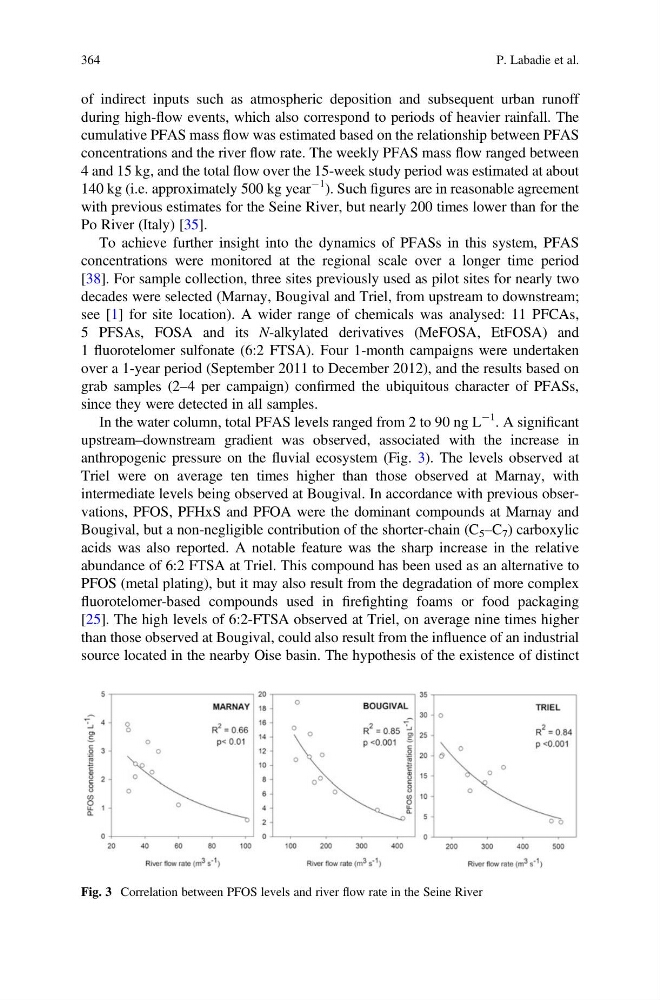
In the water column, total PFAS levels ranged from 2 to 90 ng L
À1 . A significant
upstream–downstream gradient was observed, associated with the increase in
anthropogenic pressure on the fluvial ecosystem (Fig. 3). The levels observed at
Triel were on average ten times higher than those observed at Marnay, with
intermediate levels being observed at Bougival. In accordance with previous observations, PFOS, PFHxS and PFOA were the dominant compounds at Marnay and
Bougival, but a non-negligible contribution of the shorter-chain (C 5 –C 7 ) carboxylic
acids was also reported. A notable feature was the sharp increase in the relative
abundance of 6:2 FTSA at Triel. This compound has been used as an alternative to
PFOS (metal plating), but it may also result from the degradation of more complex
fluorotelomer-based compounds used in firefighting foams or food packaging
[25]. The high levels of 6:2-FTSA observed at Triel, on average nine times higher
than those observed at Bougival, could also result from the influence of an industrial
source located in the nearby Oise basin. The hypothesis of the existence of distinct
Fig. 3 Correlation between PFOS levels and river flow rate in the Seine River
364
P. Labadie et al.
during high-flow events, which also correspond to periods of heavier rainfall. The
cumulative PFAS mass flow was estimated based on the relationship between PFAS
concentrations and the river flow rate. The weekly PFAS mass flow ranged between
4 and 15 kg, and the total flow over the 15-week study period was estimated at about
140 kg (i.e. approximately 500 kg year
À1 ). Such figures are in reasonable agreement
with previous estimates for the Seine River, but nearly 200 times lower than for the
Po River (Italy) [35].
To achieve further insight into the dynamics of PFASs in this system, PFAS
concentrations were monitored at the regional scale over a longer time period
[38]. For sample collection, three sites previously used as pilot sites for nearly two
decades were selected (Marnay, Bougival and Triel, from upstream to downstream;
see [1] for site location). A wider range of chemicals was analysed: 11 PFCAs,
5 PFSAs, FOSA and its N-alkylated derivatives (MeFOSA, EtFOSA) and
1 fluorotelomer sulfonate (6:2 FTSA). Four 1-month campaigns were undertaken
over a 1-year period (September 2011 to December 2012), and the results based on
grab samples (2–4 per campaign) confirmed the ubiquitous character of PFASs,
since they were detected in all samples.
In the water column, total PFAS levels ranged from 2 to 90 ng L
À1 . A significant
upstream–downstream gradient was observed, associated with the increase in
anthropogenic pressure on the fluvial ecosystem (Fig. 3). The levels observed at
Triel were on average ten times higher than those observed at Marnay, with
intermediate levels being observed at Bougival. In accordance with previous observations, PFOS, PFHxS and PFOA were the dominant compounds at Marnay and
Bougival, but a non-negligible contribution of the shorter-chain (C 5 –C 7 ) carboxylic
acids was also reported. A notable feature was the sharp increase in the relative
abundance of 6:2 FTSA at Triel. This compound has been used as an alternative to
PFOS (metal plating), but it may also result from the degradation of more complex
fluorotelomer-based compounds used in firefighting foams or food packaging
[25]. The high levels of 6:2-FTSA observed at Triel, on average nine times higher
than those observed at Bougival, could also result from the influence of an industrial
source located in the nearby Oise basin. The hypothesis of the existence of distinct
Fig. 3 Correlation between PFOS levels and river flow rate in the Seine River
364
P. Labadie et al.