

between the assessed situation and a reference with minimal human impact. The final
IPR is the sum of the scores on the seven metrics. Its value is close to 0 when the
community composition is close to the expected community under the reference
condition. It increases as the human impact on the community grows.
For this analysis, the Seine course was partitioned into four sectors characterised
by differences in the levels of anthropogenic pressures and how these pressures have
changed over the past few decades.
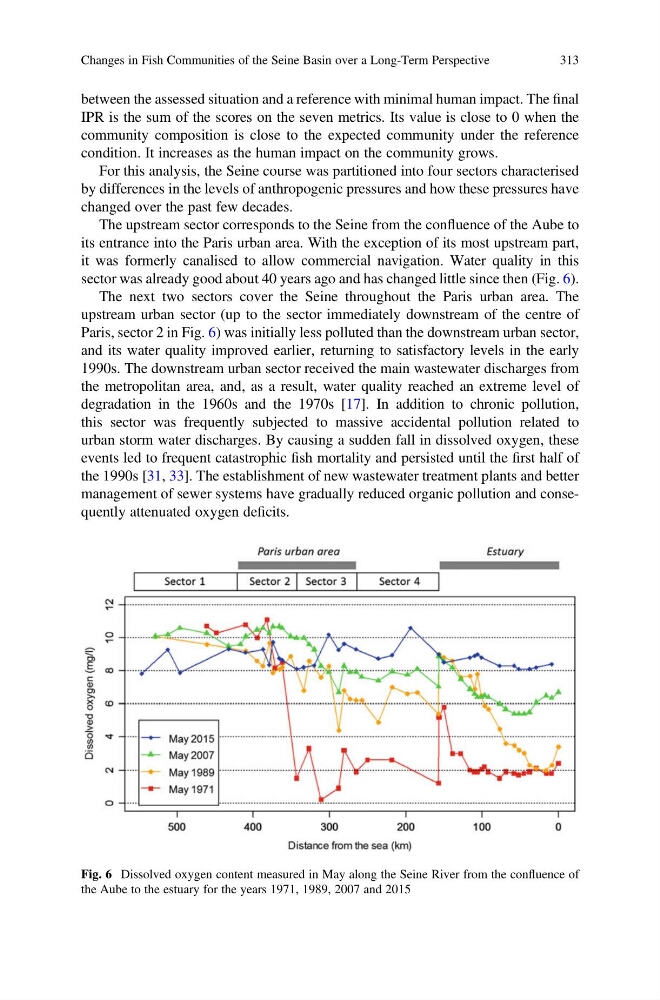
The upstream sector corresponds to the Seine from the confluence of the Aube to
its entrance into the Paris urban area. With the exception of its most upstream part,
it was formerly canalised to allow commercial navigation. Water quality in this
sector was already good about 40 years ago and has changed little since then (Fig. 6).
The next two sectors cover the Seine throughout the Paris urban area. The
upstream urban sector (up to the sector immediately downstream of the centre of
Paris, sector 2 in Fig. 6) was initially less polluted than the downstream urban sector,
and its water quality improved earlier, returning to satisfactory levels in the early
1990s. The downstream urban sector received the main wastewater discharges from
the metropolitan area, and, as a result, water quality reached an extreme level of
degradation in the 1960s and the 1970s [17]. In addition to chronic pollution,
this sector was frequently subjected to massive accidental pollution related to
urban storm water discharges. By causing a sudden fall in dissolved oxygen, these
events led to frequent catastrophic fish mortality and persisted until the first half of
the 1990s [31, 33]. The establishment of new wastewater treatment plants and better
management of sewer systems have gradually reduced organic pollution and consequently attenuated oxygen deficits.
Fig. 6 Dissolved oxygen content measured in May along the Seine River from the confluence of
the Aube to the estuary for the years 1971, 1989, 2007 and 2015
Changes in Fish Communities of the Seine Basin over a Long-Term Perspective
313
IPR is the sum of the scores on the seven metrics. Its value is close to 0 when the
community composition is close to the expected community under the reference
condition. It increases as the human impact on the community grows.
For this analysis, the Seine course was partitioned into four sectors characterised
by differences in the levels of anthropogenic pressures and how these pressures have
changed over the past few decades.
The upstream sector corresponds to the Seine from the confluence of the Aube to
its entrance into the Paris urban area. With the exception of its most upstream part,
it was formerly canalised to allow commercial navigation. Water quality in this
sector was already good about 40 years ago and has changed little since then (Fig. 6).
The next two sectors cover the Seine throughout the Paris urban area. The
upstream urban sector (up to the sector immediately downstream of the centre of
Paris, sector 2 in Fig. 6) was initially less polluted than the downstream urban sector,
and its water quality improved earlier, returning to satisfactory levels in the early
1990s. The downstream urban sector received the main wastewater discharges from
the metropolitan area, and, as a result, water quality reached an extreme level of
degradation in the 1960s and the 1970s [17]. In addition to chronic pollution,
this sector was frequently subjected to massive accidental pollution related to
urban storm water discharges. By causing a sudden fall in dissolved oxygen, these
events led to frequent catastrophic fish mortality and persisted until the first half of
the 1990s [31, 33]. The establishment of new wastewater treatment plants and better
management of sewer systems have gradually reduced organic pollution and consequently attenuated oxygen deficits.
Fig. 6 Dissolved oxygen content measured in May along the Seine River from the confluence of
the Aube to the estuary for the years 1971, 1989, 2007 and 2015
Changes in Fish Communities of the Seine Basin over a Long-Term Perspective
313