

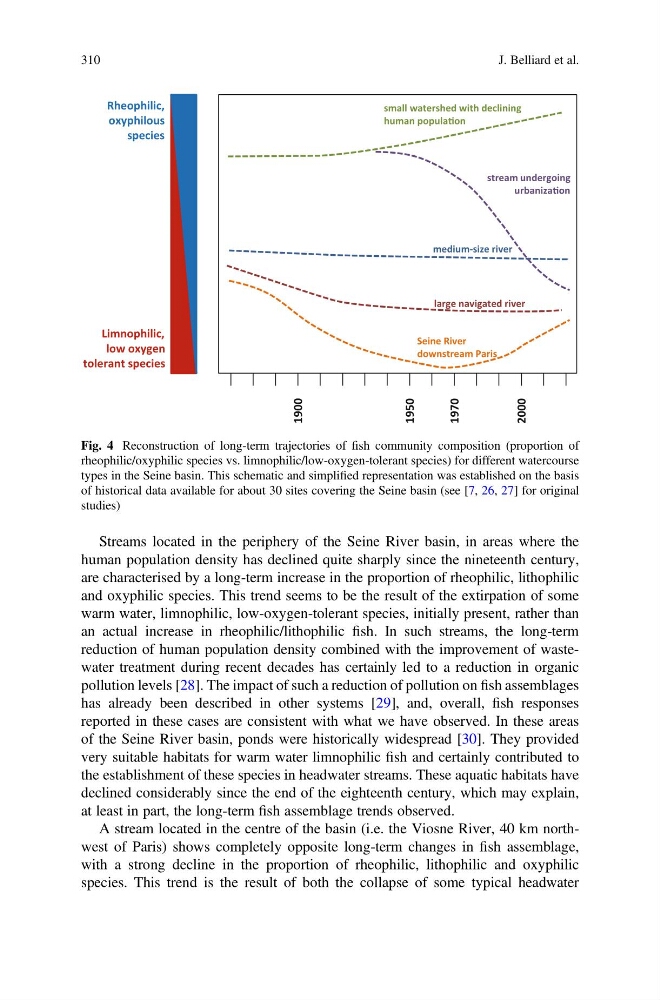
Streams located in the periphery of the Seine River basin, in areas where the
human population density has declined quite sharply since the nineteenth century,
are characterised by a long-term increase in the proportion of rheophilic, lithophilic
and oxyphilic species. This trend seems to be the result of the extirpation of some
warm water, limnophilic, low-oxygen-tolerant species, initially present, rather than
an actual increase in rheophilic/lithophilic fish. In such streams, the long-term
reduction of human population density combined with the improvement of wastewater treatment during recent decades has certainly led to a reduction in organic
pollution levels [28]. The impact of such a reduction of pollution on fish assemblages
has already been described in other systems [29], and, overall, fish responses
reported in these cases are consistent with what we have observed. In these areas
of the Seine River basin, ponds were historically widespread [30]. They provided
very suitable habitats for warm water limnophilic fish and certainly contributed to
the establishment of these species in headwater streams. These aquatic habitats have
declined considerably since the end of the eighteenth century, which may explain,
at least in part, the long-term fish assemblage trends observed.
A stream located in the centre of the basin (i.e. the Viosne River, 40 km northwest of Paris) shows completely opposite long-term changes in fish assemblage,
with a strong decline in the proportion of rheophilic, lithophilic and oxyphilic
species. This trend is the result of both the collapse of some typical headwater
1900
1950
2000
1970
Rheophilic,
oxyphilous
species
Limnophilic,
low oxygen
tolerant species
stream undergoing
urbanizaƟon
medium-size river
large navigated river
Seine River
downstream Paris
small watershed with declining
human populaƟon
Fig. 4 Reconstruction of long-term trajectories of fish community composition (proportion of
rheophilic/oxyphilic species vs. limnophilic/low-oxygen-tolerant species) for different watercourse
types in the Seine basin. This schematic and simplified representation was established on the basis
of historical data available for about 30 sites covering the Seine basin (see [7, 26, 27] for original
studies)
310
J. Belliard et al.
human population density has declined quite sharply since the nineteenth century,
are characterised by a long-term increase in the proportion of rheophilic, lithophilic
and oxyphilic species. This trend seems to be the result of the extirpation of some
warm water, limnophilic, low-oxygen-tolerant species, initially present, rather than
an actual increase in rheophilic/lithophilic fish. In such streams, the long-term
reduction of human population density combined with the improvement of wastewater treatment during recent decades has certainly led to a reduction in organic
pollution levels [28]. The impact of such a reduction of pollution on fish assemblages
has already been described in other systems [29], and, overall, fish responses
reported in these cases are consistent with what we have observed. In these areas
of the Seine River basin, ponds were historically widespread [30]. They provided
very suitable habitats for warm water limnophilic fish and certainly contributed to
the establishment of these species in headwater streams. These aquatic habitats have
declined considerably since the end of the eighteenth century, which may explain,
at least in part, the long-term fish assemblage trends observed.
A stream located in the centre of the basin (i.e. the Viosne River, 40 km northwest of Paris) shows completely opposite long-term changes in fish assemblage,
with a strong decline in the proportion of rheophilic, lithophilic and oxyphilic
species. This trend is the result of both the collapse of some typical headwater
1900
1950
2000
1970
Rheophilic,
oxyphilous
species
Limnophilic,
low oxygen
tolerant species
stream undergoing
urbanizaƟon
medium-size river
large navigated river
Seine River
downstream Paris
small watershed with declining
human populaƟon
Fig. 4 Reconstruction of long-term trajectories of fish community composition (proportion of
rheophilic/oxyphilic species vs. limnophilic/low-oxygen-tolerant species) for different watercourse
types in the Seine basin. This schematic and simplified representation was established on the basis
of historical data available for about 30 sites covering the Seine basin (see [7, 26, 27] for original
studies)
310
J. Belliard et al.