

collective desire led by the public authorities (see the creation of the French
zoological society of acclimatisation in 1854), to improve the production of natural
systems through the establishment of species from other countries. This period was
thus marked by numerous attempts to introduce species, particularly of North
American origin, many of which resulted in viable establishments.
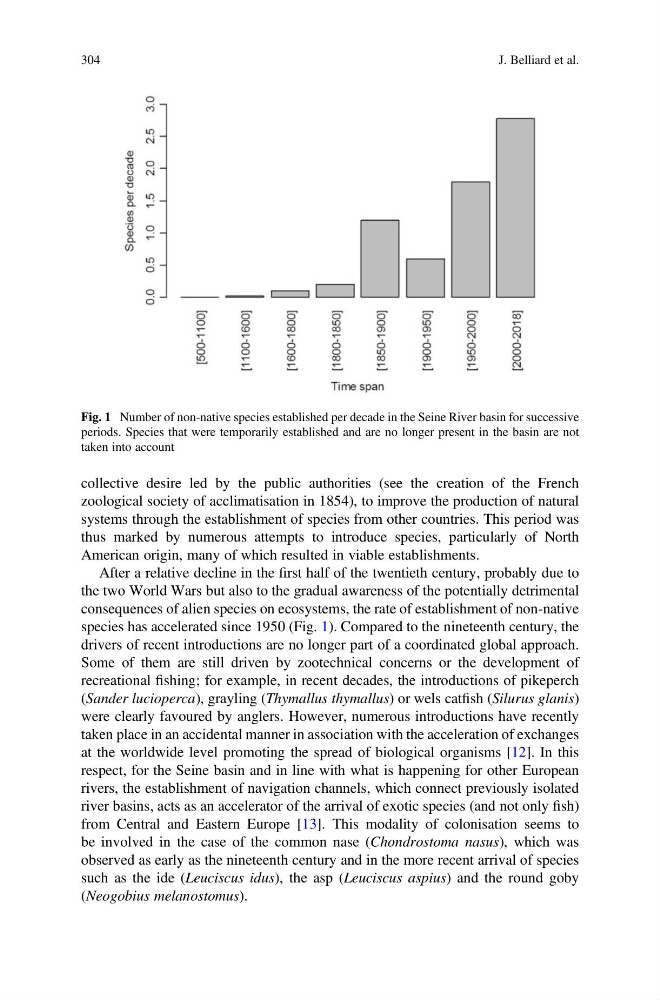
After a relative decline in the first half of the twentieth century, probably due to
the two World Wars but also to the gradual awareness of the potentially detrimental
consequences of alien species on ecosystems, the rate of establishment of non-native
species has accelerated since 1950 (Fig. 1). Compared to the nineteenth century, the
drivers of recent introductions are no longer part of a coordinated global approach.
Some of them are still driven by zootechnical concerns or the development of
recreational fishing; for example, in recent decades, the introductions of pikeperch
(Sander lucioperca), grayling (Thymallus thymallus) or wels catfish (Silurus glanis)
were clearly favoured by anglers. However, numerous introductions have recently
taken place in an accidental manner in association with the acceleration of exchanges
at the worldwide level promoting the spread of biological organisms [12]. In this
respect, for the Seine basin and in line with what is happening for other European
rivers, the establishment of navigation channels, which connect previously isolated
river basins, acts as an accelerator of the arrival of exotic species (and not only fish)
from Central and Eastern Europe [13]. This modality of colonisation seems to
be involved in the case of the common nase (Chondrostoma nasus), which was
observed as early as the nineteenth century and in the more recent arrival of species
such as the ide (Leuciscus idus), the asp (Leuciscus aspius) and the round goby
(Neogobius melanostomus).
Fig. 1 Number of non-native species established per decade in the Seine River basin for successive
periods. Species that were temporarily established and are no longer present in the basin are not
taken into account
304
J. Belliard et al.
zoological society of acclimatisation in 1854), to improve the production of natural
systems through the establishment of species from other countries. This period was
thus marked by numerous attempts to introduce species, particularly of North
American origin, many of which resulted in viable establishments.
After a relative decline in the first half of the twentieth century, probably due to
the two World Wars but also to the gradual awareness of the potentially detrimental
consequences of alien species on ecosystems, the rate of establishment of non-native
species has accelerated since 1950 (Fig. 1). Compared to the nineteenth century, the
drivers of recent introductions are no longer part of a coordinated global approach.
Some of them are still driven by zootechnical concerns or the development of
recreational fishing; for example, in recent decades, the introductions of pikeperch
(Sander lucioperca), grayling (Thymallus thymallus) or wels catfish (Silurus glanis)
were clearly favoured by anglers. However, numerous introductions have recently
taken place in an accidental manner in association with the acceleration of exchanges
at the worldwide level promoting the spread of biological organisms [12]. In this
respect, for the Seine basin and in line with what is happening for other European
rivers, the establishment of navigation channels, which connect previously isolated
river basins, acts as an accelerator of the arrival of exotic species (and not only fish)
from Central and Eastern Europe [13]. This modality of colonisation seems to
be involved in the case of the common nase (Chondrostoma nasus), which was
observed as early as the nineteenth century and in the more recent arrival of species
such as the ide (Leuciscus idus), the asp (Leuciscus aspius) and the round goby
(Neogobius melanostomus).
Fig. 1 Number of non-native species established per decade in the Seine River basin for successive
periods. Species that were temporarily established and are no longer present in the basin are not
taken into account
304
J. Belliard et al.