

products to be carefully monitored in French estuaries and river basin outlets
[51]. Marchand [81] stated that the Seine estuary sediments had the highest contamination in PCBs with regard to all other French study sites.
PCBs have been commonly used in France since 1950 in transformers and
condensers. They were first imported; then in the late 1950s, they were manufactured
in France by two chemical companies, outside the Seine River basin. In 1979, Colas
[82] estimated that the total consumption of PCBs at that period was between 40,000
and 50,000 t, i.e. about 12,000–15,000 t for the Seine River basin, considering the
proportion of industries in the Seine River basin compared to other river basins. The
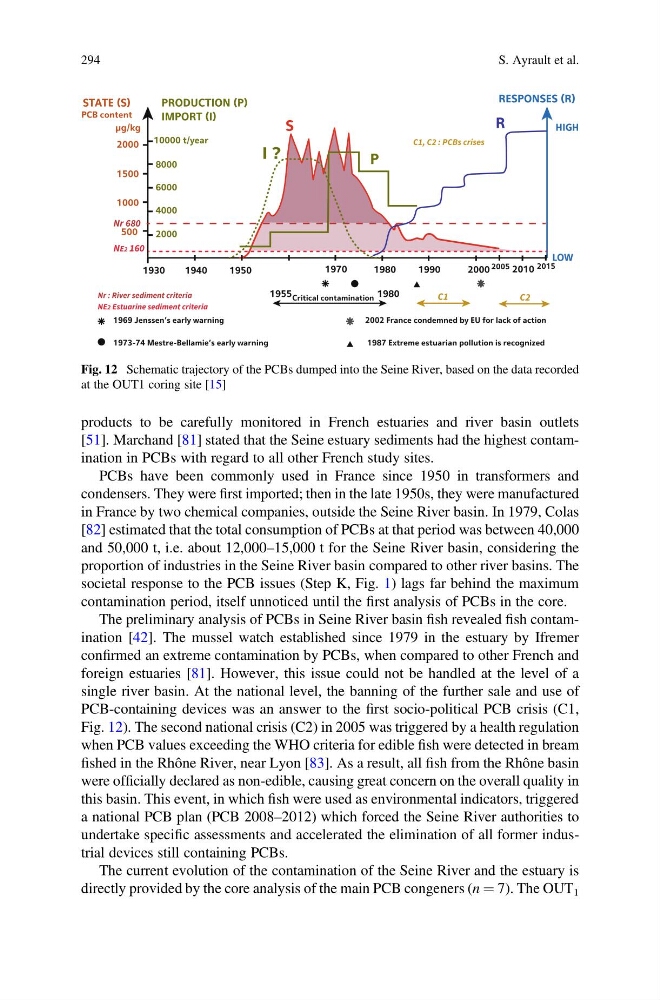
societal response to the PCB issues (Step K, Fig. 1) lags far behind the maximum
contamination period, itself unnoticed until the first analysis of PCBs in the core.
The preliminary analysis of PCBs in Seine River basin fish revealed fish contamination [42]. The mussel watch established since 1979 in the estuary by Ifremer
confirmed an extreme contamination by PCBs, when compared to other French and
foreign estuaries [81]. However, this issue could not be handled at the level of a
single river basin. At the national level, the banning of the further sale and use of
PCB-containing devices was an answer to the first socio-political PCB crisis (C1,
Fig. 12). The second national crisis (C2) in 2005 was triggered by a health regulation
when PCB values exceeding the WHO criteria for edible fish were detected in bream
fished in the Rhône River, near Lyon [83]. As a result, all fish from the Rhône basin
were officially declared as non-edible, causing great concern on the overall quality in
this basin. This event, in which fish were used as environmental indicators, triggered
a national PCB plan (PCB 2008–2012) which forced the Seine River authorities to
undertake specific assessments and accelerated the elimination of all former industrial devices still containing PCBs.
The current evolution of the contamination of the Seine River and the estuary is
directly provided by the core analysis of the main PCB congeners (n ¼ 7). The OUT 1
Fig. 12 Schematic trajectory of the PCBs dumped into the Seine River, based on the data recorded
at the OUT1 coring site [15]
294
S. Ayrault et al.
[51]. Marchand [81] stated that the Seine estuary sediments had the highest contamination in PCBs with regard to all other French study sites.
PCBs have been commonly used in France since 1950 in transformers and
condensers. They were first imported; then in the late 1950s, they were manufactured
in France by two chemical companies, outside the Seine River basin. In 1979, Colas
[82] estimated that the total consumption of PCBs at that period was between 40,000
and 50,000 t, i.e. about 12,000–15,000 t for the Seine River basin, considering the
proportion of industries in the Seine River basin compared to other river basins. The
societal response to the PCB issues (Step K, Fig. 1) lags far behind the maximum
contamination period, itself unnoticed until the first analysis of PCBs in the core.
The preliminary analysis of PCBs in Seine River basin fish revealed fish contamination [42]. The mussel watch established since 1979 in the estuary by Ifremer
confirmed an extreme contamination by PCBs, when compared to other French and
foreign estuaries [81]. However, this issue could not be handled at the level of a
single river basin. At the national level, the banning of the further sale and use of
PCB-containing devices was an answer to the first socio-political PCB crisis (C1,
Fig. 12). The second national crisis (C2) in 2005 was triggered by a health regulation
when PCB values exceeding the WHO criteria for edible fish were detected in bream
fished in the Rhône River, near Lyon [83]. As a result, all fish from the Rhône basin
were officially declared as non-edible, causing great concern on the overall quality in
this basin. This event, in which fish were used as environmental indicators, triggered
a national PCB plan (PCB 2008–2012) which forced the Seine River authorities to
undertake specific assessments and accelerated the elimination of all former industrial devices still containing PCBs.
The current evolution of the contamination of the Seine River and the estuary is
directly provided by the core analysis of the main PCB congeners (n ¼ 7). The OUT 1
Fig. 12 Schematic trajectory of the PCBs dumped into the Seine River, based on the data recorded
at the OUT1 coring site [15]
294
S. Ayrault et al.