

pyrene (B[a]P) onto MMT, goethite and quartz were studied in ultrapure water and
with SRFA or EfDOM [57].
In ultrapure water, the adsorption of PAH onto MMT is higher than for other
particles in the order MMT > goethite > quartz. With DOM, the adsorption varied
according to the nature of DOM, the mineral phase and the properties of the PAHs
(Fig. 7).
Concerning MMT, PAH adsorption was lower with DOM, especially in the
presence of SRFA (À25% to À70%) compared to EfDOM (À10 to À50%).
For goethite, the presence of SRFA mainly reduced the adsorption of light PAHs
(Pyr and B[a]A) by about 60%, while the absorption decrease is only about 20% for
heavier PAHs (Chry, B[b]F, B[k]F, B[a]P). With EfDOM, the adsorption decrease
is about 40–70% regardless of PAH molecular weight.
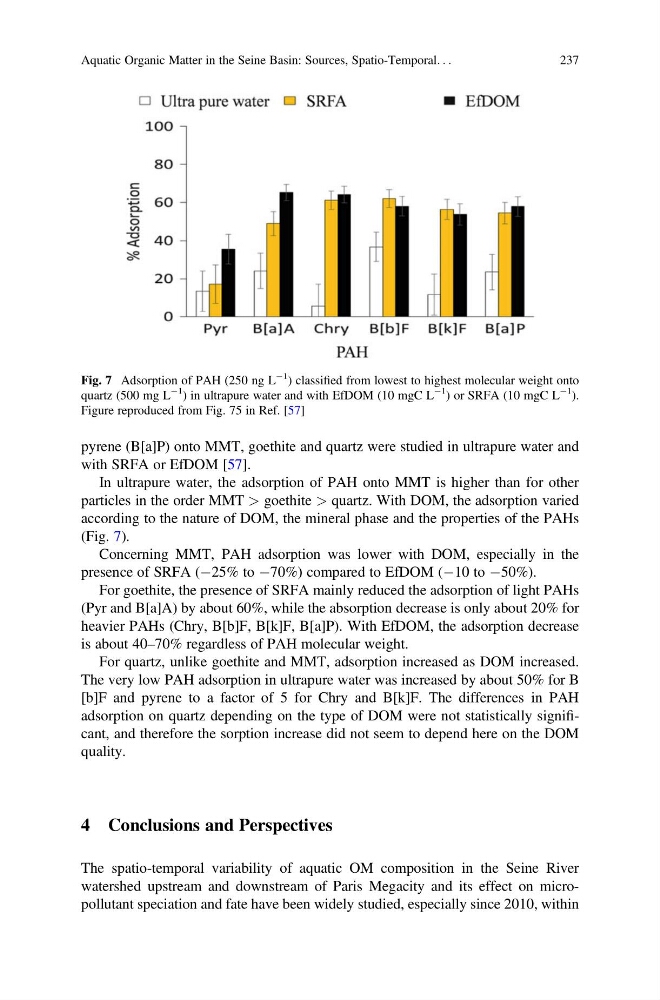
For quartz, unlike goethite and MMT, adsorption increased as DOM increased.
The very low PAH adsorption in ultrapure water was increased by about 50% for B
[b]F and pyrene to a factor of 5 for Chry and B[k]F. The differences in PAH
adsorption on quartz depending on the type of DOM were not statistically significant, and therefore the sorption increase did not seem to depend here on the DOM
quality.
4 Conclusions and Perspectives
The spatio-temporal variability of aquatic OM composition in the Seine River
watershed upstream and downstream of Paris Megacity and its effect on micropollutant speciation and fate have been widely studied, especially since 2010, within
Fig. 7 Adsorption of PAH (250 ng L
À1
) classified from lowest to highest molecular weight onto
quartz (500 mg L
À1
) in ultrapure water and with EfDOM (10 mgC L
À1
) or SRFA (10 mgC L
À1
).
Figure reproduced from Fig. 75 in Ref. [57]
Aquatic Organic Matter in the Seine Basin: Sources, Spatio-Temporal. . .
237
with SRFA or EfDOM [57].
In ultrapure water, the adsorption of PAH onto MMT is higher than for other
particles in the order MMT > goethite > quartz. With DOM, the adsorption varied
according to the nature of DOM, the mineral phase and the properties of the PAHs
(Fig. 7).
Concerning MMT, PAH adsorption was lower with DOM, especially in the
presence of SRFA (À25% to À70%) compared to EfDOM (À10 to À50%).
For goethite, the presence of SRFA mainly reduced the adsorption of light PAHs
(Pyr and B[a]A) by about 60%, while the absorption decrease is only about 20% for
heavier PAHs (Chry, B[b]F, B[k]F, B[a]P). With EfDOM, the adsorption decrease
is about 40–70% regardless of PAH molecular weight.
For quartz, unlike goethite and MMT, adsorption increased as DOM increased.
The very low PAH adsorption in ultrapure water was increased by about 50% for B
[b]F and pyrene to a factor of 5 for Chry and B[k]F. The differences in PAH
adsorption on quartz depending on the type of DOM were not statistically significant, and therefore the sorption increase did not seem to depend here on the DOM
quality.
4 Conclusions and Perspectives
The spatio-temporal variability of aquatic OM composition in the Seine River
watershed upstream and downstream of Paris Megacity and its effect on micropollutant speciation and fate have been widely studied, especially since 2010, within
Fig. 7 Adsorption of PAH (250 ng L
À1
) classified from lowest to highest molecular weight onto
quartz (500 mg L
À1
) in ultrapure water and with EfDOM (10 mgC L
À1
) or SRFA (10 mgC L
À1
).
Figure reproduced from Fig. 75 in Ref. [57]
Aquatic Organic Matter in the Seine Basin: Sources, Spatio-Temporal. . .
237