

In addition, more sampling campaigns were carried out in low-water periods
(eight campaigns between 2011 and 2014) and flood in February 2013 to determine
longitudinal profiles of particulate organic matter (POC), DOC and biodegradable
DOC (BDOC) concentrations.
The mean discharge observed at the Paris gauging station (Austerlitz) was around
100 m
3 s
À1 for both low-water campaigns. The contribution of the large reservoirs
in the upstream basin regulating the hydrology of the Seine River was about 50%
in August/September 2012 compared to only 20% in November 2011. The highwater campaign occurred in February 2013 with flows amounting to 700 m
3 s
À1 for
the Seine River at Alfortville – the confluence of the Seine and Marne Rivers – with
a contribution of 350 m
3 s
À1 by the Marne River at Gournay, and 280 m
3 s
À1 at Creil
for the Oise River, a downstream tributary of the Seine.
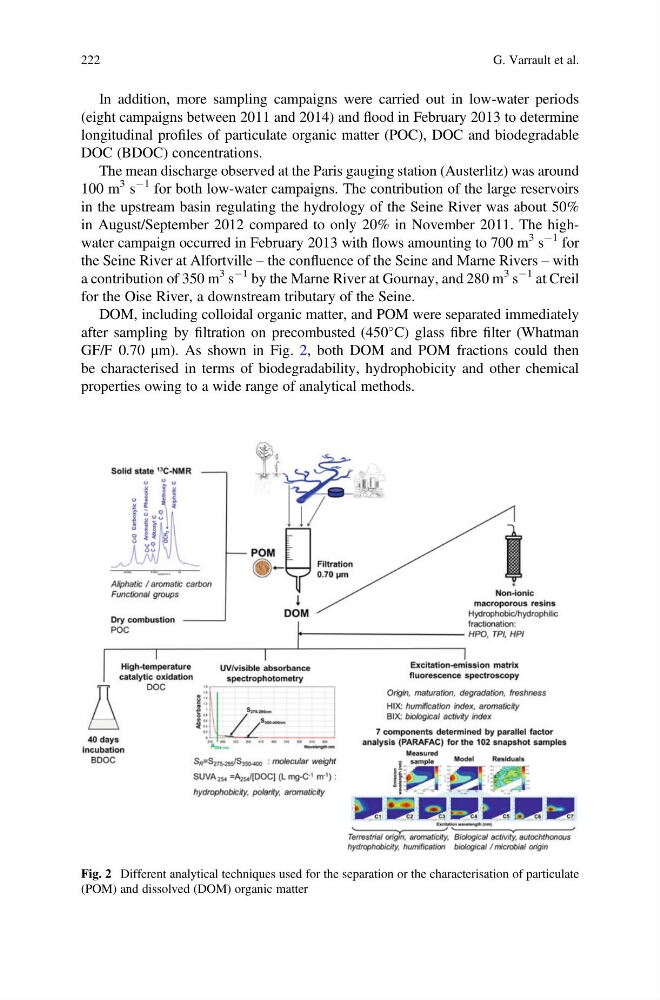
DOM, including colloidal organic matter, and POM were separated immediately
after sampling by filtration on precombusted (450
C) glass fibre filter (Whatman
GF/F 0.70 μm). As shown in Fig. 2, both DOM and POM fractions could then
be characterised in terms of biodegradability, hydrophobicity and other chemical
properties owing to a wide range of analytical methods.
Fig. 2 Different analytical techniques used for the separation or the characterisation of particulate
(POM) and dissolved (DOM) organic matter
222
G. Varrault et al.
(eight campaigns between 2011 and 2014) and flood in February 2013 to determine
longitudinal profiles of particulate organic matter (POC), DOC and biodegradable
DOC (BDOC) concentrations.
The mean discharge observed at the Paris gauging station (Austerlitz) was around
100 m
3 s
À1 for both low-water campaigns. The contribution of the large reservoirs
in the upstream basin regulating the hydrology of the Seine River was about 50%
in August/September 2012 compared to only 20% in November 2011. The highwater campaign occurred in February 2013 with flows amounting to 700 m
3 s
À1 for
the Seine River at Alfortville – the confluence of the Seine and Marne Rivers – with
a contribution of 350 m
3 s
À1 by the Marne River at Gournay, and 280 m
3 s
À1 at Creil
for the Oise River, a downstream tributary of the Seine.
DOM, including colloidal organic matter, and POM were separated immediately
after sampling by filtration on precombusted (450
C) glass fibre filter (Whatman
GF/F 0.70 μm). As shown in Fig. 2, both DOM and POM fractions could then
be characterised in terms of biodegradability, hydrophobicity and other chemical
properties owing to a wide range of analytical methods.
Fig. 2 Different analytical techniques used for the separation or the characterisation of particulate
(POM) and dissolved (DOM) organic matter
222
G. Varrault et al.