

process reported elsewhere for French sludge [41] were used to quantify the flux of
the remaining PAHs (E13d ¼ 65 kg year
À1 , Σ13) after the composting process.
Given that the composted sludge was also spread, the total flux of PAHs towards
agricultural lands totalled F13 ¼ F13c + E13d ¼ 225 kg year
À1 (Σ13).
Finally, the annual load of PAHs released to the Seine River by the WWTPs
was estimated based on PAH concentrations measured in the effluent and considering the annual volume of treated water discharged into the river. Although PAH
concentrations in WWTP effluent have been monitored for many years, only six
samples collected at two WWTP outlets [34] were available. When compared to
previous studies elsewhere in Europe [42–44], significant differences were observed
(Wilcoxon-Mann-Whitney test, p < 0.05) for similar wastewater treatment
processes. This result may be due to the high efficiency in the suspended matter
removal at one of the WWTPs (Seine-Centre). Based on data from this study, the
PAH flux related to WWTP effluent discharge reached F22f ¼ 21 Æ 4.1 kg year
À1
(Σ15). Because of the lack of data and the differences that were observed between
these data and the literature, the quality rate of this estimation was downgraded to 1.
3.2 Rural Fluxes
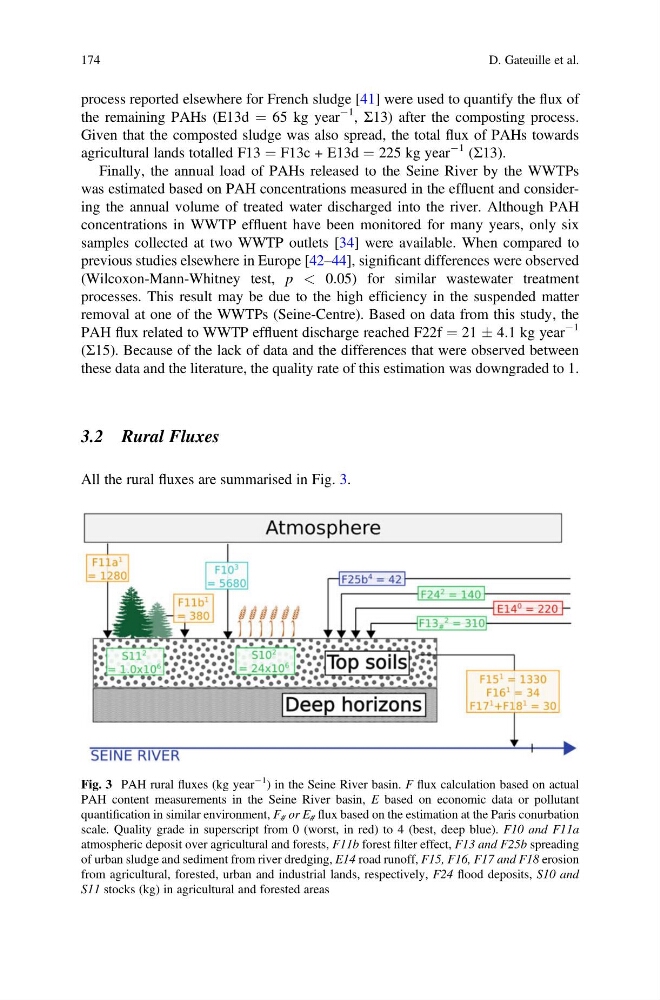
All the rural fluxes are summarised in Fig. 3.
Fig. 3 PAH rural fluxes (kg year
À1
) in the Seine River basin. F flux calculation based on actual
PAH content measurements in the Seine River basin, E based on economic data or pollutant
quantification in similar environment, F # or E # flux based on the estimation at the Paris conurbation
scale. Quality grade in superscript from 0 (worst, in red) to 4 (best, deep blue). F10 and F11a
atmospheric deposit over agricultural and forests, F11b forest filter effect, F13 and F25b spreading
of urban sludge and sediment from river dredging, E14 road runoff, F15, F16, F17 and F18 erosion
from agricultural, forested, urban and industrial lands, respectively, F24 flood deposits, S10 and
S11 stocks (kg) in agricultural and forested areas
174
D. Gateuille et al.
the remaining PAHs (E13d ¼ 65 kg year
À1 , Σ13) after the composting process.
Given that the composted sludge was also spread, the total flux of PAHs towards
agricultural lands totalled F13 ¼ F13c + E13d ¼ 225 kg year
À1 (Σ13).
Finally, the annual load of PAHs released to the Seine River by the WWTPs
was estimated based on PAH concentrations measured in the effluent and considering the annual volume of treated water discharged into the river. Although PAH
concentrations in WWTP effluent have been monitored for many years, only six
samples collected at two WWTP outlets [34] were available. When compared to
previous studies elsewhere in Europe [42–44], significant differences were observed
(Wilcoxon-Mann-Whitney test, p < 0.05) for similar wastewater treatment
processes. This result may be due to the high efficiency in the suspended matter
removal at one of the WWTPs (Seine-Centre). Based on data from this study, the
PAH flux related to WWTP effluent discharge reached F22f ¼ 21 Æ 4.1 kg year
À1
(Σ15). Because of the lack of data and the differences that were observed between
these data and the literature, the quality rate of this estimation was downgraded to 1.
3.2 Rural Fluxes
All the rural fluxes are summarised in Fig. 3.
Fig. 3 PAH rural fluxes (kg year
À1
) in the Seine River basin. F flux calculation based on actual
PAH content measurements in the Seine River basin, E based on economic data or pollutant
quantification in similar environment, F # or E # flux based on the estimation at the Paris conurbation
scale. Quality grade in superscript from 0 (worst, in red) to 4 (best, deep blue). F10 and F11a
atmospheric deposit over agricultural and forests, F11b forest filter effect, F13 and F25b spreading
of urban sludge and sediment from river dredging, E14 road runoff, F15, F16, F17 and F18 erosion
from agricultural, forested, urban and industrial lands, respectively, F24 flood deposits, S10 and
S11 stocks (kg) in agricultural and forested areas
174
D. Gateuille et al.