

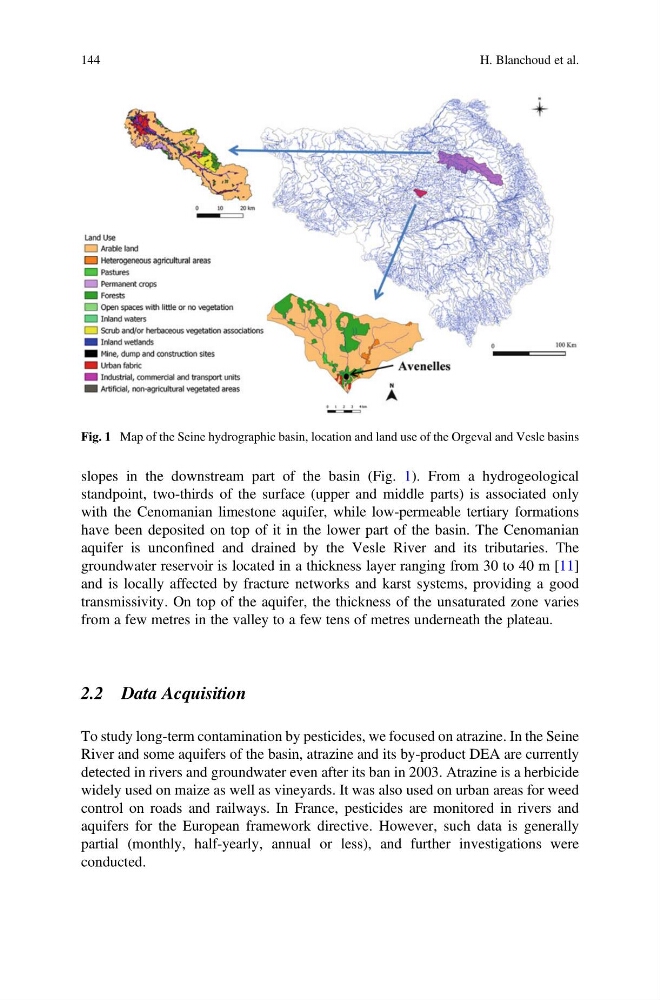
slopes in the downstream part of the basin (Fig. 1). From a hydrogeological
standpoint, two-thirds of the surface (upper and middle parts) is associated only
with the Cenomanian limestone aquifer, while low-permeable tertiary formations
have been deposited on top of it in the lower part of the basin. The Cenomanian
aquifer is unconfined and drained by the Vesle River and its tributaries. The
groundwater reservoir is located in a thickness layer ranging from 30 to 40 m [11]
and is locally affected by fracture networks and karst systems, providing a good
transmissivity. On top of the aquifer, the thickness of the unsaturated zone varies
from a few metres in the valley to a few tens of metres underneath the plateau.
2.2 Data Acquisition
To study long-term contamination by pesticides, we focused on atrazine. In the Seine
River and some aquifers of the basin, atrazine and its by-product DEA are currently
detected in rivers and groundwater even after its ban in 2003. Atrazine is a herbicide
widely used on maize as well as vineyards. It was also used on urban areas for weed
control on roads and railways. In France, pesticides are monitored in rivers and
aquifers for the European framework directive. However, such data is generally
partial (monthly, half-yearly, annual or less), and further investigations were
conducted.
Fig. 1 Map of the Seine hydrographic basin, location and land use of the Orgeval and Vesle basins
144
H. Blanchoud et al.
standpoint, two-thirds of the surface (upper and middle parts) is associated only
with the Cenomanian limestone aquifer, while low-permeable tertiary formations
have been deposited on top of it in the lower part of the basin. The Cenomanian
aquifer is unconfined and drained by the Vesle River and its tributaries. The
groundwater reservoir is located in a thickness layer ranging from 30 to 40 m [11]
and is locally affected by fracture networks and karst systems, providing a good
transmissivity. On top of the aquifer, the thickness of the unsaturated zone varies
from a few metres in the valley to a few tens of metres underneath the plateau.
2.2 Data Acquisition
To study long-term contamination by pesticides, we focused on atrazine. In the Seine
River and some aquifers of the basin, atrazine and its by-product DEA are currently
detected in rivers and groundwater even after its ban in 2003. Atrazine is a herbicide
widely used on maize as well as vineyards. It was also used on urban areas for weed
control on roads and railways. In France, pesticides are monitored in rivers and
aquifers for the European framework directive. However, such data is generally
partial (monthly, half-yearly, annual or less), and further investigations were
conducted.
Fig. 1 Map of the Seine hydrographic basin, location and land use of the Orgeval and Vesle basins
144
H. Blanchoud et al.