

5 Conclusion
Over the last two centuries, human excreta management has undergone great
changes in Paris, some of them counterintuitive. Indeed, the driver of these transformations can be found in the goals that were assigned to this urban service: during
the nineteenth century, it was as much dedicated to the improvement of public health
as to the production of fertiliser, in order to prevent “hunger arising from the furrow,
and disease from the stream”
8 [38]. Urban sanitation went hand in hand with rural
food production; these two targets oriented technical choices towards the
maximisation of nutrient recovery. Night soil was turned into poudrette, ammonium
sulphate, urate and so on, moderately increasing recovery rates. The development of
the domestic water supply during the second half of the nineteenth century raised a
huge debate on the appropriateness of the combined sewer system associated with
sewage farms. These were implemented during the last third of the century; sewer
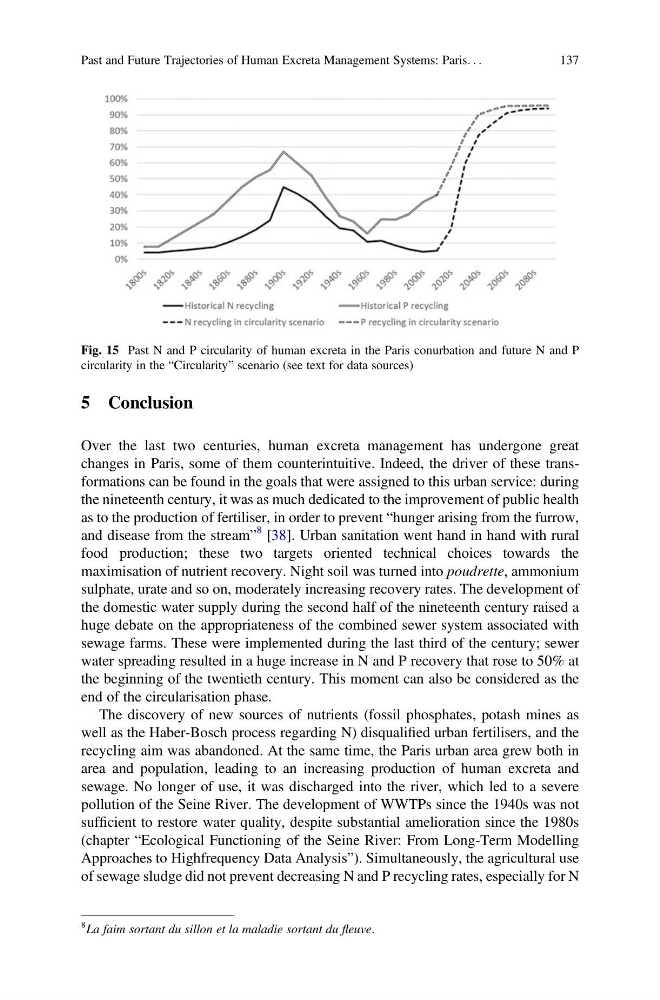
water spreading resulted in a huge increase in N and P recovery that rose to 50% at
the beginning of the twentieth century. This moment can also be considered as the
end of the circularisation phase.
The discovery of new sources of nutrients (fossil phosphates, potash mines as
well as the Haber-Bosch process regarding N) disqualified urban fertilisers, and the
recycling aim was abandoned. At the same time, the Paris urban area grew both in
area and population, leading to an increasing production of human excreta and
sewage. No longer of use, it was discharged into the river, which led to a severe
pollution of the Seine River. The development of WWTPs since the 1940s was not
sufficient to restore water quality, despite substantial amelioration since the 1980s
(chapter “Ecological Functioning of the Seine River: From Long-Term Modelling
Approaches to Highfrequency Data Analysis”). Simultaneously, the agricultural use
of sewage sludge did not prevent decreasing N and P recycling rates, especially for N
Fig. 15 Past N and P circularity of human excreta in the Paris conurbation and future N and P
circularity in the “Circularity” scenario (see text for data sources)
8 La faim sortant du sillon et la maladie sortant du fleuve.
Past and Future Trajectories of Human Excreta Management Systems: Paris. . .
137
Over the last two centuries, human excreta management has undergone great
changes in Paris, some of them counterintuitive. Indeed, the driver of these transformations can be found in the goals that were assigned to this urban service: during
the nineteenth century, it was as much dedicated to the improvement of public health
as to the production of fertiliser, in order to prevent “hunger arising from the furrow,
and disease from the stream”
8 [38]. Urban sanitation went hand in hand with rural
food production; these two targets oriented technical choices towards the
maximisation of nutrient recovery. Night soil was turned into poudrette, ammonium
sulphate, urate and so on, moderately increasing recovery rates. The development of
the domestic water supply during the second half of the nineteenth century raised a
huge debate on the appropriateness of the combined sewer system associated with
sewage farms. These were implemented during the last third of the century; sewer
water spreading resulted in a huge increase in N and P recovery that rose to 50% at
the beginning of the twentieth century. This moment can also be considered as the
end of the circularisation phase.
The discovery of new sources of nutrients (fossil phosphates, potash mines as
well as the Haber-Bosch process regarding N) disqualified urban fertilisers, and the
recycling aim was abandoned. At the same time, the Paris urban area grew both in
area and population, leading to an increasing production of human excreta and
sewage. No longer of use, it was discharged into the river, which led to a severe
pollution of the Seine River. The development of WWTPs since the 1940s was not
sufficient to restore water quality, despite substantial amelioration since the 1980s
(chapter “Ecological Functioning of the Seine River: From Long-Term Modelling
Approaches to Highfrequency Data Analysis”). Simultaneously, the agricultural use
of sewage sludge did not prevent decreasing N and P recycling rates, especially for N
Fig. 15 Past N and P circularity of human excreta in the Paris conurbation and future N and P
circularity in the “Circularity” scenario (see text for data sources)
8 La faim sortant du sillon et la maladie sortant du fleuve.
Past and Future Trajectories of Human Excreta Management Systems: Paris. . .
137