

Tabassum et al. 2018). Risk assessment traces the pathway of exposure and also
estimates the probability and nature of possible toxic effects of a pollutant to humans
when exposed to that pollutant (Arslan et al. 2016; Diepens et al. 2016). Recently,
several research reports and studies used different kinds of risk assessment parameters/
tools to estimate the possible associated health risks (Antoniadis et al. 2019; Khalid
et al. 2018). In this study, we used the previously reported heavy metal(loid) concentrations in edible plant parts due to foliar deposition and uptake and estimated the values
of different risk assessment parameters such as hazard quotient (HQ), estimated daily
intake (EDI), maximum daily intake (MDI), lifetime cancer risk (ILTCR), total hazard
quotient (THQ), and hazard index (HI) both in adults and children (Tables 7, 8, 9, 10,
and 11). The parameters used to calculate these risk assessment factors are described in
detail in Tables 12 and 13.
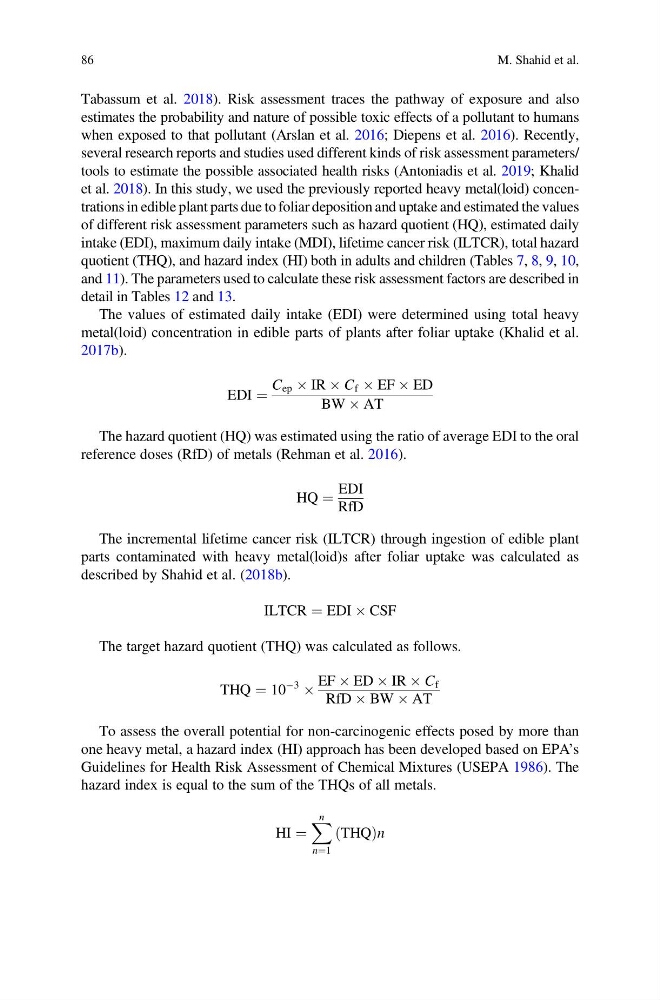
The values of estimated daily intake (EDI) were determined using total heavy
metal(loid) concentration in edible parts of plants after foliar uptake (Khalid et al.
2017b).
EDI ¼
C ep  IR  C f  EF  ED
BW Â AT
The hazard quotient (HQ) was estimated using the ratio of average EDI to the oral
reference doses (RfD) of metals (Rehman et al. 2016).
HQ ¼
EDI
RfD
The incremental lifetime cancer risk (ILTCR) through ingestion of edible plant
parts contaminated with heavy metal(loid)s after foliar uptake was calculated as
described by Shahid et al. (2018b).
ILTCR ¼ EDI Â CSF
The target hazard quotient (THQ) was calculated as follows.
THQ ¼ 10
À3
Â
EF Â ED Â IR Â C f
RfD Â BW Â AT
To assess the overall potential for non-carcinogenic effects posed by more than
one heavy metal, a hazard index (HI) approach has been developed based on EPA’s
Guidelines for Health Risk Assessment of Chemical Mixtures (USEPA 1986). The
hazard index is equal to the sum of the THQs of all metals.
HI ¼
X n
n¼1
THQ
ð
Þn
86
M. Shahid et al.
estimates the probability and nature of possible toxic effects of a pollutant to humans
when exposed to that pollutant (Arslan et al. 2016; Diepens et al. 2016). Recently,
several research reports and studies used different kinds of risk assessment parameters/
tools to estimate the possible associated health risks (Antoniadis et al. 2019; Khalid
et al. 2018). In this study, we used the previously reported heavy metal(loid) concentrations in edible plant parts due to foliar deposition and uptake and estimated the values
of different risk assessment parameters such as hazard quotient (HQ), estimated daily
intake (EDI), maximum daily intake (MDI), lifetime cancer risk (ILTCR), total hazard
quotient (THQ), and hazard index (HI) both in adults and children (Tables 7, 8, 9, 10,
and 11). The parameters used to calculate these risk assessment factors are described in
detail in Tables 12 and 13.
The values of estimated daily intake (EDI) were determined using total heavy
metal(loid) concentration in edible parts of plants after foliar uptake (Khalid et al.
2017b).
EDI ¼
C ep  IR  C f  EF  ED
BW Â AT
The hazard quotient (HQ) was estimated using the ratio of average EDI to the oral
reference doses (RfD) of metals (Rehman et al. 2016).
HQ ¼
EDI
RfD
The incremental lifetime cancer risk (ILTCR) through ingestion of edible plant
parts contaminated with heavy metal(loid)s after foliar uptake was calculated as
described by Shahid et al. (2018b).
ILTCR ¼ EDI Â CSF
The target hazard quotient (THQ) was calculated as follows.
THQ ¼ 10
À3
Â
EF Â ED Â IR Â C f
RfD Â BW Â AT
To assess the overall potential for non-carcinogenic effects posed by more than
one heavy metal, a hazard index (HI) approach has been developed based on EPA’s
Guidelines for Health Risk Assessment of Chemical Mixtures (USEPA 1986). The
hazard index is equal to the sum of the THQs of all metals.
HI ¼
X n
n¼1
THQ
ð
Þn
86
M. Shahid et al.