

Xiong et al. (2014a) showed that adsorption of heavy metal(loid)s is highly
dependent on the morphology and physiology of the leaves as well as on the species
of metals. Metals can penetrate through the cuticle layer of foliar organs and adopt
symplastic or apoplastic pathway to move between cells and thus can be released
into the phloem and are distributed throughout the plant (Shahid et al. 2017b; Xiong
et al. 2014a). It is anticipated that metals after foliar application can penetrate
through the cuticle into the intracellular spaces of the leaves from where they can
undergo phloem loading (Geiger 1975) and translocated throughout the plant.
Previous studies indicate the transport of foliar-applied metals into the roots. Leaves
absorb maximum metal and a little is transported to the roots <1% (Colle et al.
2009). Dollard (1986) reported the 0.1%, 0.1–0.3%, and <1% transfer of foliarapplied lead to the root tissues, in radish, carrot, and broad beans. So far, less data is
reported on shoot to roots to transfer of metals.
Like root uptake, foliar metal uptake could also be in a dose- and time-dependent
manner. For example, Bondada et al. (2004) reported the linear relation between As
content in plant and the foliar-applied doses of arsenic over time. Likewise, a linear
relation was reported between the foliar Zn levels and the concentration inside the
plant (Deshpande et al. 2017). Hong et al. (2016) reported a significant increase of
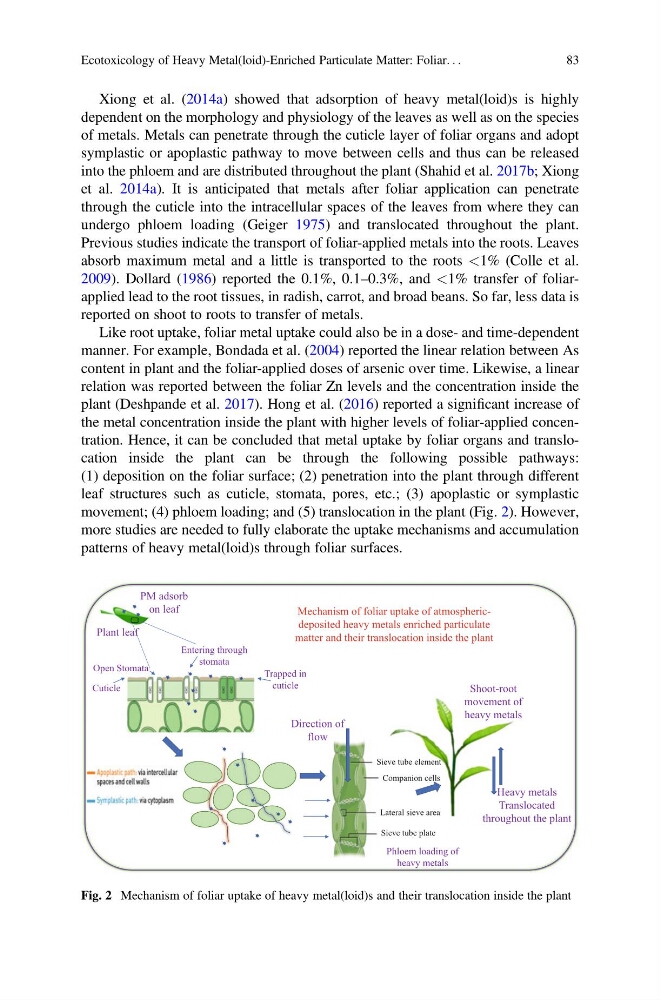
the metal concentration inside the plant with higher levels of foliar-applied concentration. Hence, it can be concluded that metal uptake by foliar organs and translocation inside the plant can be through the following possible pathways:
(1) deposition on the foliar surface; (2) penetration into the plant through different
leaf structures such as cuticle, stomata, pores, etc.; (3) apoplastic or symplastic
movement; (4) phloem loading; and (5) translocation in the plant (Fig. 2). However,
more studies are needed to fully elaborate the uptake mechanisms and accumulation
patterns of heavy metal(loid)s through foliar surfaces.
Entering through
stomata
Trapped in
cuticle
PM adsorb
on leaf
Cuticle
Open Stomata
Plant leaf
Phloem loading of
heavy metals
Direction of
flow
Heavy metals
Translocated
throughout the plant
Shoot-root
movement of
heavy metals
Mechanism of foliar uptake of atmosphericdeposited heavy metals enriched particulate
matter and their translocation inside the plant
Sieve tube element
Companion cells
Lateral sieve area
Sieve tube plate
Fig. 2 Mechanism of foliar uptake of heavy metal(loid)s and their translocation inside the plant
Ecotoxicology of Heavy Metal(loid)-Enriched Particulate Matter: Foliar. . .
83
dependent on the morphology and physiology of the leaves as well as on the species
of metals. Metals can penetrate through the cuticle layer of foliar organs and adopt
symplastic or apoplastic pathway to move between cells and thus can be released
into the phloem and are distributed throughout the plant (Shahid et al. 2017b; Xiong
et al. 2014a). It is anticipated that metals after foliar application can penetrate
through the cuticle into the intracellular spaces of the leaves from where they can
undergo phloem loading (Geiger 1975) and translocated throughout the plant.
Previous studies indicate the transport of foliar-applied metals into the roots. Leaves
absorb maximum metal and a little is transported to the roots <1% (Colle et al.
2009). Dollard (1986) reported the 0.1%, 0.1–0.3%, and <1% transfer of foliarapplied lead to the root tissues, in radish, carrot, and broad beans. So far, less data is
reported on shoot to roots to transfer of metals.
Like root uptake, foliar metal uptake could also be in a dose- and time-dependent
manner. For example, Bondada et al. (2004) reported the linear relation between As
content in plant and the foliar-applied doses of arsenic over time. Likewise, a linear
relation was reported between the foliar Zn levels and the concentration inside the
plant (Deshpande et al. 2017). Hong et al. (2016) reported a significant increase of
the metal concentration inside the plant with higher levels of foliar-applied concentration. Hence, it can be concluded that metal uptake by foliar organs and translocation inside the plant can be through the following possible pathways:
(1) deposition on the foliar surface; (2) penetration into the plant through different
leaf structures such as cuticle, stomata, pores, etc.; (3) apoplastic or symplastic
movement; (4) phloem loading; and (5) translocation in the plant (Fig. 2). However,
more studies are needed to fully elaborate the uptake mechanisms and accumulation
patterns of heavy metal(loid)s through foliar surfaces.
Entering through
stomata
Trapped in
cuticle
PM adsorb
on leaf
Cuticle
Open Stomata
Plant leaf
Phloem loading of
heavy metals
Direction of
flow
Heavy metals
Translocated
throughout the plant
Shoot-root
movement of
heavy metals
Mechanism of foliar uptake of atmosphericdeposited heavy metals enriched particulate
matter and their translocation inside the plant
Sieve tube element
Companion cells
Lateral sieve area
Sieve tube plate
Fig. 2 Mechanism of foliar uptake of heavy metal(loid)s and their translocation inside the plant
Ecotoxicology of Heavy Metal(loid)-Enriched Particulate Matter: Foliar. . .
83