

speciation can be due to industrial processes. In another study, using Raman
spectroscopy and XRD, Uzu et al. (2009) revealed minor variation in the speciation
in decreasing order of their abundance: PbS, PbSO 4 , PbSO 4 -PbO, a-PbO, and PbO.
Recently Liu et al. (2018b) showed source-specific speciation profiles of different
heavy metal(loid)s (Mn, Cr, V, Co, Cu, Ni, As, Zn, Sn, Cd, Ba, Sb, and Pb) from ten
anthropogenic sources in China.
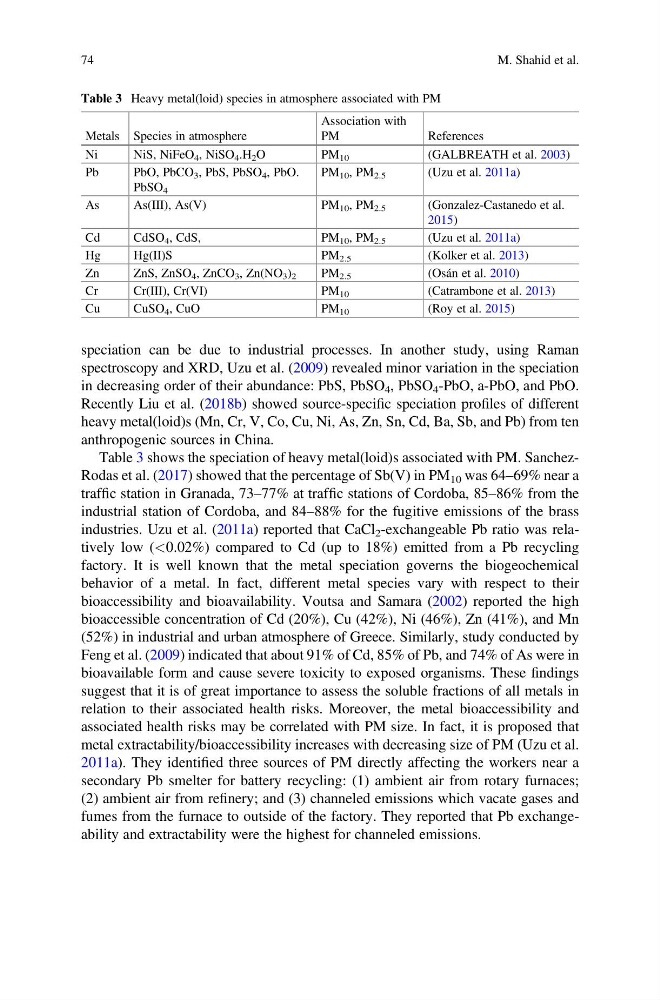
Table 3 shows the speciation of heavy metal(loid)s associated with PM. SanchezRodas et al. (2017) showed that the percentage of Sb(V) in PM 10 was 64–69% near a
traffic station in Granada, 73–77% at traffic stations of Cordoba, 85–86% from the
industrial station of Cordoba, and 84–88% for the fugitive emissions of the brass
industries. Uzu et al. (2011a) reported that CaCl 2 -exchangeable Pb ratio was relatively low (<0.02%) compared to Cd (up to 18%) emitted from a Pb recycling
factory. It is well known that the metal speciation governs the biogeochemical
behavior of a metal. In fact, different metal species vary with respect to their
bioaccessibility and bioavailability. Voutsa and Samara (2002) reported the high
bioaccessible concentration of Cd (20%), Cu (42%), Ni (46%), Zn (41%), and Mn
(52%) in industrial and urban atmosphere of Greece. Similarly, study conducted by
Feng et al. (2009) indicated that about 91% of Cd, 85% of Pb, and 74% of As were in
bioavailable form and cause severe toxicity to exposed organisms. These findings
suggest that it is of great importance to assess the soluble fractions of all metals in
relation to their associated health risks. Moreover, the metal bioaccessibility and
associated health risks may be correlated with PM size. In fact, it is proposed that
metal extractability/bioaccessibility increases with decreasing size of PM (Uzu et al.
2011a). They identified three sources of PM directly affecting the workers near a
secondary Pb smelter for battery recycling: (1) ambient air from rotary furnaces;
(2) ambient air from refinery; and (3) channeled emissions which vacate gases and
fumes from the furnace to outside of the factory. They reported that Pb exchangeability and extractability were the highest for channeled emissions.
Table 3 Heavy metal(loid) species in atmosphere associated with PM
Metals Species in atmosphere
Association with
PM
References
Ni
NiS, NiFeO 4 , NiSO 4 .H 2 O
P M 10
(GALBREATH et al. 2003)
Pb
PbO, PbCO 3 , PbS, PbSO 4 , PbO.
PbSO 4
PM 10 , PM 2.5
(Uzu et al. 2011a)
As
As(III), As(V)
PM 10 , PM 2.5
(Gonzalez-Castanedo et al.
2015)
Cd
CdSO 4 , CdS,
PM 10 , PM 2.5
(Uzu et al. 2011a)
Hg
Hg(II)S
PM 2.5
(Kolker et al. 2013)
Zn
ZnS, ZnSO 4 , ZnCO 3 , Zn(NO 3 ) 2
PM 2.5
(Osán et al. 2010)
Cr
Cr(III), Cr(VI)
PM 10
(Catrambone et al. 2013)
Cu
CuSO 4 , CuO
PM 10
(Roy et al. 2015)
74
M. Shahid et al.
spectroscopy and XRD, Uzu et al. (2009) revealed minor variation in the speciation
in decreasing order of their abundance: PbS, PbSO 4 , PbSO 4 -PbO, a-PbO, and PbO.
Recently Liu et al. (2018b) showed source-specific speciation profiles of different
heavy metal(loid)s (Mn, Cr, V, Co, Cu, Ni, As, Zn, Sn, Cd, Ba, Sb, and Pb) from ten
anthropogenic sources in China.
Table 3 shows the speciation of heavy metal(loid)s associated with PM. SanchezRodas et al. (2017) showed that the percentage of Sb(V) in PM 10 was 64–69% near a
traffic station in Granada, 73–77% at traffic stations of Cordoba, 85–86% from the
industrial station of Cordoba, and 84–88% for the fugitive emissions of the brass
industries. Uzu et al. (2011a) reported that CaCl 2 -exchangeable Pb ratio was relatively low (<0.02%) compared to Cd (up to 18%) emitted from a Pb recycling
factory. It is well known that the metal speciation governs the biogeochemical
behavior of a metal. In fact, different metal species vary with respect to their
bioaccessibility and bioavailability. Voutsa and Samara (2002) reported the high
bioaccessible concentration of Cd (20%), Cu (42%), Ni (46%), Zn (41%), and Mn
(52%) in industrial and urban atmosphere of Greece. Similarly, study conducted by
Feng et al. (2009) indicated that about 91% of Cd, 85% of Pb, and 74% of As were in
bioavailable form and cause severe toxicity to exposed organisms. These findings
suggest that it is of great importance to assess the soluble fractions of all metals in
relation to their associated health risks. Moreover, the metal bioaccessibility and
associated health risks may be correlated with PM size. In fact, it is proposed that
metal extractability/bioaccessibility increases with decreasing size of PM (Uzu et al.
2011a). They identified three sources of PM directly affecting the workers near a
secondary Pb smelter for battery recycling: (1) ambient air from rotary furnaces;
(2) ambient air from refinery; and (3) channeled emissions which vacate gases and
fumes from the furnace to outside of the factory. They reported that Pb exchangeability and extractability were the highest for channeled emissions.
Table 3 Heavy metal(loid) species in atmosphere associated with PM
Metals Species in atmosphere
Association with
PM
References
Ni
NiS, NiFeO 4 , NiSO 4 .H 2 O
P M 10
(GALBREATH et al. 2003)
Pb
PbO, PbCO 3 , PbS, PbSO 4 , PbO.
PbSO 4
PM 10 , PM 2.5
(Uzu et al. 2011a)
As
As(III), As(V)
PM 10 , PM 2.5
(Gonzalez-Castanedo et al.
2015)
Cd
CdSO 4 , CdS,
PM 10 , PM 2.5
(Uzu et al. 2011a)
Hg
Hg(II)S
PM 2.5
(Kolker et al. 2013)
Zn
ZnS, ZnSO 4 , ZnCO 3 , Zn(NO 3 ) 2
PM 2.5
(Osán et al. 2010)
Cr
Cr(III), Cr(VI)
PM 10
(Catrambone et al. 2013)
Cu
CuSO 4 , CuO
PM 10
(Roy et al. 2015)
74
M. Shahid et al.