

Recent publications suggest that baseline toxicity or narcosis for organic ions
occurs at about the same critical membrane concentration of 100 mmol/L mem as for
neutral chemicals (Baumer et al. 2017; Bittermann and Goss 2017; Bittner et al.
2018; Escher et al. 2017). Hence, narcotic effects can be predicted from the fraction
of the ionic and neutral species freely dissolved in water and their respective
liposome–water partition constants, which can be calculated (see above) in case of
lacking experimental values.
6.2 Membrane Permeability
The very hydrophobic inner part of biological membranes constitutes the major
energy barrier for the permeation of ions. This is even more pronounced for cations
than for anions due to the positive dipole potential in the membrane (Flewelling and
Hubbell 1986b). As a result, the membrane permeability of ionic species is orders of
magnitude smaller than that of the corresponding neutral species (Ebert et al. 2018).
This has a number of consequences for the toxicokinetics of permanent ions and
ionizable compounds.
If the membrane permeability of an ionic species is much smaller than that of its
corresponding neutral species, then the so-called ion trap effect will occur between
compartments that are separated by a membrane and possess different pH values. In
this case, equilibrium sorption between both compartments is reached, when the
neutral species has attained equal concentrations on both sides of the membrane.
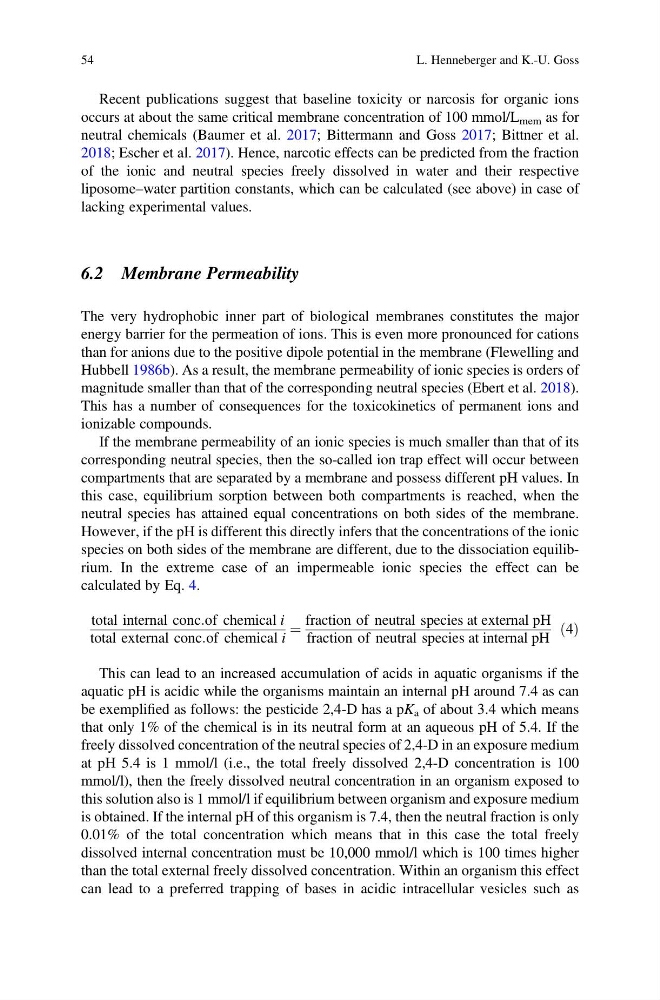
However, if the pH is different this directly infers that the concentrations of the ionic
species on both sides of the membrane are different, due to the dissociation equilibrium. In the extreme case of an impermeable ionic species the effect can be
calculated by Eq. 4.
total internal conc:of chemical i
total external conc:of chemical i
¼
fraction of neutral species at external pH
fraction of neutral species at internal pH
ð4Þ
This can lead to an increased accumulation of acids in aquatic organisms if the
aquatic pH is acidic while the organisms maintain an internal pH around 7.4 as can
be exemplified as follows: the pesticide 2,4-D has a pK a of about 3.4 which means
that only 1% of the chemical is in its neutral form at an aqueous pH of 5.4. If the
freely dissolved concentration of the neutral species of 2,4-D in an exposure medium
at pH 5.4 is 1 mmol/l (i.e., the total freely dissolved 2,4-D concentration is 100
mmol/l), then the freely dissolved neutral concentration in an organism exposed to
this solution also is 1 mmol/l if equilibrium between organism and exposure medium
is obtained. If the internal pH of this organism is 7.4, then the neutral fraction is only
0.01% of the total concentration which means that in this case the total freely
dissolved internal concentration must be 10,000 mmol/l which is 100 times higher
than the total external freely dissolved concentration. Within an organism this effect
can lead to a preferred trapping of bases in acidic intracellular vesicles such as
54
L. Henneberger and K.-U. Goss
occurs at about the same critical membrane concentration of 100 mmol/L mem as for
neutral chemicals (Baumer et al. 2017; Bittermann and Goss 2017; Bittner et al.
2018; Escher et al. 2017). Hence, narcotic effects can be predicted from the fraction
of the ionic and neutral species freely dissolved in water and their respective
liposome–water partition constants, which can be calculated (see above) in case of
lacking experimental values.
6.2 Membrane Permeability
The very hydrophobic inner part of biological membranes constitutes the major
energy barrier for the permeation of ions. This is even more pronounced for cations
than for anions due to the positive dipole potential in the membrane (Flewelling and
Hubbell 1986b). As a result, the membrane permeability of ionic species is orders of
magnitude smaller than that of the corresponding neutral species (Ebert et al. 2018).
This has a number of consequences for the toxicokinetics of permanent ions and
ionizable compounds.
If the membrane permeability of an ionic species is much smaller than that of its
corresponding neutral species, then the so-called ion trap effect will occur between
compartments that are separated by a membrane and possess different pH values. In
this case, equilibrium sorption between both compartments is reached, when the
neutral species has attained equal concentrations on both sides of the membrane.
However, if the pH is different this directly infers that the concentrations of the ionic
species on both sides of the membrane are different, due to the dissociation equilibrium. In the extreme case of an impermeable ionic species the effect can be
calculated by Eq. 4.
total internal conc:of chemical i
total external conc:of chemical i
¼
fraction of neutral species at external pH
fraction of neutral species at internal pH
ð4Þ
This can lead to an increased accumulation of acids in aquatic organisms if the
aquatic pH is acidic while the organisms maintain an internal pH around 7.4 as can
be exemplified as follows: the pesticide 2,4-D has a pK a of about 3.4 which means
that only 1% of the chemical is in its neutral form at an aqueous pH of 5.4. If the
freely dissolved concentration of the neutral species of 2,4-D in an exposure medium
at pH 5.4 is 1 mmol/l (i.e., the total freely dissolved 2,4-D concentration is 100
mmol/l), then the freely dissolved neutral concentration in an organism exposed to
this solution also is 1 mmol/l if equilibrium between organism and exposure medium
is obtained. If the internal pH of this organism is 7.4, then the neutral fraction is only
0.01% of the total concentration which means that in this case the total freely
dissolved internal concentration must be 10,000 mmol/l which is 100 times higher
than the total external freely dissolved concentration. Within an organism this effect
can lead to a preferred trapping of bases in acidic intracellular vesicles such as
54
L. Henneberger and K.-U. Goss