

ionized organic acids and bases as compared to their corresponding neutral form
(Escher and Schwarzenbach 1996; Jafvert et al. 1990; Johnson and Westall 1990).
However, phospholipids (i.e., polar lipids), the major constituent of cellular membranes, can have high sorption capacities for IOCs (Austin et al. 1995; Avdeef et al.
1998; Escher et al. 2002; Escher and Schwarzenbach 1996; Escher et al. 2000;
Ottiger and Wunderli-Allenspach 1997; Smejtek et al. 1996; Thomae et al. 2007).
Experimental liposome–water partition constants up to 10
5 (L water /L membrane ) and
higher can be found in the literature (Bittermann et al. 2014). High affinity to
biological membranes has also implications on the toxicity of IOCs, as it is directly
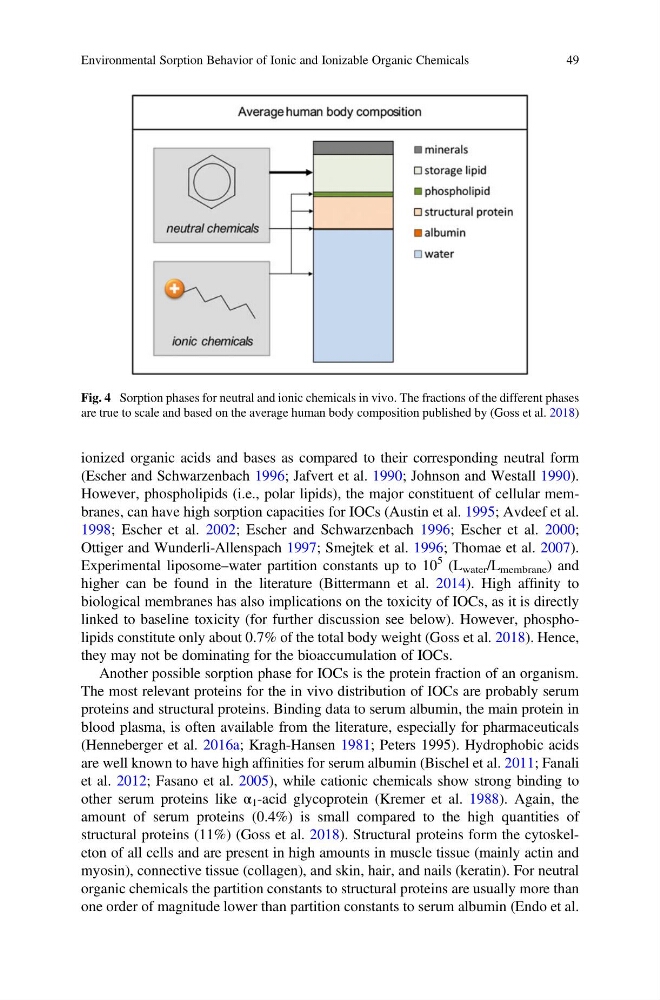
linked to baseline toxicity (for further discussion see below). However, phospholipids constitute only about 0.7% of the total body weight (Goss et al. 2018). Hence,
they may not be dominating for the bioaccumulation of IOCs.
Another possible sorption phase for IOCs is the protein fraction of an organism.
The most relevant proteins for the in vivo distribution of IOCs are probably serum
proteins and structural proteins. Binding data to serum albumin, the main protein in
blood plasma, is often available from the literature, especially for pharmaceuticals
(Henneberger et al. 2016a; Kragh-Hansen 1981; Peters 1995). Hydrophobic acids
are well known to have high affinities for serum albumin (Bischel et al. 2011; Fanali
et al. 2012; Fasano et al. 2005), while cationic chemicals show strong binding to
other serum proteins like α 1 -acid glycoprotein (Kremer et al. 1988). Again, the
amount of serum proteins (0.4%) is small compared to the high quantities of
structural proteins (11%) (Goss et al. 2018). Structural proteins form the cytoskeleton of all cells and are present in high amounts in muscle tissue (mainly actin and
myosin), connective tissue (collagen), and skin, hair, and nails (keratin). For neutral
organic chemicals the partition constants to structural proteins are usually more than
one order of magnitude lower than partition constants to serum albumin (Endo et al.
Fig. 4 Sorption phases for neutral and ionic chemicals in vivo. The fractions of the different phases
are true to scale and based on the average human body composition published by (Goss et al. 2018)
Environmental Sorption Behavior of Ionic and Ionizable Organic Chemicals
49
(Escher and Schwarzenbach 1996; Jafvert et al. 1990; Johnson and Westall 1990).
However, phospholipids (i.e., polar lipids), the major constituent of cellular membranes, can have high sorption capacities for IOCs (Austin et al. 1995; Avdeef et al.
1998; Escher et al. 2002; Escher and Schwarzenbach 1996; Escher et al. 2000;
Ottiger and Wunderli-Allenspach 1997; Smejtek et al. 1996; Thomae et al. 2007).
Experimental liposome–water partition constants up to 10
5 (L water /L membrane ) and
higher can be found in the literature (Bittermann et al. 2014). High affinity to
biological membranes has also implications on the toxicity of IOCs, as it is directly
linked to baseline toxicity (for further discussion see below). However, phospholipids constitute only about 0.7% of the total body weight (Goss et al. 2018). Hence,
they may not be dominating for the bioaccumulation of IOCs.
Another possible sorption phase for IOCs is the protein fraction of an organism.
The most relevant proteins for the in vivo distribution of IOCs are probably serum
proteins and structural proteins. Binding data to serum albumin, the main protein in
blood plasma, is often available from the literature, especially for pharmaceuticals
(Henneberger et al. 2016a; Kragh-Hansen 1981; Peters 1995). Hydrophobic acids
are well known to have high affinities for serum albumin (Bischel et al. 2011; Fanali
et al. 2012; Fasano et al. 2005), while cationic chemicals show strong binding to
other serum proteins like α 1 -acid glycoprotein (Kremer et al. 1988). Again, the
amount of serum proteins (0.4%) is small compared to the high quantities of
structural proteins (11%) (Goss et al. 2018). Structural proteins form the cytoskeleton of all cells and are present in high amounts in muscle tissue (mainly actin and
myosin), connective tissue (collagen), and skin, hair, and nails (keratin). For neutral
organic chemicals the partition constants to structural proteins are usually more than
one order of magnitude lower than partition constants to serum albumin (Endo et al.
Fig. 4 Sorption phases for neutral and ionic chemicals in vivo. The fractions of the different phases
are true to scale and based on the average human body composition published by (Goss et al. 2018)
Environmental Sorption Behavior of Ionic and Ionizable Organic Chemicals
49