

mechanisms: (1) the speciation of ionizable chemicals is pH-dependent and (2) the
conformation and charge status of the sorption phase can change when changing the
pH, e.g., the conformation and charge of proteins like human serum albumin is
highly pH-dependent (Peters 1995). The salt concentration can also influence sorption either by competing for the same sorption sites at an ion exchange sorbent
(Droge and Goss 2013b) or by their impact on ion-pair formation. Westall and
coworkers report that the partition constants of neutral ion pairs correlate well with
the partition constants of the corresponding neutral organic acids (Jafvert et al. 1990)
and for high pH and ionic strength, partitioning between water and octanol is
dominated by ion-pair partitioning rather than the partitioning of free ions
(Strathmann and Jafvert 1998; Westall et al. 1985). As a result, the octanol–water
partitioning of IOCs increases with salinity because of the increasing amount of
available partners for ion-pair formation (mass action law). Consequently, there
cannot be a single log K ow value for an IOC. Instead, the log K ow of an IOC must
always be an operationally defined value for a concrete concentration and composition of counter ions (typically the inorganic ions will prevail) present in the
aqueous phase. Yet another sorption mechanism that depends on the presence of
inorganic ions in the aqueous solution is “ion bridging” by which a multivalent
(inorganic) ion such as Ca
2+ could connect an organic anion to a negatively charged
surface site (Chen et al. 2012; Figueroa et al. 2004; Haftka et al. 2015).
benzene, neutral
hexyltriethylammonium, cationic
tetraphenylphosphonium, cationic
A Molecules with low surface charge density
B Molecules with different surface charge densities
bis(fluorosulfonyl)imid, anionic
phenol, neutral
phenolate, anionic
surface charge density
<< 0.0 e/nm
2
>> 0.0 e/nm
2
0.0 e/nm
2
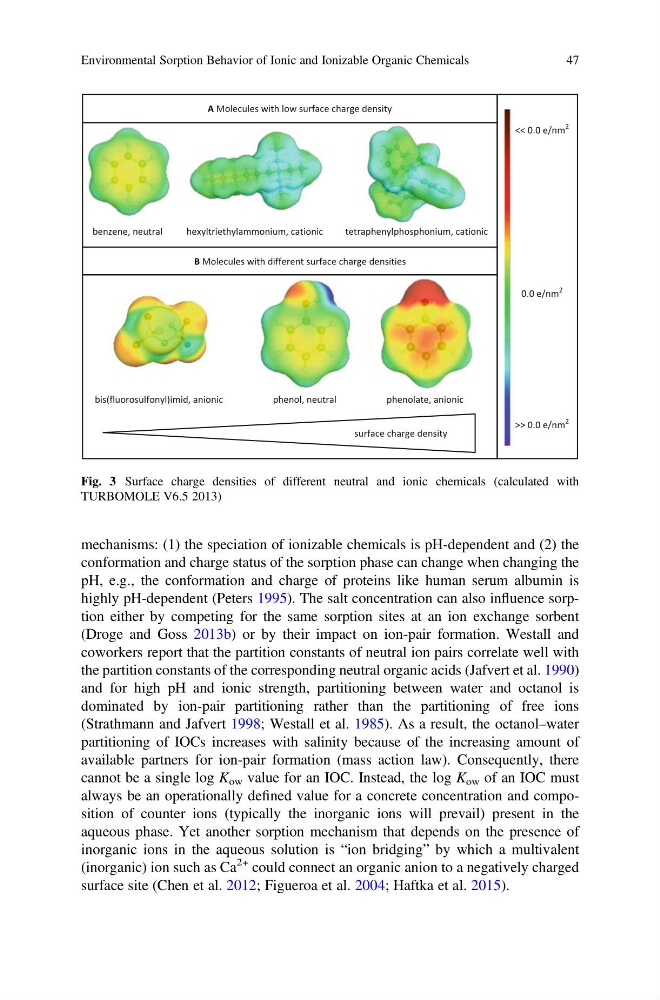
Fig. 3 Surface charge densities of different neutral and ionic chemicals (calculated with
TURBOMOLE V6.5 2013)
Environmental Sorption Behavior of Ionic and Ionizable Organic Chemicals
47
conformation and charge status of the sorption phase can change when changing the
pH, e.g., the conformation and charge of proteins like human serum albumin is
highly pH-dependent (Peters 1995). The salt concentration can also influence sorption either by competing for the same sorption sites at an ion exchange sorbent
(Droge and Goss 2013b) or by their impact on ion-pair formation. Westall and
coworkers report that the partition constants of neutral ion pairs correlate well with
the partition constants of the corresponding neutral organic acids (Jafvert et al. 1990)
and for high pH and ionic strength, partitioning between water and octanol is
dominated by ion-pair partitioning rather than the partitioning of free ions
(Strathmann and Jafvert 1998; Westall et al. 1985). As a result, the octanol–water
partitioning of IOCs increases with salinity because of the increasing amount of
available partners for ion-pair formation (mass action law). Consequently, there
cannot be a single log K ow value for an IOC. Instead, the log K ow of an IOC must
always be an operationally defined value for a concrete concentration and composition of counter ions (typically the inorganic ions will prevail) present in the
aqueous phase. Yet another sorption mechanism that depends on the presence of
inorganic ions in the aqueous solution is “ion bridging” by which a multivalent
(inorganic) ion such as Ca
2+ could connect an organic anion to a negatively charged
surface site (Chen et al. 2012; Figueroa et al. 2004; Haftka et al. 2015).
benzene, neutral
hexyltriethylammonium, cationic
tetraphenylphosphonium, cationic
A Molecules with low surface charge density
B Molecules with different surface charge densities
bis(fluorosulfonyl)imid, anionic
phenol, neutral
phenolate, anionic
surface charge density
<< 0.0 e/nm
2
>> 0.0 e/nm
2
0.0 e/nm
2
Fig. 3 Surface charge densities of different neutral and ionic chemicals (calculated with
TURBOMOLE V6.5 2013)
Environmental Sorption Behavior of Ionic and Ionizable Organic Chemicals
47