

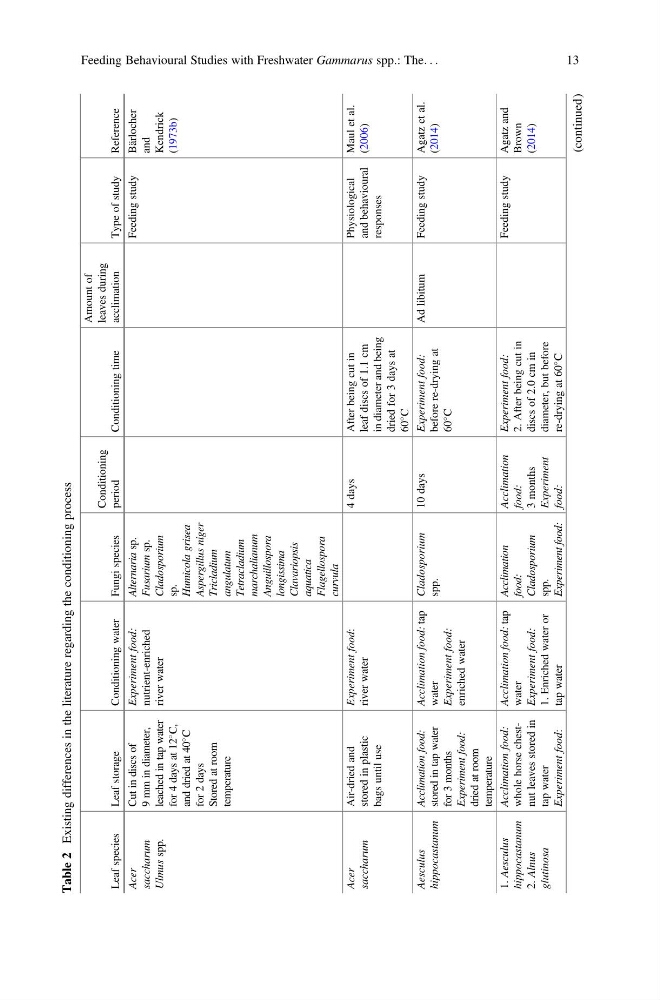
Table 2
Existing differences in the literature regarding the conditioning process
Leaf species
Leaf storage
Conditioning water
Fungi species
Conditioning
period
Conditioning time
Amount of
leaves during
acclimation
Type of study
Reference
Acer
saccharum
Ulmus
spp.
Cut in discs of
9 mm in diameter,
leached in tap water
for 4 days at 12
C,
and dried at 40
C
for 2 days
Stored at room
temperature
Experiment food:
nutrient-enriched
river water
Alternaria
sp.
Fusarium
sp.
Cladosporium
sp.
Humicola grisea
Aspergillus niger
Tricladium
angulatum
Tetracladium
marchalianum
Anguillospora
longissima
Clavariopsis
aquatica
Flagellospora
curvula
Feeding study
Bärlocher
and
Kendrick
(1973b)
Acer
saccharum
Air-dried and
stored in plastic
bags until use
Experiment food:
river water
4 days
After being cut in
leaf discs of 1.1 cm
in diameter and being
dried for 3 days at
60
C
Physiological
and behavioural
responses
Maul et al.
(2006)
Aesculus
hippocastanum
Acclimation food:
stored in tap water
for 3 months
Experiment food:
dried at room
temperature
Acclimation food:
tap
water
Experiment food:
enriched water
Cladosporium
spp.
10 days
Experiment food:
before re-drying at
60
C
Ad libitum
Feeding study
Agatz et al.
(2014)
1. Aesculus
hippocastanum
2. Alnus
glutinosa
Acclimation food:
whole horse chestnut leaves stored in
tap water
Experiment food:
Acclimation food:
tap
water
Experiment food:
1. Enriched water or
tap water
Acclimation
food:
Cladosporium
spp.
Experiment food:
Acclimation
food:
3 months
Experiment
food:
Experiment food:
2. After being cut in
discs of 2.0 cm in
diameter, but before
re-drying at 60
C
Feeding study
Agatz and
Brown
(2014)
(continued)
Feeding Behavioural Studies with Freshwater Gammarus spp.: The. . .
13
Existing differences in the literature regarding the conditioning process
Leaf species
Leaf storage
Conditioning water
Fungi species
Conditioning
period
Conditioning time
Amount of
leaves during
acclimation
Type of study
Reference
Acer
saccharum
Ulmus
spp.
Cut in discs of
9 mm in diameter,
leached in tap water
for 4 days at 12
C,
and dried at 40
C
for 2 days
Stored at room
temperature
Experiment food:
nutrient-enriched
river water
Alternaria
sp.
Fusarium
sp.
Cladosporium
sp.
Humicola grisea
Aspergillus niger
Tricladium
angulatum
Tetracladium
marchalianum
Anguillospora
longissima
Clavariopsis
aquatica
Flagellospora
curvula
Feeding study
Bärlocher
and
Kendrick
(1973b)
Acer
saccharum
Air-dried and
stored in plastic
bags until use
Experiment food:
river water
4 days
After being cut in
leaf discs of 1.1 cm
in diameter and being
dried for 3 days at
60
C
Physiological
and behavioural
responses
Maul et al.
(2006)
Aesculus
hippocastanum
Acclimation food:
stored in tap water
for 3 months
Experiment food:
dried at room
temperature
Acclimation food:
tap
water
Experiment food:
enriched water
Cladosporium
spp.
10 days
Experiment food:
before re-drying at
60
C
Ad libitum
Feeding study
Agatz et al.
(2014)
1. Aesculus
hippocastanum
2. Alnus
glutinosa
Acclimation food:
whole horse chestnut leaves stored in
tap water
Experiment food:
Acclimation food:
tap
water
Experiment food:
1. Enriched water or
tap water
Acclimation
food:
Cladosporium
spp.
Experiment food:
Acclimation
food:
3 months
Experiment
food:
Experiment food:
2. After being cut in
discs of 2.0 cm in
diameter, but before
re-drying at 60
C
Feeding study
Agatz and
Brown
(2014)
(continued)
Feeding Behavioural Studies with Freshwater Gammarus spp.: The. . .
13