

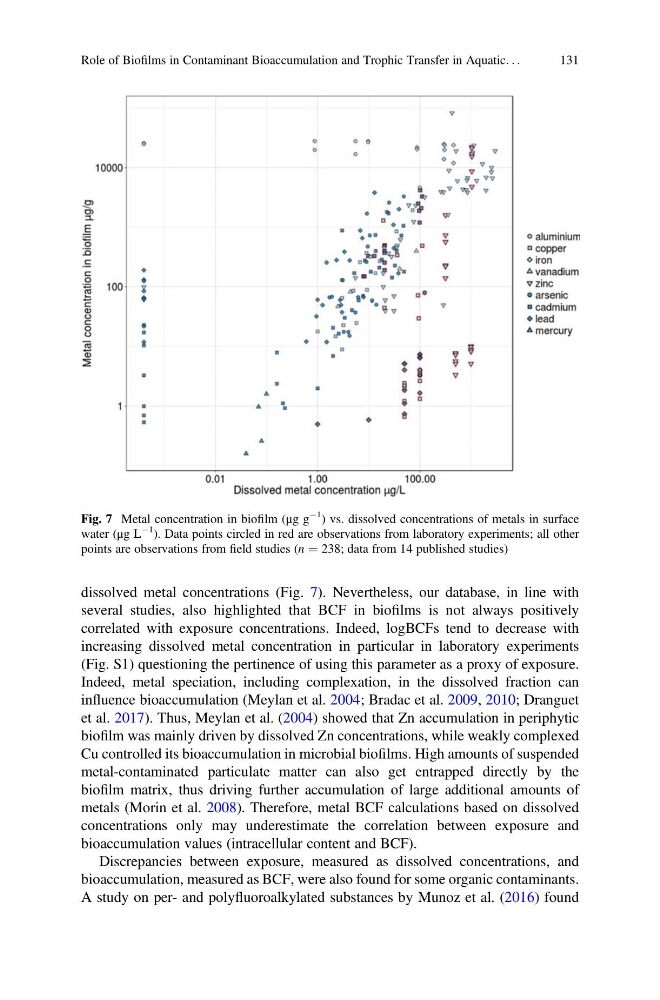
dissolved metal concentrations (Fig. 7). Nevertheless, our database, in line with
several studies, also highlighted that BCF in biofilms is not always positively
correlated with exposure concentrations. Indeed, logBCFs tend to decrease with
increasing dissolved metal concentration in particular in laboratory experiments
(Fig. S1) questioning the pertinence of using this parameter as a proxy of exposure.
Indeed, metal speciation, including complexation, in the dissolved fraction can
influence bioaccumulation (Meylan et al. 2004; Bradac et al. 2009, 2010; Dranguet
et al. 2017). Thus, Meylan et al. (2004) showed that Zn accumulation in periphytic
biofilm was mainly driven by dissolved Zn concentrations, while weakly complexed
Cu controlled its bioaccumulation in microbial biofilms. High amounts of suspended
metal-contaminated particulate matter can also get entrapped directly by the
biofilm matrix, thus driving further accumulation of large additional amounts of
metals (Morin et al. 2008). Therefore, metal BCF calculations based on dissolved
concentrations only may underestimate the correlation between exposure and
bioaccumulation values (intracellular content and BCF).
Discrepancies between exposure, measured as dissolved concentrations, and
bioaccumulation, measured as BCF, were also found for some organic contaminants.
A study on per- and polyfluoroalkylated substances by Munoz et al. (2016) found
Fig. 7 Metal concentration in biofilm (μg g
À1
) vs. dissolved concentrations of metals in surface
water (μg L
À1
). Data points circled in red are observations from laboratory experiments; all other
points are observations from field studies (n ¼ 238; data from 14 published studies)
Role of Biofilms in Contaminant Bioaccumulation and Trophic Transfer in Aquatic. . .
131
several studies, also highlighted that BCF in biofilms is not always positively
correlated with exposure concentrations. Indeed, logBCFs tend to decrease with
increasing dissolved metal concentration in particular in laboratory experiments
(Fig. S1) questioning the pertinence of using this parameter as a proxy of exposure.
Indeed, metal speciation, including complexation, in the dissolved fraction can
influence bioaccumulation (Meylan et al. 2004; Bradac et al. 2009, 2010; Dranguet
et al. 2017). Thus, Meylan et al. (2004) showed that Zn accumulation in periphytic
biofilm was mainly driven by dissolved Zn concentrations, while weakly complexed
Cu controlled its bioaccumulation in microbial biofilms. High amounts of suspended
metal-contaminated particulate matter can also get entrapped directly by the
biofilm matrix, thus driving further accumulation of large additional amounts of
metals (Morin et al. 2008). Therefore, metal BCF calculations based on dissolved
concentrations only may underestimate the correlation between exposure and
bioaccumulation values (intracellular content and BCF).
Discrepancies between exposure, measured as dissolved concentrations, and
bioaccumulation, measured as BCF, were also found for some organic contaminants.
A study on per- and polyfluoroalkylated substances by Munoz et al. (2016) found
Fig. 7 Metal concentration in biofilm (μg g
À1
) vs. dissolved concentrations of metals in surface
water (μg L
À1
). Data points circled in red are observations from laboratory experiments; all other
points are observations from field studies (n ¼ 238; data from 14 published studies)
Role of Biofilms in Contaminant Bioaccumulation and Trophic Transfer in Aquatic. . .
131